


Wedding Seminar Requirements for Foreigners Marrying a Filipino in the Philippines
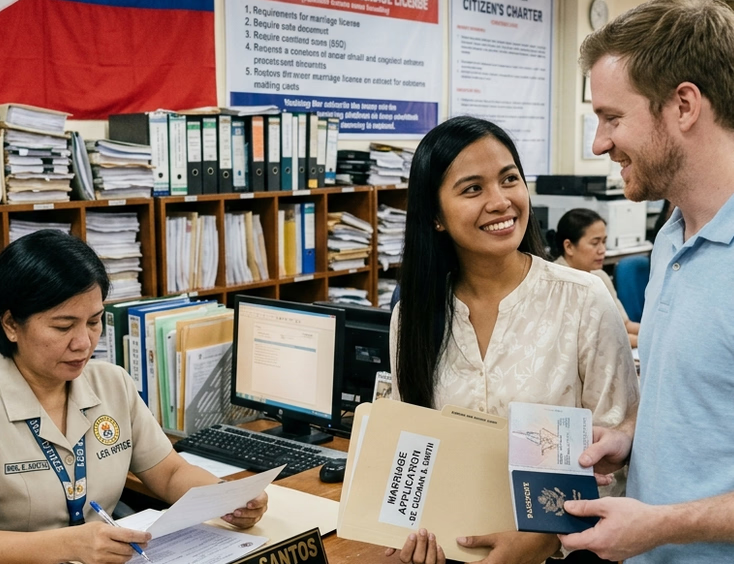
Foreigners marrying a Filipino in the Philippines attend the same pre-marriage seminars as Filipino couples. Both partners sit through the Local Civil Registrar (LCR) seminars on family planning, responsible parenthood, and pre-marriage counseling. Catholic ceremonies add a Pre-Cana Seminar at the parish, plus a canonical interview with the priest.
The foreign partner also submits a Certificate of Legal Capacity to Contract Marriage from their embassy, alongside other documents. The seminar attendance applies to both partners regardless of nationality. Plan four to six months ahead and the paperwork sorts itself out.
Why the Seminars Apply to Foreign Partners
The marriage license issued by the Philippine LCR governs the entire marriage, not just the Filipino partner. Republic Act 10354 and local ordinances require both applicants to attend the pre-marriage seminars before the LCR releases the license. Nationality does not exempt the foreign partner from this requirement.
The LCR clerk checks both partners' names on the certificate of attendance before stamping the application as received. A certificate with only the Filipino partner's name fails the check, and the application gets rejected.
For the full marriage license process, our guide on how to get a marriage license in the Philippines walks through every step.
The LCR-Mandated Seminars Both Partners Attend
The standard list of LCR seminars includes:
Pre-Marriage Counseling and Orientation Seminar (PMOS). A short orientation covering communication, finances, family roles, and conflict management. Most LGUs run it as a single half-day session.
Responsible Parenthood Seminar. A government-mandated session under RA 10354 covering family planning, reproductive health, and parental responsibility. Our complete guide on the Responsible Parenthood Seminar covers what to expect.
Family Planning Seminar. Some LGUs combine this with the Responsible Parenthood Seminar. Others separate them. Our guide on the Natural Family Planning Seminar covers the differences.
The seminars run in English or Filipino depending on the LGU. Foreign partners who do not speak Filipino can request English-language sessions, which most major cities like Manila, Cebu, and Davao offer. Smaller municipalities may run Filipino-only sessions, in which case the couple either travels to a nearby city or works with an accredited private provider.
Government-run seminars cost zero pesos. Private providers charge between PHP 500 and PHP 1,500 per couple, with English-language and weekend options.
The Catholic Pre-Cana Seminar for Mixed-Nationality Couples
Couples planning a Catholic ceremony attend the Pre-Cana Seminar through the parish hosting the wedding. Both partners attend together, regardless of the foreign partner's religion or nationality. The parish accommodates English-speaking foreigners by providing English-language facilitators or printed materials.
If the foreign partner is not Catholic, the marriage falls under the mixed-religion or disparity of cult rules. The Catholic partner makes specific promises about raising children in the faith, and the parish requests a dispensation from the diocese. Our guide on Pre-Cana seminar requirements for mixed-religion couples covers the dispensation process in full.
For a refresher on what Pre-Cana covers, read our guide on what a Pre-Cana Seminar is and why the Catholic Church requires it.
The Canonical Interview
Catholic ceremonies also require a one-on-one canonical interview with the parish priest. Both partners attend, and the priest verifies that both enter the marriage freely, understand its permanent nature, and accept the openness to children that Catholic teaching requires.
For mixed-nationality couples, the priest may ask additional questions about cultural differences, plans for raising children with two cultural traditions, and where the couple intends to live after the wedding. The interview runs 30 to 60 minutes per couple.
Our guide on the Catholic canonical interview explains the process.
Documents the Foreign Partner Submits
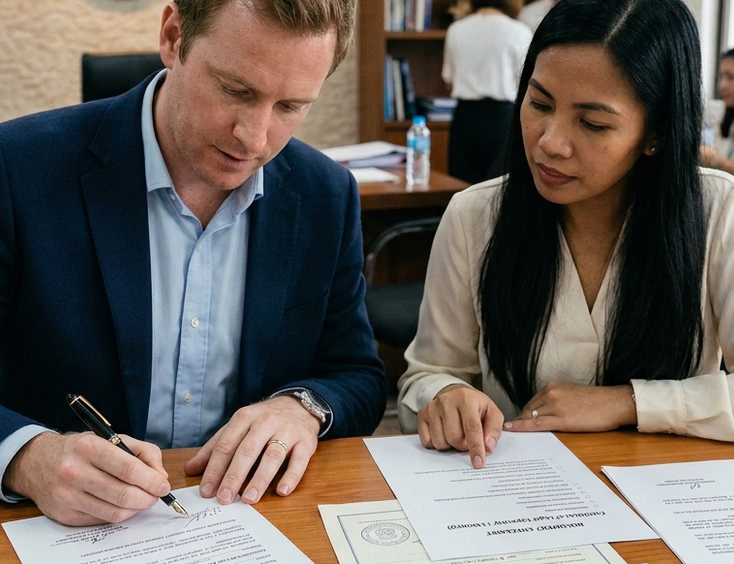
The foreign partner provides a different set of documents than the Filipino partner. The standard list:
Certificate of Legal Capacity to Contract Marriage (CLCCM). This document, issued by the foreign partner's embassy or consulate in the Philippines, certifies that the foreigner is legally free to marry under their home country's laws. Some embassies issue it within a day, others take a week. Couples request it with the foreign partner's passport, divorce decree (if applicable), and other supporting papers.
Affidavit in Lieu of Legal Capacity. A few countries, including the United States, do not issue the CLCCM. The foreign partner instead signs a notarized affidavit at their embassy stating they are legally free to marry. The LCR accepts this affidavit in place of the CLCCM.
Valid passport. The LCR requires the original and a photocopy.
Visa or proof of legal stay in the Philippines. Tourists, residents, and balikbayan visa holders all qualify, as long as their stay is legal.
Birth certificate. Some LCRs ask for it. Bring an authenticated copy from the foreign partner's home country, with apostille if applicable.
Divorce decree or annulment papers. If the foreign partner was previously married, the LCR requires proof of legal termination. Some countries' divorce decrees are recognized in the Philippines, but others require a judicial recognition of foreign divorce filed at a Philippine court. Couples in this situation work with a Philippine lawyer.
Death certificate of previous spouse. Required if the foreign partner is widowed.
The Filipino partner submits the standard PSA documents, IDs, CENOMAR, and supporting papers covered in our marriage license guide.
The CENOMAR and the Foreign Partner
The Philippine Statistics Authority issues a Certificate of No Marriage (CENOMAR) for Filipino citizens, but not for foreigners. The foreign partner's CLCCM or Affidavit in Lieu serves the same purpose, certifying that they are free to marry.
Some LCRs ask the foreign partner to provide additional proof, such as a single status certificate or a bachelorhood certificate, depending on the country. The embassy advises on which document the LCR in that city typically accepts.
How the LCR Application Works for Mixed-Nationality Couples
Both partners file the application in person at the LCR of the city or municipality where either partner has lived for at least six months. The foreign partner uses their visa, residency permit, or passport stamp as proof of legal stay.
The clerk reviews the documents, checks the seminar certificates, and accepts the application. The 10-day posting period applies the same way as it does for Filipino couples. After the posting period, the couple returns to claim the marriage license, which stays valid for 120 days nationwide.
For couples wondering whether they can skip the seminars, our direct answer is in Can you get married without attending a seminar in the Philippines.
Visa Requirements for Foreign Partners
Foreign partners enter the Philippines on different visa types depending on their nationality and purpose of stay. The most common categories:
Tourist visa or visa-free entry. Citizens of more than 150 countries enter the Philippines visa-free for 30 days. The stay extends through the Bureau of Immigration up to 36 months for some nationalities. Tourists can legally marry a Filipino in the Philippines as long as their stay is current.
Balikbayan privilege. Former Filipino citizens, foreign spouses of Filipinos, and dependents of returning Filipinos receive a one-year visa-free stay. Some couples use this privilege for the wedding planning period.
13(a) Permanent Resident Visa. After marriage, the foreign spouse applies for this visa, which grants permanent residency in the Philippines. It is not a requirement for the wedding itself, only for staying long-term afterward.
The Bureau of Immigration handles all visa-related matters. Couples confirm the foreign partner's visa status before filing for the marriage license.

Timeline for Mixed-Nationality Couples
Plan four to six months ahead. The added embassy and document authentication steps need extra weeks.
A typical timeline:
- Months 5 to 6 before wedding. Foreign partner gathers documents from home country, including authenticated birth certificate, divorce decree if applicable, and proof of legal stay.
- Months 4 to 5. Foreign partner requests the CLCCM or signs the Affidavit in Lieu at the embassy. Filipino partner orders fresh PSA documents.
- Months 3 to 4. Both partners attend LCR seminars and Pre-Cana if marrying in the Catholic Church.
- Months 2 to 3. File the marriage license application at the LCR. Wait through the 10-day posting period.
- Month 2. Claim the marriage license. Schedule the canonical interview if Catholic.
- Month 1. Final parish or judge meeting, rehearsal, last-minute coordination.
- Wedding day. Ceremony, signing of the marriage certificate, registration.
Couples who start late sometimes face delays because of slow embassy processing or missing authenticated documents.
Common Mistakes Foreign Partners Make
Predictable errors slow down the process:
- Assuming the seminars apply only to the Filipino partner. Both partners attend. The certificate carries both names.
- Missing the apostille on home country documents. The DFA replaced the red ribbon authentication in 2019. Documents from countries that signed the Apostille Convention need the apostille from the issuing country.
- Booking embassy appointments too late. Some embassies have waitlists of two to four weeks for the CLCCM. Book early.
- Forgetting the divorce recognition step. A foreign divorce does not automatically apply in the Philippines. The Filipino partner files a judicial recognition of foreign divorce at a Philippine Regional Trial Court before the LCR processes the marriage license.
- Overstaying the visa. A foreign partner with an expired visa cannot file for the marriage license. The Bureau of Immigration handles extensions.
- Skipping the English-language seminar option. Foreign partners who do not understand Filipino lose value from the sessions. Major cities offer English-language seminars. Confirm with the LCR or private provider before booking.
After the Wedding: Registration and Next Steps
The marriage gets registered with the LCR within 15 days of the ceremony, then forwarded to the PSA in Manila. The PSA issues an authenticated marriage certificate two to four months later, which the couple uses for spousal visa applications, joint property filings, and other legal matters.
The foreign spouse can then apply for the 13(a) Non-Quota Immigrant Visa with the Bureau of Immigration, which grants permanent residency in the Philippines. The Filipino spouse moving abroad files spousal visa applications with the foreign country's embassy in the Philippines.
Couples planning to move abroad after the wedding follow a different documentation path. Our guide on wedding seminar requirements for Filipinos getting married abroad covers the reverse scenario.
Where to Find Accredited Pre-Marriage Seminar Providers
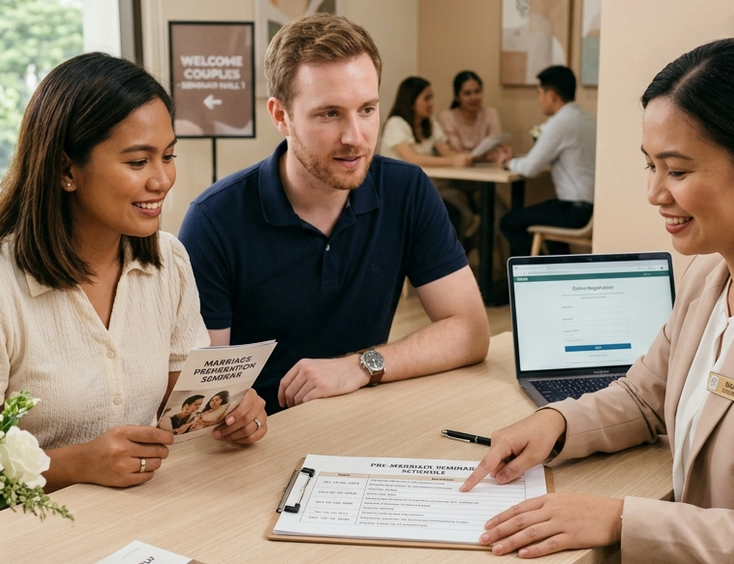
Some couples prefer private seminar providers for English-language sessions, weekend schedules, or online formats. Browse verified providers in our Pre-Wedding Seminars Suppliers Directory to compare options across Metro Manila, Cebu, Davao, and other destinations popular for mixed-nationality weddings.
Booking through a verified provider saves the couple from accepting certificates the LCR later rejects.
The Big Picture for Foreign Partners
The seminar requirements apply to both partners regardless of nationality. The Filipino partner provides PSA documents, the foreign partner provides embassy-issued documents, and both attend the same seminars together. Catholic couples add Pre-Cana and a canonical interview, and mixed-religion couples follow the dispensation process.
For the full map of how every seminar fits together, read our pillar guide on wedding seminars in the Philippines. For couples in a Catholic-Muslim or Catholic-non-Christian pairing, the dispensation rules in our guide on Pre-Cana seminar requirements for mixed-religion couples cover the additional steps.
The wedding in the Philippines runs smoothly when the foreign partner starts gathering documents early, books embassy appointments well in advance, and attends every seminar alongside the Filipino partner. The legal framework welcomes mixed-nationality couples, and the paperwork takes patience but not magic.
Still Searching for a Right Match?
Find Your Perfect Wedding Supplier Today!
Discover trusted wedding suppliers across the Philippines in our complete directory. Compare services and connect with the ones that fit your dream celebration.
Browse Wedding SuppliersFeatured Blog Posts

Filipino Wedding Entourage - Roles, Order of March, and Modern Etiquette
6 mins readCivil Weddings in the Philippines - Requirements, Costs, and Step-by-Step Process
9 mins readCivil Wedding Requirements in the Philippines - Complete Checklist
6 mins readCost of Wedding in the Philippines - 5 Essential Things You Need to Know
7 mins readPrincipal Sponsors (Ninong/Ninang) - How Many, How to Ask, What They Really Do
4 mins readVeil, Cord, Candle & Coins - Roles, Options, and When They Happen
4 mins readEntourage for a Traditional Pinoy Wedding - Complete Roles and Guide
6 mins readComplete List of Civil Wedding Requirements in the Philippines
8 mins readHow to Choose Wedding Ninongs and Ninangs - Ask Yourself These 3 Important Questions
5 mins read