


Special Circumstances: Marrying a Foreigner in the Philippines and What Your Officiant Needs to Know
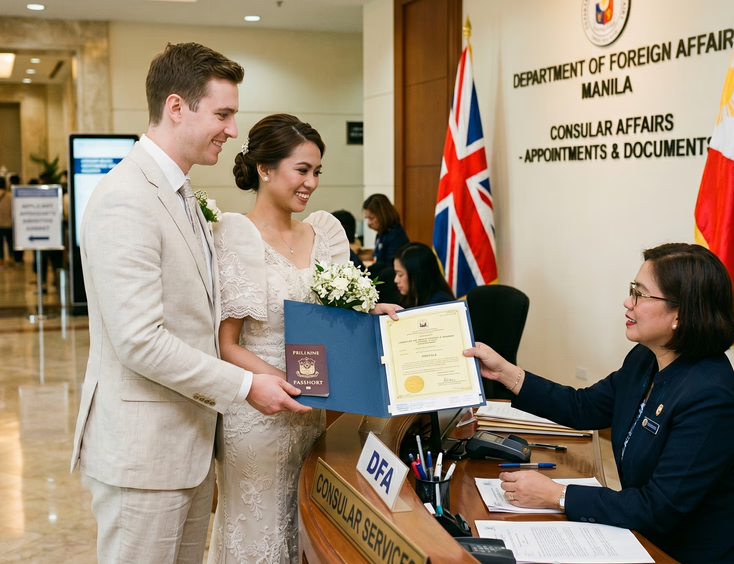
A Filipino marrying a foreigner in the Philippines runs through the same Family Code as any other couple. The difference lies in the documents. The foreign party brings paperwork from another country, in another language, under another legal system, and that paperwork has to satisfy a Local Civil Registrar that works strictly by Philippine standards. Get the documents right and the wedding proceeds like any other. Miss a requirement and the LCR rejects the marriage license application weeks before the ceremony, leaving you scrambling.
The process is well established. Thousands of Filipino-foreigner couples marry here every year, the path is clear, the documents are predictable, and an officiant experienced with international couples handles the situation calmly. The catch is that requirements shift with the foreigner's nationality, the embassy or consulate covering them, and the policies of individual LCRs. What works for an American groom in Makati may not work for a German groom in Cebu. Confirm the specifics with the LCR and the officiant before you book anything. For the wider picture on who can marry you and how to choose them, start with our guide to wedding officiants in the Philippines.
The Core Document: Certificate of Legal Capacity to Contract Marriage
Article 21 of the Family Code requires a foreign national marrying in the Philippines to submit a Certificate of Legal Capacity to Contract Marriage from their diplomatic or consular officials in the country. The certificate confirms three things:
- The foreign national is single, divorced with the divorce recognized under their home country's law, or widowed
- The foreign national is of legal age to marry under their home country's law
- The foreign national is otherwise free to marry under their home country's law, with no existing impediment such as a bigamy prohibition, an incest restriction, or a court-ordered marriage ban
The LCR requires the certificate as part of the marriage license application. Without it, the LCR will not release the license, and the officiant cannot proceed.
Embassies That Issue the Certificate
Most Philippine-resident foreign embassies and consulates issue the Certificate of Legal Capacity, though procedures vary. Japan, South Korea, China, the United Kingdom, France, Germany, Italy, Spain, Australia, Canada, India, and many others issue it through their embassies in Manila or consulates in other cities. The applicant usually schedules an appointment, submits identification and proof of civil status, pays a fee, and receives the certificate within days or weeks.
Some embassies require documents authenticated first by the foreigner's home country, which adds weeks or months. Each embassy also keeps its own list of supporting documents, commonly the birth certificate, current passport, civil status documentation (a single status certificate, divorce decree, or death certificate of a late spouse), and proof of Philippine residence or visa. Contact the embassy or consulate directly to confirm current requirements, since procedures change, fees update, and processing times shift. The embassy website usually lists requirements, but a call or email to the consular section gives the most reliable answer.
Tip: Start the embassy process at least three months out and hold a backup wedding date. The Certificate of Legal Capacity is the one document fully outside your control and the LCR's, since a foreign government issues it on its own timeline. Every other piece of the wedding can be ready and a slow embassy still stops the license cold.
Embassies That Do Not Issue the Certificate
A small number of embassies have suspended issuing the Certificate of Legal Capacity. The most notable is the United States Embassy in Manila, which has not issued it for many years. In its place, the U.S. citizen executes an Affidavit in Lieu of a Certificate of Legal Capacity to Contract Marriage before a U.S. consular officer or a notary, stating the citizen's name, date and place of birth, current civil status, parents' names, and the fact that the citizen is free to marry under U.S. law.
Most LCRs accept the affidavit in place of the certificate for U.S. citizens. Some ask for additional support, such as a single status affidavit from the citizen's home state, where state-level marriage records sit, or a divorce decree for a previously married citizen. Other countries run their own non-issuance or limited-issuance policies:
| Country | Document in place of the certificate |
|---|---|
| United States | Affidavit in Lieu of a Certificate of Legal Capacity, before a consular officer or notary |
| Canada | Statement in Lieu of a Certificate of Non-Impediment, before a notary |
| United Kingdom | Certificate of No Impediment from the UK General Register Office, with set procedures for nationals abroad |
| Australia | Statutory Declaration in Lieu of a Certificate of Legal Capacity, before a notary |
Verify the current procedure with the specific embassy before you assume any document will be accepted.
Other Documents the Foreign Party Submits
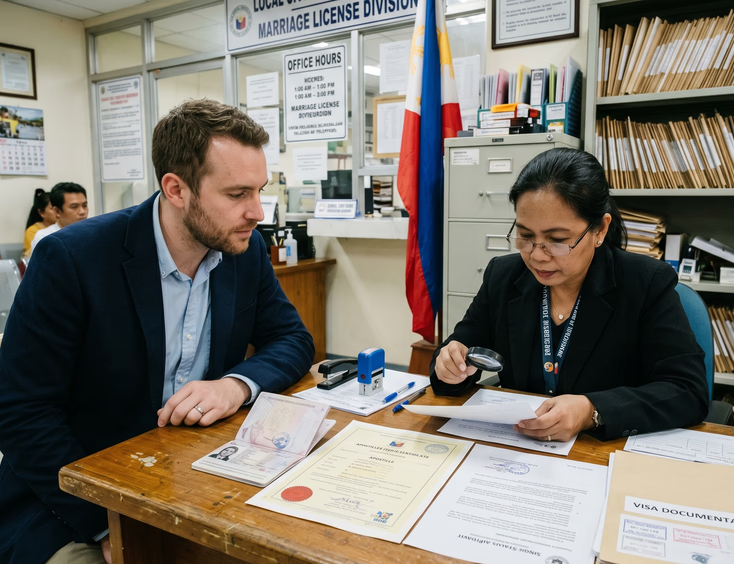
Beyond the Certificate of Legal Capacity or its alternative, the foreign national submits several more documents to the LCR:
- Passport. The current passport with a valid Philippine entry stamp, visa, or visa-free entry record, carrying a name that matches every other document.
- Birth certificate. A copy authenticated through the apostille process for Hague Convention countries, or through the home country's foreign affairs ministry plus the Philippine embassy there for non-apostille countries. The LCR does not accept an unauthenticated foreign birth certificate.
- Civil status documentation. Support for the claim of single, divorced, or widowed status: a single status certificate or affidavit for a single foreigner, the divorce decree for a divorced foreigner (with extra steps where the divorce needs Philippine recognition), or the death certificate of the late spouse for a widowed foreigner, each authenticated the same way.
- Visa or immigration documentation. Some LCRs want evidence of current immigration status, such as the visa stamp, a tourist visa extension, a work permit, or an alien certificate of registration.
- Other documents the embassy or LCR may require. Photo ID, proof of a Philippine address, recent photographs, and anything specific to the foreigner's nationality.
The full set your officiant needs on the wedding day, including the Filipino party's documents, runs through what documents does your wedding officiant need from you in the Philippines.
The Apostille Process
The Hague Apostille Convention, which the Philippines joined in 2019, simplified document authentication between member countries. A document issued in one apostille country and authenticated with an apostille is accepted in another without further steps.
Most major Western countries are members, including the United States, the United Kingdom, Canada, Australia, Germany, France, Italy, Spain, and Japan. For documents from these countries, the foreign national obtains an apostille from the home country's designated authority: the Department of State for the U.S., the Foreign, Commonwealth and Development Office for the U.K., Global Affairs Canada for Canada, and the equivalent office elsewhere. For documents from non-apostille countries, the older route applies: the home country's foreign affairs ministry authenticates the document, then the Philippine embassy or consulate in that country does. That path takes longer and costs more. Start the apostille or authentication two to three months before the wedding, since the home-country step often runs weeks, especially in peak travel seasons.
Filipino Citizens Who Obtained Divorce Abroad
A Filipino citizen whose foreign spouse obtained a divorce abroad faces a particular situation. Under Article 26 of the Family Code, as shaped by Supreme Court rulings such as Republic v. Manalo, a Filipino can remarry in the Philippines if the foreign spouse obtained a valid divorce abroad that frees the foreign spouse to remarry under foreign law.
The Filipino cannot rely on the foreign divorce decree alone. The Filipino files a Petition for Recognition of Foreign Divorce before the Regional Trial Court, which reviews the petition, the decree, the foreign law, and the evidence. A favorable decision recognizes the divorce in the Philippines and clears the Filipino to remarry. The process runs several months to over a year depending on the court's docket, and the Filipino engages a Philippine lawyer to handle the petition. Once the order becomes final, it gets annotated on the Filipino's marriage records, and only then is the Filipino free to remarry here. A wedding held before the recognition is granted produces a marriage the Philippine government may treat as void for failing to dissolve the prior marriage.
Same-Sex Marriages and the Philippines
The Family Code defines marriage as a special contract of permanent union between a man and a woman. The Philippines does not recognize same-sex marriage under the Family Code or PD 1083, the Code of Muslim Personal Laws.
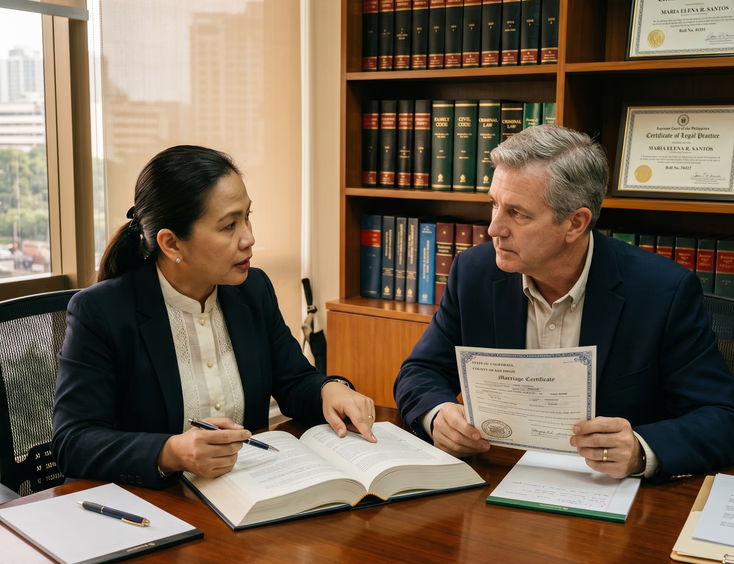
A foreigner who entered a same-sex marriage in another country and wishes to marry a Filipino here meets a legal obstacle. The Philippines does not recognize the foreign same-sex marriage, so the foreigner may still appear single from the Philippine perspective. Yet if the home country treats that marriage as valid and the foreigner has not dissolved it, the foreigner remains married under home-country law, and the embassy's Certificate of Legal Capacity reflects that. The practical result: the embassy will usually decline to issue a Certificate of Legal Capacity for a Philippine marriage, since the foreigner is not single under its law, and the foreigner would need to dissolve the earlier marriage abroad before marrying here. The area stays legally complex and keeps developing, so couples in this situation should consult a Philippine lawyer familiar with international family law before proceeding.
Immigration Implications for the Foreign Spouse
A foreign spouse married to a Filipino here often pursues a Philippine immigrant visa after the wedding. The common route is the 13(a) non-quota immigrant visa, the spouse visa, which requires:
- A valid marriage to a Filipino citizen, with a PSA-certified marriage certificate
- The foreign spouse's passport with sufficient validity
- A police clearance from the foreign spouse's home country
- A medical examination from a Bureau of Immigration-accredited hospital or clinic
- Proof of financial capacity of either spouse
- Application and visa fees
The 13(a) usually issues first as a one-year probationary visa, then converts to permanent after one year of marriage and continued residence. It lets the foreign spouse live in the Philippines permanently, work without a separate permit, and travel freely in and out. The Bureau of Immigration handles marriage-based applications carefully because of past fraud concerns, and a void marriage, such as one solemnized by an unauthorized officiant, cannot support a 13(a). A foreign spouse with a void marriage may face visa cancellation, deportation, or future inadmissibility. The full discussion of unauthorized-officiant consequences runs through what happens if your wedding officiant is not legally authorized in the Philippines.
Immigration Implications for the Filipino Spouse Going Abroad
The Filipino spouse of a foreign national often pursues an immigration benefit in the foreign spouse's home country. The specifics turn on that country's law, though most provide some spousal path, from a spousal visa to a faster route to citizenship:
- United States. A K-1 fiancé visa if the Filipino travels to the U.S. for the marriage, or a CR-1/IR-1 spouse visa if the marriage already happened, both running through U.S. Citizenship and Immigration Services and then a consular interview in Manila.
- Canada. Spousal sponsorship processed by Immigration, Refugees and Citizenship Canada.
- United Kingdom. A family visa (spouse) processed by UK Visas and Immigration.
- Australia. A partner visa processed in two stages, temporary then permanent.
- Schengen countries. A family reunification visa under each country's law.
Each path needs the marriage to be valid and recognized. A certificate signed by an unauthorized officiant produces no recognizable marriage abroad, and the application fails. Foreign immigration authorities typically request the PSA-certified marriage certificate, which takes four to six months after the wedding to issue, so a couple filing soon after the wedding should plan around that wait.
Property Regime Considerations for International Couples
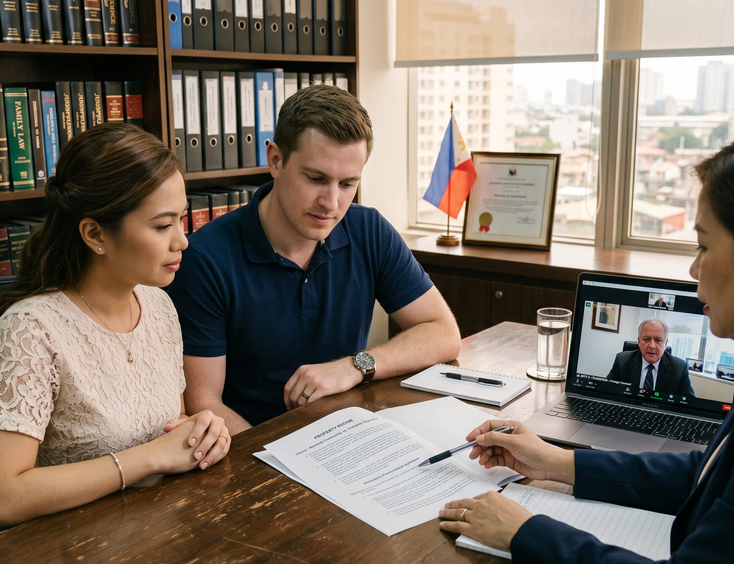
A Filipino marrying a foreigner under the Family Code defaults to absolute community of property unless the couple signs a prenuptial agreement choosing a different regime. International couples have extra reason to think this through, particularly when:
- One or both parties hold significant pre-marriage assets
- One or both parties expect an inheritance from family abroad
- The couple owns or plans to own property in more than one country
- The couple may eventually move to the foreign spouse's home country, which may apply different default property rules
A prenuptial agreement under the Family Code lets the couple choose conjugal partnership of gains, complete separation of property, or another regime. Sign it in writing before the wedding, before a notary, and register it with the LCR and the Register of Deeds, since an unregistered agreement does not bind third parties. Consult both a Philippine family lawyer and a lawyer in the foreign spouse's country to coordinate the arrangement across jurisdictions, because property laws differ sharply and a regime that holds in one country may not be recognized in another.
Foreigners Marrying Foreigners in the Philippines
A foreigner-to-foreigner marriage in the Philippines is less common but legally possible. Both parties submit Certificates of Legal Capacity from their respective embassies, plus the standard supporting documents. The marriage proceeds under the Family Code, the LCR issues the license, an authorized solemnizing officer performs the ceremony, and the PSA registers the marriage and issues PSA-certified certificates to both parties.
Recognition back home depends on each country's law. Most countries recognize a foreign marriage validly contracted under the law of the place of celebration, and a PSA-certified marriage certificate, sometimes apostilled or authenticated, supports that recognition.
How Your Officiant Should Handle a Filipino-Foreigner Wedding
An officiant experienced with international couples treats the extra documents as part of the standard process. Before you book, confirm that experience by asking directly:
- How many Filipino-foreigner weddings have you officiated?
- Are you familiar with the Certificate of Legal Capacity to Contract Marriage?
- Have you worked with couples from the foreign party's specific country?
- What documents will you need to see before the ceremony?
- How do you handle the Affidavit in Lieu of a Certificate of Legal Capacity for U.S. citizens, or similar alternatives for other nationalities?
- Will you file the marriage certificate with the LCR within the required period after the wedding?
An experienced officiant has handled many of these situations and flags potential problems weeks ahead. An inexperienced one may miss a requirement that surfaces on the wedding day or in the months after. The full verification process for solemnizing officers, including those experienced with international couples, lives in how to verify if your wedding officiant is registered and recognized in the Philippines.
A Timeline for Filipino-Foreigner Weddings
The longer timeline reflects the international documentation.
- Six to eight months out: The foreign party orders the home-country birth certificate and civil status documents and starts the apostille or authentication process. The Filipino party orders PSA documents (birth certificate, CENOMAR). Both confirm the LCR's current requirements for foreign-spouse marriages. A Filipino party with a prior foreign divorce files the Petition for Recognition of Foreign Divorce, which alone can take a year.
- Four to six months out: The foreign party books the embassy appointment for the Certificate of Legal Capacity or alternative. The couple engages a solemnizing officer experienced with international couples and settles the property regime, drafting and reviewing a prenuptial agreement if they want one.
- Two to three months out: The foreign party receives the Certificate of Legal Capacity or alternative, all supporting documents clear apostille or embassy authentication, the couple files the marriage license application at the correct LCR, the ten-day publication begins, and the couple attends the required pre-marriage seminars.
- One to two months out: The couple picks up the marriage license, finalizes ceremony details with the officiant, hands over copies of all documents for review, and registers any prenuptial agreement.
- Wedding day: The couple brings the marriage license, IDs for both parties, IDs for two witnesses, and all foreign documents in original. The officiant performs the ceremony, and the couple, witnesses, and officiant complete the signing.
- Within 15 to 30 days after: The officiant files the signed certificate with the LCR, and the couple confirms it.
- Four to six months after: The couple requests the PSA-certified marriage certificate. The foreign spouse begins the 13(a) visa application if staying, or the Filipino spouse begins the spousal immigration application if moving abroad, with the PSA certificate apostilled where a foreign country needs it.
Common Problems and How to Avoid Them
Filipino-foreigner couples hit the same recurring problems, and most yield to planning.
- The Certificate of Legal Capacity arrives late. The embassy takes longer than expected and the date slips. Start the embassy process at least three months out and hold a backup date.
- The home-country birth certificate is not authenticated. A foreign party brings a plain copy with no apostille or embassy authentication, and the LCR rejects it. Finish the apostille or authentication in the home country before traveling.
- The prior divorce is not yet recognized. The Filipino party was married to a foreigner who divorced abroad but has not completed the Recognition of Foreign Divorce. File the petition as soon as the foreign divorce is final, and set no new wedding date until the court order is annotated on the marriage records.
- The foreign party's name does not match across documents. Different formats (with or without a middle name, maiden versus married name) trigger an LCR rejection. Confirm the name format across every document before submission, and obtain a name affidavit or correction where needed.
- The officiant lacks experience with international couples. The officiant takes the booking but misses a requirement, and the gap surfaces on the wedding day. Confirm experience with international couples and ask for references.
- The foreign party overstays the visa. A foreigner on a tourist visa during a long marriage process can exceed the visa duration. Monitor the status, request Bureau of Immigration extensions as needed, and do not let the visa expire.
Working With an Experienced Officiant
The right officiant makes a Filipino-foreigner wedding straightforward. The wrong one turns it into a months-long headache. Browse pre-verified solemnizing officers, including those experienced with international couples, through our wedding officiants directory, where every listed officer provides credentials, contact details, and an overview of their experience, including the types of weddings they have performed. Confirm the officer's experience with marriages involving foreigners before you book, and ask specifically about the documentation for the foreign party's nationality.
The full Family Code framework, including the categories of authorized solemnizing officers and the marriage license process, runs through who is legally authorized to solemnize a marriage in the Philippines under the Family Code and the marriage license process in the Philippines and the role your officiant plays in it. Both apply to Filipino-foreigner weddings, with the foreign-party documentation layered on top.
A wedding between a Filipino and a foreigner is a legal arrangement that crosses borders, languages, and legal systems. It rewards careful planning, accurate documentation, and the right professionals at every step. Start early, confirm requirements with both the LCR and the embassy, choose an officiant experienced with international couples, and the wedding day arrives with the paperwork in order and the foundation set for a marriage recognized wherever life takes you.
Still Searching for a Right Match?
Find Your Perfect Wedding Supplier Today!
Discover trusted wedding suppliers across the Philippines in our complete directory. Compare services and connect with the ones that fit your dream celebration.
Browse Wedding SuppliersFeatured Blog Posts

Filipino Wedding Entourage - Roles, Order of March, and Modern Etiquette
6 mins readCivil Weddings in the Philippines - Requirements, Costs, and Step-by-Step Process
9 mins readCivil Wedding Requirements in the Philippines - Complete Checklist
6 mins readCost of Wedding in the Philippines - 5 Essential Things You Need to Know
7 mins readPrincipal Sponsors (Ninong/Ninang) - How Many, How to Ask, What They Really Do
4 mins readVeil, Cord, Candle & Coins - Roles, Options, and When They Happen
4 mins readEntourage for a Traditional Pinoy Wedding - Complete Roles and Guide
6 mins readComplete List of Civil Wedding Requirements in the Philippines
8 mins readHow to Choose Wedding Ninongs and Ninangs - Ask Yourself These 3 Important Questions
5 mins read