


What Happens If Your Wedding Officiant Is Not Legally Authorized in the Philippines
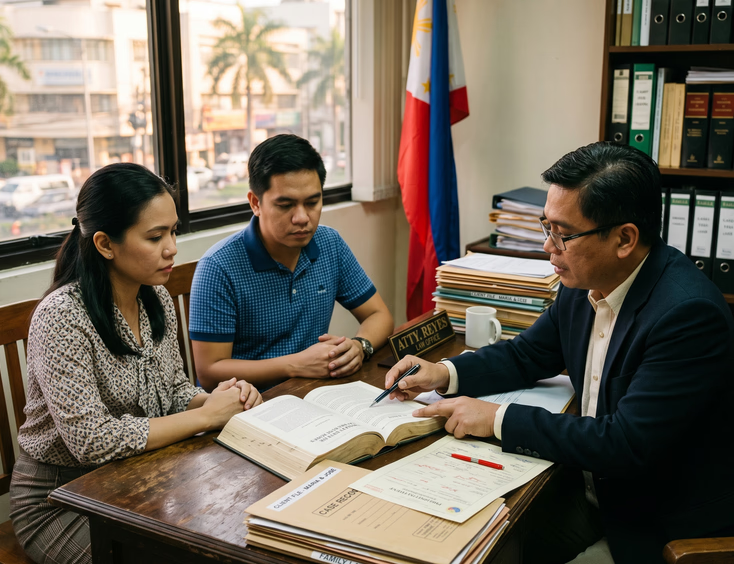
You stood at the altar, exchanged vows, signed a marriage certificate, and walked out as husband and wife. Six months later you request your PSA marriage certificate for a passport application, and the PSA has no record. You dig deeper and learn the officiant who signed your certificate held no legal authority. The wedding happened. The marriage did not.
Article 35 of the Family Code declares this marriage void from the beginning. Void means it never existed. You were never married under the law. The reception was a party, the vows were promises, and the certificate was paper. For the wider context on who can legally marry you and how to choose them, start with our guide to wedding officiants in the Philippines.
Article 35 and the Void Marriage
Article 35 of the Family Code lists the marriages void from the beginning. Paragraph 2 covers any marriage solemnized by a person without legal authority to perform marriages, which is the heart of the problem we cover in our guide to who is legally authorized to solemnize a marriage in the Philippines under the Family Code.
A void marriage produces no legal effect. You both stay single in the eyes of the law. No conjugal property regime arises, no spousal inheritance rights exist, and there is no marital domicile, no marital benefits, no marital tax treatment, no marital immigration status. You walk away with the same legal standing you held before the ceremony.
A void marriage needs no annulment. Annulment applies to voidable marriages, which were valid when solemnized but can be set aside on specific grounds. A void marriage was never valid. You can still file a Petition for Declaration of Nullity of Marriage before the Regional Trial Court to clear the public record, but your legal status does not wait on the court. The marriage was void the moment the unauthorized person signed the certificate.
The Good Faith Exception
Article 35 carries one narrow exception. If you or your partner believed in good faith that the solemnizing officer held legal authority, the marriage stands valid despite the missing authority.
Good faith means honest belief without negligence, and both halves matter. You must have believed the officiant was authorized, and you must have had no reasonable basis to doubt it. A couple who saw a Certificate of Authority to Solemnize Marriage, confirmed the officiant came from a recognized church, and verified the CASM number with the PSA can claim good faith. A couple who hired a "minister" from an online ordination website and skipped any verification cannot.
The exception protects couples who were honestly deceived, not couples who chose not to ask. The burden of proving good faith falls on the parties claiming the marriage is valid, and Philippine courts apply the standard strictly. Discover the defect years later and you often face a hard evidentiary spot: the CASM the officiant once showed you is gone, the religious organization may have dissolved or disclaimed him, and the records that would prove your good faith have vanished. Proving honest belief without negligence turns into a steep climb.
Property Complications
The property fallout of a void marriage reaches past the couple. Without a valid marriage, no conjugal partnership of gains or absolute community of property exists. Each of you separately owns whatever you earned, bought, inherited, or received during the period you thought you were married.
The trouble shows up in the everyday:
- A house "bought together" during the supposed marriage belongs to whichever party holds the title.
- A car registered under one name belongs to that party alone.
- Business assets, savings accounts, investments, retirement funds, and insurance policies follow the same individual-ownership rule.
- The party who paid for an asset titled in the other's name holds no automatic claim under marriage law and has to pursue civil remedies as a co-owner or creditor.
Articles 147 and 148 of the Family Code offer a partial remedy. Article 147 applies when both of you could legally marry but the marriage is void for another reason, including a void marriage under Article 35, and it treats property from your joint efforts during cohabitation under co-ownership rules in proportion to your contributions. Article 148 applies when one or both of you could not legally marry, with a stricter co-ownership rule. The remedies exist, but they run through court, demand evidence, and take time. None of it would matter if the marriage had been valid from the start.
Inheritance and Succession
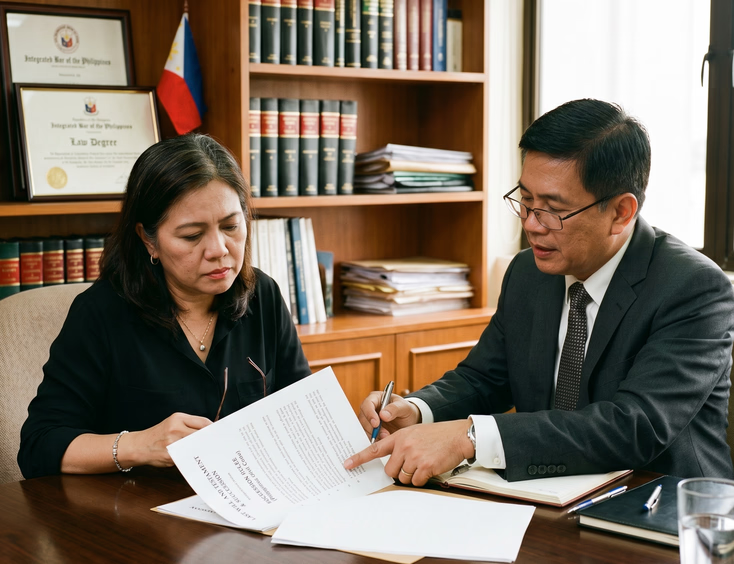
A surviving spouse inherits from the deceased spouse under the Civil Code rules on succession. A surviving "spouse" from a void marriage does not.
The party left behind after the other dies holds no compulsory heir status. The estate passes to the legal heirs (legitimate children, parents, or siblings, depending on the family) under intestate succession rules, and the surviving "spouse" inherits nothing from the law, relying only on whatever a valid last will leaves them. Insurance policies, retirement benefits, and pensions that name a "spouse" beneficiary hit the same wall: the paying institution may pay the named person, but a competing legal heir can challenge that payment in court, and the surviving party wins some cases and loses others depending on how the policies read.
Children of the deceased from the void marriage carry their own questions. The Family Code treats children of a marriage void under Article 35 paragraph 2 as illegitimate, with the rights and limits that follow under Philippine succession law. A later court declaration of nullity does not change their status, though it can clarify the public record.
Children's Legitimacy and Surname
The children's status under the law follows the marriage's status under the law. Children born to a marriage void under Article 35 paragraph 2 are illegitimate under the Family Code.
An illegitimate child carries the mother's surname by default under Article 176, as amended by Republic Act 9255. The child can use the father's surname once the father acknowledges paternity through an affidavit of admission of paternity, a birth record he signs, or a private handwritten instrument acknowledging the child as his own, and the Local Civil Registrar processes the surname change through the standard procedure. Illegitimate children inherit from their parents too, receiving half the share of a legitimate child under Article 176. The right exists. The amount differs.
For couples committed to each other and to their children, the practical fix runs through a later valid marriage. A second marriage between the same parties, solemnized by an authorized officer with a valid license, legitimates the children retroactively if no impediment existed during the cohabitation. The legitimation reaches every child born during the void marriage period and restores them to the status of legitimate children.
Immigration Consequences for Foreign Spouses
A foreign spouse marrying a Filipino here often leans on the marriage for immigration. A void marriage breaks every immigration benefit that ran through the spousal relationship.
The 13(a) non-quota immigrant visa, the common route for foreign spouses of Filipino citizens, requires a valid marriage to a Filipino. A void marriage cannot support the application. A foreign spouse who already holds the visa on the basis of a void marriage risks cancellation once the defect surfaces, and the Bureau of Immigration treats fraudulent or void-marriage-based visas seriously enough to open deportation proceedings.
The reverse breaks down the same way. A Filipino immigrating to the foreign spouse's country relies on that country recognizing the marriage. If its immigration authority later learns the marriage was void under Philippine law, the Filipino spouse's visa or residency turns vulnerable to cancellation, with removal from that country on the table. The full set of issues facing couples with one foreign party runs through special circumstances: marrying a foreigner in the Philippines and what your officiant needs to know.
Benefits, Insurance, and Government Records
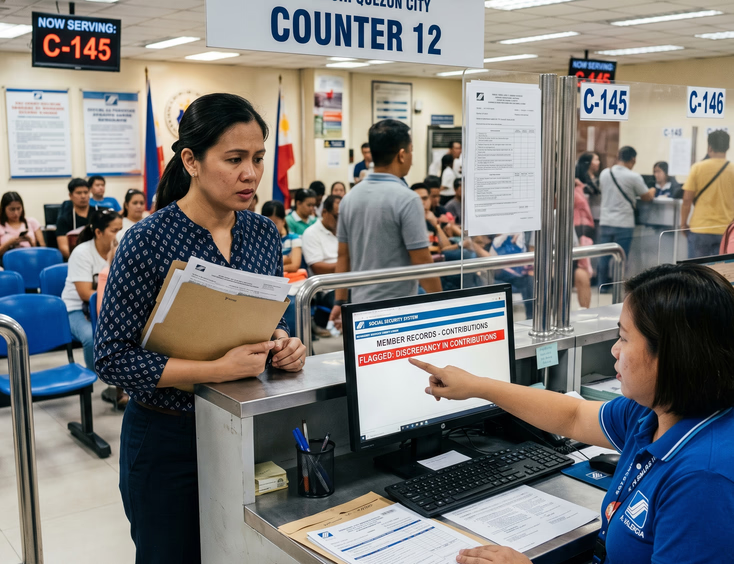
Your marriage status connects to a long list of benefits, registrations, and records. A void marriage breaks each one.
- SSS and GSIS benefits. A "spouse" beneficiary on Social Security System or Government Service Insurance System records loses the claim if the marriage is void, and the actual legal heirs claim the benefits instead.
- PhilHealth dependents. A "spouse" listed as a PhilHealth dependent can be removed from the principal member's records once the void status surfaces, with claims paid under that dependent status potentially recoverable by PhilHealth.
- Bank joint accounts. A joint account opened on the basis of marriage keeps working as a joint account between two individuals, but survivorship and conjugal property rules do not apply when one party dies. The survivor's claim runs through co-ownership rather than spousal succession.
- Insurance policies. Life, health, and other policies naming a "spouse" beneficiary draw the same scrutiny as SSS and inheritance claims. The insurer may pay the named person while reserving the right to challenge the payment when competing legal heirs come forward.
- Tax filings. A couple who filed joint returns or claimed marriage-based deductions may face a Bureau of Internal Revenue review, and the BIR can assess deficiency taxes for the years they claimed marital status in error.
- Passport and immigration records. A Filipino who changed her passport name to her "husband's" surname can keep using it in practice, but the legal basis for the change disappears, and a future renewal, visa application, or document authentication can surface the discrepancy.
Criminal Liability for the Officiant
The unauthorized officiant carries criminal exposure. Article 352 of the Revised Penal Code penalizes the performance of an illegal marriage ceremony, reaching any priest or minister of any religious denomination or sect, or any civil authority, who performs or authorizes one.
Article 350 penalizes contracting a marriage while knowing it is illegal or invalid, and that penalty can reach you and your partner too if you knew the officiant lacked authority and went ahead. Article 358 covers false certification of marriage, so an officer who certifies authority he does not hold commits a separate offense.
Tip: The officiant's criminal exposure works against you when you try to clean up the mess. Someone facing charges has every reason to vanish, deny involvement, or destroy records. Keep your own copies from day one: photograph the CASM, save every message, and note the registration number, so your case never depends on an officiant who has gone quiet.
Civil Liability and Damages
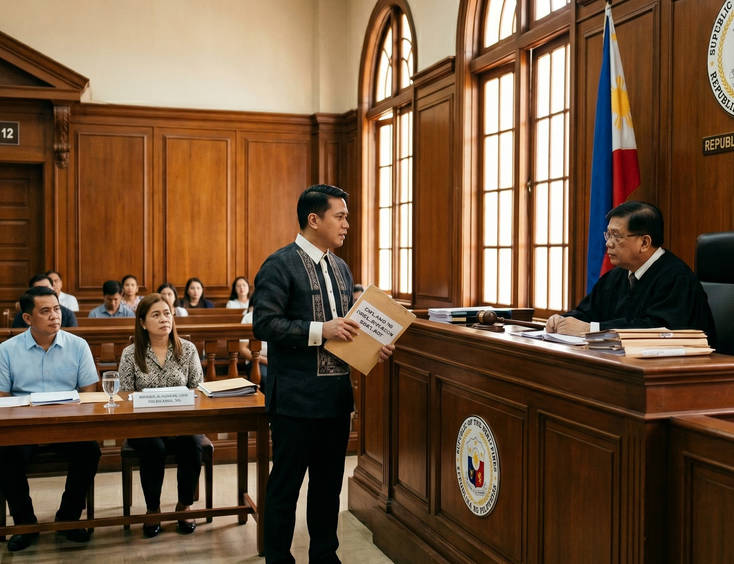
You can sue the unauthorized officiant for damages. The cause of action runs through Articles 19, 20, and 21 of the Civil Code, which set liability for acts that cause damage through fraud, negligence, or willful violation of law.
Damages can cover actual losses from the void marriage, moral damages for the emotional distress and social humiliation, and exemplary damages to make an example of the officiant for the public good, with attorney's fees recoverable in some cases. Recovery in practice depends on whether the officiant has money and whether you can find him. A pastor of an unregistered church running out of a rented unit can disappear faster than the lawsuit finds him, and an online impostor may hold no traceable assets. The civil action gives you a remedy on paper that often delivers no money in fact.
How to Fix a Void Marriage
A couple who discovers their marriage is void has several paths. The right one depends on whether you want to stay together, how much time has passed, and what legal entanglements have built up.
| Option | What it does | Typical timeline |
|---|---|---|
| Subsequent valid marriage | A new license, the publication period, and an authorized officer make you married from the date of the second ceremony; children can be legitimated retroactively | Weeks to a few months |
| Petition for Declaration of Nullity | A Regional Trial Court formally declares the prior marriage void, and the PSA annotates the record to clear it | One to three years |
| Civil partition of property | A court divides property from the void marriage period under Article 147 or 148, by each party's contribution | Varies with the court and the assets |
| Criminal complaint against the officiant | Filed with the Office of the Prosecutor; it does not fix the marriage but can deter repeat offenders | Varies |
| Civil action for damages | Sues the officiant for the harm caused, often paired with the criminal complaint | Varies |
For most couples who want to stay together, the subsequent valid marriage is the cleanest route. The nullity petition matters most when the public record has to show the first marriage was void, often before either party can marry someone else.
How to Avoid the Problem in the First Place
The void marriage is preventable. Verify your officiant's authority before you book, before you pay, and before the ceremony.
- Ask for the CASM. Religious officers carry a Certificate of Authority to Solemnize Marriage from the Office of the Civil Registrar General under the PSA. Request a copy and confirm the registration number, the religious organization, and the area of authority. The CASM must be current.
- Confirm the religious organization. The CASM is only as good as the body behind it. Confirm the church or sect registered with the Securities and Exchange Commission and earned PSA recognition. A pastor whose CASM traces to an unregistered group cannot solemnize.
- For judges and mayors, confirm incumbency. Their authority comes from holding office. Confirm the judge currently serves in the court where they preside, and the mayor currently holds office in the city or municipality where you will marry. Retired judges and former mayors cannot officiate.
- Confirm territorial jurisdiction. A judge officiates only within the judicial region where they sit, a mayor only within their city or municipality, a religious officer only within the area on their CASM. Take the wedding outside that jurisdiction and the marriage is void.
- Cross-check with the PSA. The PSA keeps the registry of authorized solemnizing officers and answers verification requests, which helps most with less-common organizations or unfamiliar officiants. The full process lives in how to verify if your wedding officiant is registered and recognized in the Philippines.
You can also skip most of this legwork by starting with pre-screened officers. Browse our wedding officiants directory, where every listed officer has submitted credentials, including a current CASM, contact information, and references, so the verification happens before you book rather than after.
The legal authority of the person who signs your marriage certificate decides whether the marriage exists at all. Spend the time on verification, the questions on credentials, the effort on confirmation. Getting it right costs you a phone call to the PSA. Getting it wrong costs you the rest of your legal life.
Still Searching for a Right Match?
Find Your Perfect Wedding Supplier Today!
Discover trusted wedding suppliers across the Philippines in our complete directory. Compare services and connect with the ones that fit your dream celebration.
Browse Wedding SuppliersFeatured Blog Posts




Filipino Wedding Entourage - Roles, Order of March, and Modern Etiquette
6 mins readCivil Weddings in the Philippines - Requirements, Costs, and Step-by-Step Process
9 mins readCivil Wedding Requirements in the Philippines - Complete Checklist
6 mins readCost of Wedding in the Philippines - 5 Essential Things You Need to Know
7 mins readPrincipal Sponsors (Ninong/Ninang) - How Many, How to Ask, What They Really Do
4 mins readVeil, Cord, Candle & Coins - Roles, Options, and When They Happen
4 mins readEntourage for a Traditional Pinoy Wedding - Complete Roles and Guide
6 mins readComplete List of Civil Wedding Requirements in the Philippines
8 mins readHow to Choose Wedding Ninongs and Ninangs - Ask Yourself These 3 Important Questions
5 mins read