


How to Verify If Your Wedding Officiant Is Registered and Recognized in the Philippines
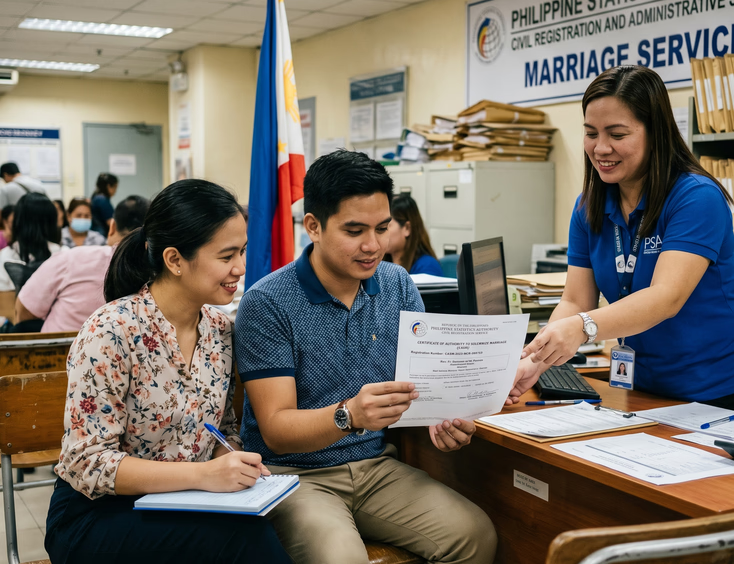
A pastor with a printed certificate, a fancy title, and a confident handshake can look like an authorized solemnizing officer. So can a complete impostor. The Family Code does not ask you to take anyone's word for it. The tools to check exist. Most couples skip them, assume the officiant is legitimate, and learn the truth six months later when the PSA cannot produce a marriage certificate.
Verification takes a few phone calls, a few document requests, and a couple of trips to government offices. The investment is small. The protection is the gap between a valid marriage and a void one. For the wider picture on who can marry you and how to choose them, start with our guide to wedding officiants in the Philippines.
The Six Categories of Authorized Solemnizing Officers
Verification starts with knowing what authority your officiant claims to hold. Article 7 of the Family Code, supplemented by the Local Government Code of 1991, names six categories:
- Incumbent members of the judiciary, within their territorial jurisdiction
- Priests, imams, rabbis, ministers, and pastors of registered religious sects, with a current Certificate of Authority to Solemnize Marriage
- Ship captains and airplane chiefs, in articulo mortis during a voyage
- Military commanders of units, in articulo mortis within the zone of military operations
- Consuls-general, consuls, and vice-consuls, abroad for Filipino citizens
- Mayors, within their territorial jurisdiction under the Local Government Code
The full discussion of each lives in who is legally authorized to solemnize a marriage in the Philippines under the Family Code. The steps below assume your officiant falls into the first two categories or the sixth, since those cover the vast majority of weddings. The articulo mortis categories apply to emergencies no couple plans for, and the consul category applies only abroad.
Verifying a Judge
A judge's authority comes from holding office. You confirm two things: the judge currently sits on the bench, and your venue falls within their territorial jurisdiction.
- Identify the court and division. Ask your officiant for the full name of the court (Regional Trial Court Branch X, Metropolitan Trial Court of Y, Municipal Trial Court of Z) and the location.
- Call the Office of the Court Administrator. The OCA under the Supreme Court oversees lower court judges and can confirm whether a judge currently serves, sits suspended, has retired, or has been dismissed. Its numbers appear on the Supreme Court website.
- Call the court directly. The clerk of court at the judge's branch can confirm the judge is presently assigned there and not on leave or detail elsewhere, and can confirm the court's territorial jurisdiction.
- Check for disciplinary records. The Supreme Court publishes its decisions on judicial discipline. A search of the Court's website and recent news can surface any active case against the judge.
- Confirm territorial jurisdiction. A Regional Trial Court judge has jurisdiction within the judicial region where they sit; a Metropolitan or Municipal Trial Court judge, within the city or municipality of their court. A judge who officiates outside that jurisdiction hands you a void marriage even when every other requirement is met.
A judge can officiate after office hours at a hotel, garden, or private home and still produce a valid marriage, as long as the location sits within their territorial jurisdiction. Confirm the venue maps to the judge's court before you book.
Verifying a Mayor
A mayor's authority runs through the Local Government Code. You confirm the mayor holds office and your venue sits within the city or municipality.
- Confirm incumbency. Call or visit the City Hall or Municipal Hall. The City or Municipal Administrator's office can confirm the mayor currently holds office. Election results are public, and the law fixes the term.
- Confirm the venue is within the jurisdiction. A Quezon City mayor solemnizes only within Quezon City. A wedding at a Tagaytay venue falls outside that reach, even when the couple lives in Quezon City.
- Check for suspension or disciplinary action. The Office of the Ombudsman, the Office of the President, or the Sandiganbayan can suspend a mayor, and a suspended mayor cannot officiate. The Department of the Interior and Local Government and recent news can surface active cases.
- Confirm the ceremony arrangements. Some mayors solemnize only at City Hall, others accept off-site ceremonies within their jurisdiction for an added fee. Get it in writing.
- Check the vice mayor's standing. The vice mayor can solemnize when the mayor is incapacitated or absent. Confirm the circumstances justify the role, since a vice mayor officiating while the mayor is available and not validly absent raises questions about authority.
Verifying a Religious Solemnizing Officer
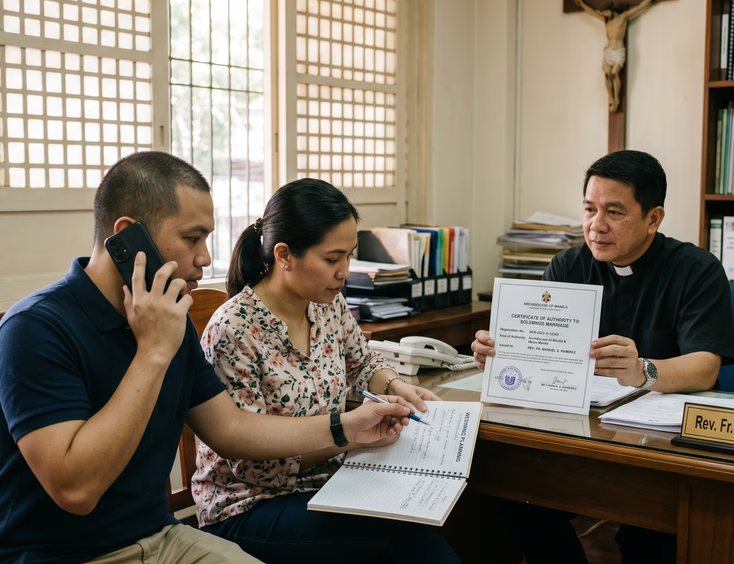
The deepest verification applies to religious officers. The category covers the most officiants, the widest range of denominations, and the most potential impostors.
Start by requesting the Certificate of Authority to Solemnize Marriage (CASM) at your first meeting. A religious officer authorized under Article 7 paragraph 2 holds a CASM issued by the Office of the Civil Registrar General (OCRG) under the PSA, and it carries:
- The full name of the solemnizing officer
- The religious organization the officer represents
- The CASM registration number
- The date of issuance
- The area where the officer can solemnize marriages
A legitimate officer carries the CASM, keeps copies for couples, and answers questions about it without flinching. An officer who delays, dodges, or claims the CASM is "at the church" earns closer scrutiny. From there, work through the rest:
- Verify the CASM with the PSA. Contact the OCRG with the registration number, the officer's full name, and the religious organization. The OCRG can confirm the CASM is on file, the registration is current, and the area of authority covers your venue. The PSA runs verification through its Quezon City main office and PSA Serbilis branches, some by phone and some by written or in-person request. The PSA website lists the current channels.
- Confirm the religious organization is registered. The CASM is only as good as the body behind it. The PSA recognizes organizations registered with the Securities and Exchange Commission as non-stock, non-profit corporations or other recognized structures. Search the SEC database for the organization and confirm the registration is current and not revoked. A pastor with a CASM from an unregistered group cannot solemnize, whatever the CASM says.
- Confirm the area of authority. The CASM names the geographic area, which might cover a whole archdiocese for a Catholic priest, a province for a Protestant pastor, or a city for a smaller denomination's minister. Your venue must fall inside it. An officer whose CASM covers Pampanga cannot officiate in Cavite.
- For Catholic priests, verify with the archdiocese or diocese. The archbishop or bishop of the territory issues the priest's faculties to officiate. The Office of the Chancellor or the Curia can confirm a priest's current faculties and where they extend.
- For other Christian denominations, verify with the national or regional office. Most established Protestant and Evangelical denominations keep records of ordained ministers and their assignments, and Iglesia ni Cristo keeps records through its central administration. Confirm with the denomination's office, not only the local church.
Watch for red flags alongside the formal checks. An officiant who offers to skip the marriage license while citing an exemption that does not fit (a couple together two years cannot claim the Article 34 cohabitation exemption), who cannot produce a current CASM, or whose CASM looks expired or altered deserves a hard second look. So does a religious organization with no physical address, no congregation, and no online presence, an officiant who works only online and refuses to meet, a cash-only fee with no receipt, a refusal to share references, or pressure to schedule fast with no time to verify.
Verifying a Consul Abroad
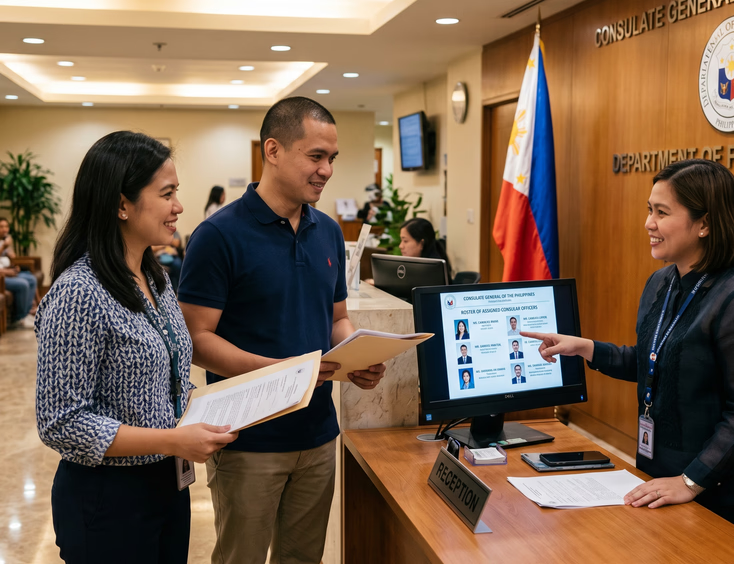
Filipino couples marrying abroad through a Philippine consulate verify through the Department of Foreign Affairs.
- Confirm the consul's appointment and assignment. The DFA keeps the list of consular officers and their posts, and the embassy or consulate website usually lists the current consul-general, consul, and vice-consuls.
- Confirm the consul performs solemnization duties. Not every consular officer handles marriages routinely. Confirm the specific consul at your post is currently authorized and assigned to marry Filipino citizens.
- Confirm the process. The consul performs the duties of both solemnizing officer and local civil registrar abroad. The marriage goes to the Philippine government through the Report of Marriage filed with the embassy or consulate, then on to the PSA.
Verifying an Imam or Hakim for Muslim Marriages
Marriages under Presidential Decree 1083, the Code of Muslim Personal Laws, go to an Imam, a Hakim, or a person the Imam designates, following Muslim law. Verification runs through the Office of the Circuit Registrar where the marriage will be registered and the Shari'a courts in the area. The full framework and the verification specific to Muslim solemnizers run through marriage under the Code of Muslim Personal Laws: a legal guide for Muslim couples in the Philippines.
What to Do With Verification Documents
After you verify, keep the paper. It protects you if questions arise later.
- The officiant's CASM. A physical copy or a clear scan, with the registration number, the date of issuance, and the area of authority noted.
- A record of the PSA verification. For a phone call, note the date, the staff member's name, and any reference number; for a written or in-person inquiry, keep the receipt or the response.
- Proof of the SEC registration. A screenshot or printout of the SEC database entry showing the organization currently registered.
- Correspondence with the officiant. Emails, the contract, receipts, and any written confirmation of authority and agreed terms.
A future question about your marriage resolves fast when you hold the records. The good faith exception under Article 35, which protects couples who honestly believed in the officiant's authority, becomes far easier to invoke when you can show the steps you took to verify.
What Verification Cannot Cover
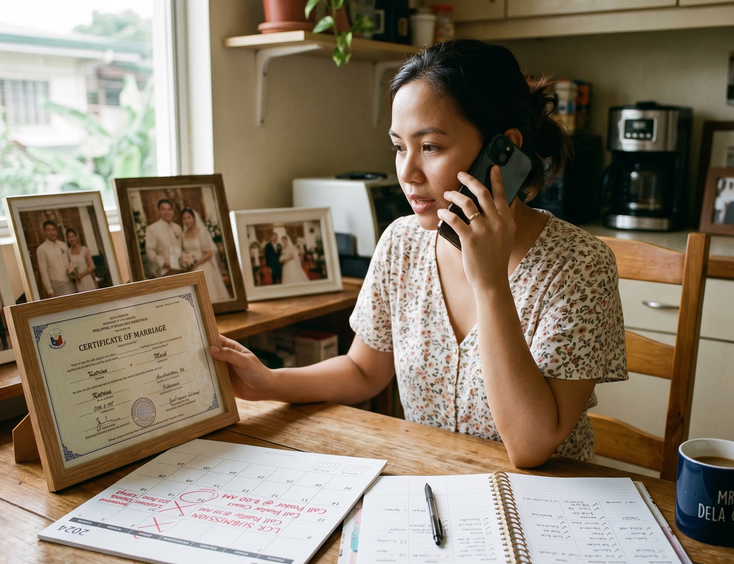
Verification confirms authority on the day you check it. Some risks outlast that day.
- Authority can lapse before the wedding. A judge retires, a mayor gets suspended, a CASM expires, an organization loses its SEC registration. Re-verify in the weeks before the wedding, especially for officiants booked many months ahead.
- The officiant can still skip the submission. Authority to solemnize is one thing; filing the certificate with the LCR within 30 days is another. Follow up 15 to 30 days after the wedding and confirm it happened. The full timeline runs through the marriage license process in the Philippines and the role your officiant plays in it.
- Documents can still carry errors. A verified, authorized officer can still sign a certificate with a misspelled name, a wrong birthdate, a missing witness signature, or a missing date stamp. Read the certificate closely before the officer submits it.
Tip: Re-verify your officiant in the final weeks even after a clean first check. A CASM you confirmed ten months ago may have expired by the wedding date, and a judge you cleared in January may have retired by November. The second call takes ten minutes and closes the one gap that early verification cannot.
What Happens If Verification Reveals a Problem
Catch a problem before the wedding and you have time to fix it. Catch it after, and the path turns harder.
Before the wedding, cancel the booking and find a different authorized officiant. Recover any deposit paid to the unauthorized one, and report them to the PSA, the SEC if a religious organization is involved, and the appropriate authorities. Replacements exist in every category, and a quick search through our wedding officiants directory surfaces vetted alternatives.
After the wedding, the marriage may be void under Article 35 paragraph 2 of the Family Code. The full consequences, including the property, inheritance, immigration, and children's status complications, run through what happens if your wedding officiant is not legally authorized in the Philippines. The good faith exception may save the marriage if you can show you honestly believed and reasonably verified, and a subsequent valid marriage is the cleanest fix.
A Verification Checklist You Can Run This Week
The right list depends on who is marrying you.
| Officiant | Run these checks |
|---|---|
| Judge (civil) | Confirm the name, court, and branch; call the Office of the Court Administrator for incumbency; call the clerk to confirm the current assignment; confirm the venue sits within the territorial jurisdiction; confirm no active suspension or disciplinary matter |
| Mayor (civil) | Confirm the name and term; call City or Municipal Hall for incumbency; confirm the venue sits within the city or municipality; confirm no active suspension; confirm the ceremony location, fee, and schedule |
| Religious officer (church) | Request a copy of the current CASM; note the registration number and area of authority; verify the CASM with the PSA's OCRG; confirm SEC registration of the organization; for Catholic priests confirm with the archdiocese chancery; for others confirm with the national or regional office; confirm the venue sits within the CASM's area |
| Consul (abroad) | Confirm the name and current assignment; verify through the DFA or the embassy or consulate website; confirm the consul performs marriages at the post; confirm the Report of Marriage process |
The verification spreads a few hours across a few weeks. The protection lasts a lifetime. The signature on your marriage certificate is only as valid as the authority of the person who signs it. Confirm that authority before the signature lands, and the marriage stands on solid ground from day one.
Browse pre-verified solemnizing officers through our wedding officiants directory, where every listed officer has submitted credentials, including a current CASM or proof of incumbency, contact details, and references, so the verification happens before you book rather than after the wedding ends and the consequences cannot be undone.
Still Searching for a Right Match?
Find Your Perfect Wedding Supplier Today!
Discover trusted wedding suppliers across the Philippines in our complete directory. Compare services and connect with the ones that fit your dream celebration.
Browse Wedding SuppliersFeatured Blog Posts



Filipino Wedding Entourage - Roles, Order of March, and Modern Etiquette
6 mins readCivil Weddings in the Philippines - Requirements, Costs, and Step-by-Step Process
9 mins readCivil Wedding Requirements in the Philippines - Complete Checklist
6 mins readCost of Wedding in the Philippines - 5 Essential Things You Need to Know
7 mins readPrincipal Sponsors (Ninong/Ninang) - How Many, How to Ask, What They Really Do
4 mins readVeil, Cord, Candle & Coins - Roles, Options, and When They Happen
4 mins readEntourage for a Traditional Pinoy Wedding - Complete Roles and Guide
6 mins readComplete List of Civil Wedding Requirements in the Philippines
8 mins readHow to Choose Wedding Ninongs and Ninangs - Ask Yourself These 3 Important Questions
5 mins read