


Legal Requirements for a Valid Prenuptial Agreement in the Philippines

A prenup that misses one formality can collapse when you need it most. You picture it protecting your business or your inheritance, then a court sets it aside because you signed it a day too late or skipped a notary. The Family Code sets clear requirements, and meeting all of them turns your agreement from a hopeful document into an enforceable one.
Get these right and your marriage settlement holds. Miss one and you may end up under the default regime you tried to avoid. Here's what the law demands.
The agreement must be in writing
An oral understanding carries no weight. You and your partner can talk through every term and shake on it, and the law treats that as nothing.
A valid marriage settlement exists on paper, with the terms set down clearly. Verbal promises about who keeps the house or how you'll split income hold no legal effect. The written document is the agreement, and anything not written into it falls outside it.
You must sign it before the wedding
Timing decides everything here. The agreement has to be signed before the marriage ceremony, because a marriage settlement is, by definition, an arrangement made in contemplation of marriage.
Sign it after the wedding and it carries no legal effect at all. The moment you marry, the window closes. This single rule traps couples who treat the prenup as something they can sort out later, and it explains why the timing of a prenup within your wedding planning matters so much. Once you marry, the regime locks in, which the rules on changing a prenup after the wedding cover in full.

Both parties must consent freely
A prenup signed under pressure can be challenged and struck down. The law requires genuine, voluntary agreement from both partners.
If one partner signed because of fraud, coercion, mistake, undue influence, or bad faith, a court can set the agreement aside. This protects both of you, and it shapes how you should approach the drafting. An agreement one partner felt forced into sits on shaky ground. The conversation that leads to a prenup matters legally as well as emotionally, which is part of why talking it through with your partner the right way protects the agreement itself.
Many couples use separate lawyers so each person gets independent advice, which strengthens the case that both consented freely. The guide to choosing the right lawyer for your prenuptial agreement covers that choice.
The terms must stay within the law
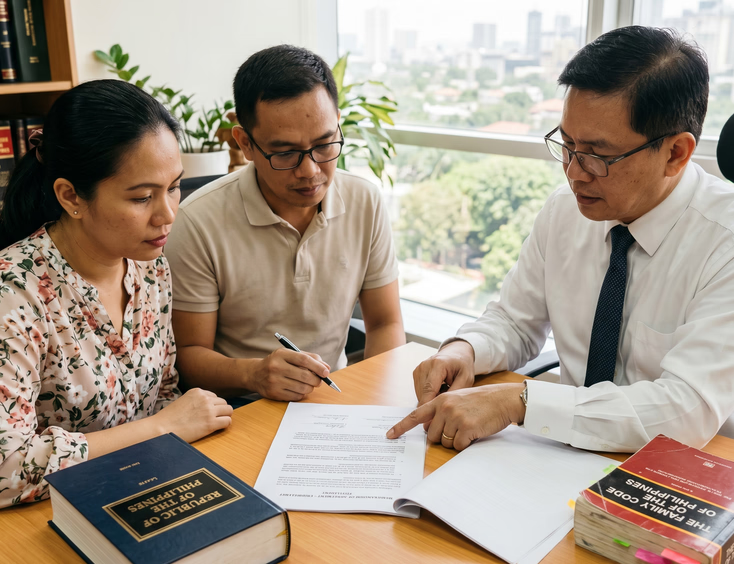
You hold wide freedom to design your arrangement, and that freedom has limits. The Family Code lets you choose Absolute Community of Property, Conjugal Partnership of Gains, Complete Separation, or a custom regime, as long as your terms break no law, morals, or public policy.
A clause that crosses those limits can void part or all of the agreement. This is where the custom route demands care, because a creative term that violates a legal boundary can collapse the protection you built. The breakdown of the four property regimes shows what falls inside the lines.
It must be notarized
A private signed document is not enough. The agreement has to be notarized by a notary public to carry the legal weight you need.
Notarization turns your settlement into a public document, gives it evidentiary strength, and makes it eligible for registration. You and your partner appear before the notary, present valid identification, and sign. Couples often sign with witnesses as well, adding another layer of proof that both parties agreed.
It must be registered to bind third parties
Here the requirements split into two effects. A notarized agreement binds you and your spouse between yourselves. To bind outsiders, you have to register it.
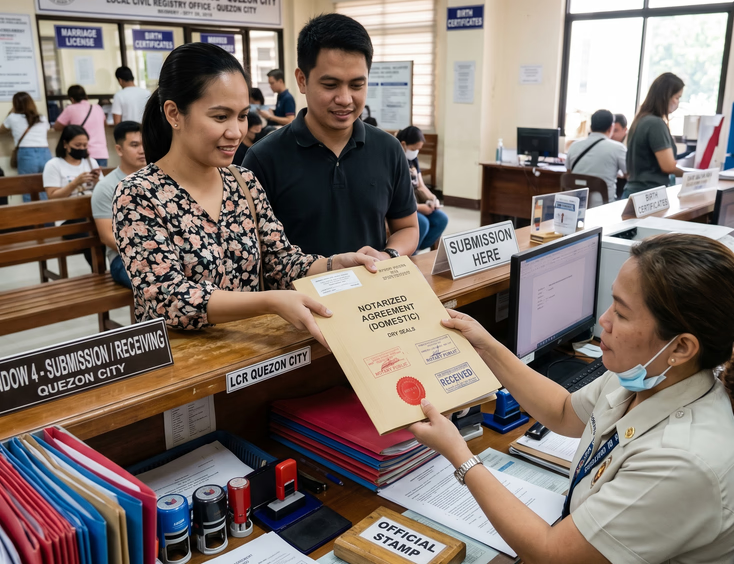
Record the marriage settlement in the Local Civil Registry where the marriage is registered. If the agreement covers real property, record it in the Registry of Deeds where that property sits. Skip registration and the agreement still governs the two of you, but a creditor, a bank, or a buyer can act as if it never existed. The full consequences appear in why your prenup must be registered.
Putting the requirements in order
Read together, the requirements form a sequence. You draft the terms in writing within legal limits, both of you consent freely, you sign before the wedding, you notarize the document, and you register it. Drop any step and you weaken or void the protection.
The sequence also maps onto the process of actually getting one done, which the step-by-step guide to getting a prenuptial agreement walks through from first conversation to final registration.
For how a marriage settlement works start to finish, who it serves, and how to set one up, the complete guide to prenuptial agreements in the Philippines brings the full picture together.
This article gives general information, not legal advice. Talk with a licensed Philippine family lawyer before drafting or signing any agreement.
Still Searching for a Right Match?
Find Your Perfect Wedding Supplier Today!
Discover trusted wedding suppliers across the Philippines in our complete directory. Compare services and connect with the ones that fit your dream celebration.
Browse Wedding SuppliersFeatured Blog Posts




Filipino Wedding Entourage - Roles, Order of March, and Modern Etiquette
6 mins readCivil Weddings in the Philippines - Requirements, Costs, and Step-by-Step Process
9 mins readCivil Wedding Requirements in the Philippines - Complete Checklist
6 mins readCost of Wedding in the Philippines - 5 Essential Things You Need to Know
7 mins readPrincipal Sponsors (Ninong/Ninang) - How Many, How to Ask, What They Really Do
4 mins readVeil, Cord, Candle & Coins - Roles, Options, and When They Happen
4 mins readEntourage for a Traditional Pinoy Wedding - Complete Roles and Guide
6 mins readComplete List of Civil Wedding Requirements in the Philippines
8 mins readHow to Choose Wedding Ninongs and Ninangs - Ask Yourself These 3 Important Questions
5 mins read