


The Four Property Regimes in a Philippine Prenup, Explained Simply

A property regime is the rulebook for who owns what once you marry. It decides whether your savings stay yours, whether your salary goes into a shared pot, and who keeps the house if the marriage ends. The Family Code gives you four to choose from, and a prenuptial agreement lets you pick the one that fits.
Pick none and the law assigns you the first one by default. Understanding all four lets you judge whether that default serves you or whether another arrangement suits your life better. Here's each one in plain terms.
Absolute Community of Property
This is the default. Marry without a prenup and the Family Code places you here automatically.
Under Absolute Community of Property, almost everything becomes shared the moment you marry. The savings you built while single, the condo you bought before you met, the car under your name, most of it folds into one common pool you both own. Property either of you acquires during the marriage joins that pool too. A few exclusions exist, like property one spouse receives through inheritance or donation during the marriage, but the regime pulls a wide range of assets into shared ownership.
How it treats your assets: your house, salary, and most belongings become joint property. Both of you own them, both of you share in them, and if the marriage ends, you generally split the common pool. A business you owned before marriage risks getting drawn in, and marital property can answer for certain debts either of you takes on.
Best for couples who enter with similar finances, plan to pool everything, and want a single shared estate without dividing lines.
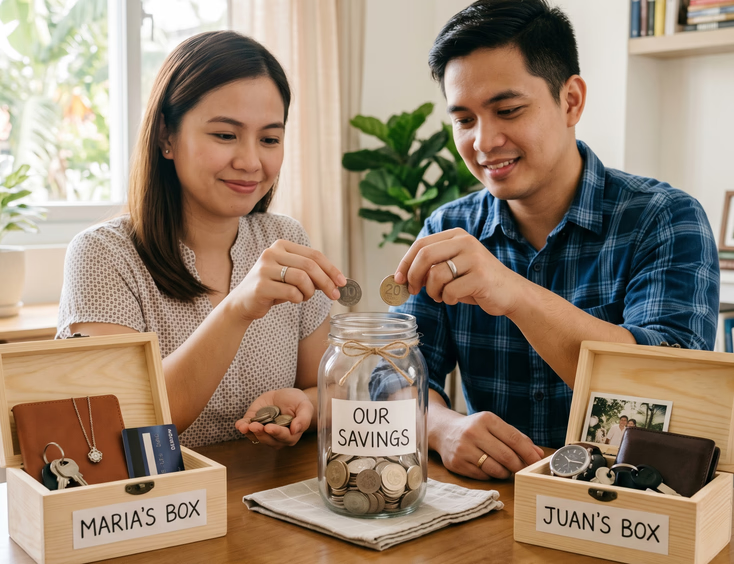
Conjugal Partnership of Gains
This regime splits the difference between sharing and keeping separate. Each of you holds onto what you owned before the marriage, while what you build together gets shared.
Under Conjugal Partnership of Gains, the property you brought in stays yours. The income, fruits, and gains that come during the marriage, your salary, the rent from your pre-marriage condo, the profit from a venture you start together, go into a common fund. When the marriage ends, you divide the net gains built during the marriage, while each of you keeps the separate property you started with.
How it treats your assets: the house you owned before marriage stays yours, but the income it earns during the marriage gets shared. Your salary during the marriage goes into the common fund. A business you built before marrying stays your separate property, though its earnings during the marriage may be shared.
Best for couples who want to keep their pre-marriage assets distinct while still sharing the life and income they build together. This was the default regime for marriages before the Family Code took effect, so older couples may already live under it.

Complete Separation of Property
This regime keeps everything separate. What's yours stays yours, what's theirs stays theirs, during the marriage and after.
Under Complete Separation of Property, each of you owns, manages, and disposes of your own assets without needing the other's consent. Your income is yours. Your partner's income is theirs. Each of you answers for your own debts. The marriage joins your lives without merging your finances.
How it treats your assets: your house, your salary, your business, and your debts stay entirely your own. Your partner's stay entirely theirs. If the marriage ends, there's little to divide because nothing pooled in the first place. Couples under this regime usually agree separately on how they'll split shared household expenses.
Best for couples with significant assets to protect, business owners shielding a company from marital disputes, partners with mismatched finances or debt, and many Filipino-foreigner couples whose cross-border situation calls for clear lines. The specifics for Filipino-foreigner couples show why separation often fits when one spouse is not a Filipino citizen.

A custom regime you design
The Family Code lets you build your own arrangement instead of taking one of the three named regimes whole. You can mix elements, set specific terms for particular assets, and tailor the rules to your situation, as long as the agreement breaks no law, morals, or public policy.
You might keep most things separate while sharing a single jointly bought home. You might pool income but ring-fence a family business and an expected inheritance. The custom route gives you flexibility, and it also demands careful drafting, because a clause that crosses legal limits can void part or all of the agreement.
How it treats your assets: however you and your lawyer write it, within the bounds of the law. This route rewards couples with complex finances, and it raises the value of good counsel, which the guide to choosing the right lawyer for your prenuptial agreement addresses.
Choosing the regime that fits
Line the four up against your own situation. Similar finances and a plan to share everything point toward the default community regime. Pre-marriage assets you want to keep while sharing what you build point toward partnership of gains. A business, mismatched finances, or a foreign spouse point toward separation. A complicated mix points toward a custom design.
Whichever you pick, the choice only holds if the agreement meets the formalities, so the legal requirements for a valid prenuptial agreement decide whether your regime survives a challenge. And because the default community regime is hard to undo once you marry, the difference between signing a prenup and relying on that default shows what you accept if you choose nothing.
For how a marriage settlement works start to finish, who it serves, and how to set one up, the complete guide to prenuptial agreements in the Philippines brings the full picture together.
This article gives general information, not legal advice. Talk with a licensed Philippine family lawyer before drafting or signing any agreement.
Still Searching for a Right Match?
Find Your Perfect Wedding Supplier Today!
Discover trusted wedding suppliers across the Philippines in our complete directory. Compare services and connect with the ones that fit your dream celebration.
Browse Wedding SuppliersFeatured Blog Posts




Filipino Wedding Entourage - Roles, Order of March, and Modern Etiquette
6 mins readCivil Weddings in the Philippines - Requirements, Costs, and Step-by-Step Process
9 mins readCivil Wedding Requirements in the Philippines - Complete Checklist
6 mins readCost of Wedding in the Philippines - 5 Essential Things You Need to Know
7 mins readPrincipal Sponsors (Ninong/Ninang) - How Many, How to Ask, What They Really Do
4 mins readVeil, Cord, Candle & Coins - Roles, Options, and When They Happen
4 mins readEntourage for a Traditional Pinoy Wedding - Complete Roles and Guide
6 mins readComplete List of Civil Wedding Requirements in the Philippines
8 mins readHow to Choose Wedding Ninongs and Ninangs - Ask Yourself These 3 Important Questions
5 mins read