

How to Choose the Perfect Wedding Ring as a Filipino Couple: A Step-by-Step Guide
The perfect wedding ring is not the most expensive one you can afford. It is not the one your ninang suggested, or the style trending on Pinterest right now, or the ring your officemate chose for her wedding last year.
The perfect wedding ring is the one that fits your finger, suits your life, reflects who you are as a couple, and still feels right twenty years from now when the excitement of the wedding day has settled into the quiet satisfaction of a good marriage.
Finding that ring is not complicated — but it does require asking the right questions in the right order, and resisting the pressure to skip steps because the answer feels obvious before you've actually looked.
This guide walks Filipino couples through the complete decision-making process, step by step. Not a checklist of features to compare, but a genuine thinking framework — the kind that produces a ring you are proud of and comfortable in, bought from a jeweler you trust, at a price that doesn't compromise your start as a married couple.
Why Most Filipino Couples Approach Ring Shopping Backwards
Here is the most common pattern: a Filipino couple gets engaged, gets swept up in the excitement, visits the nearest mall jewelry shop within the first two weeks, and chooses a ring based primarily on what is in stock and what looks good under the boutique's flattering lighting.
Sometimes this produces a ring they love. More often it produces a ring they like well enough — and occasionally a ring they regret, but feel too committed to return.
The backwards approach starts with the object — browsing rings before clarifying what you need — and works backward to the requirements. The better approach inverts this entirely: start with your actual life, your actual budget, your actual values, and your actual aesthetic — then find the ring that serves all of those things.
Every step in this guide follows that sequence. The ring comes last, not first.
Step 1: Have the Real Money Conversation First
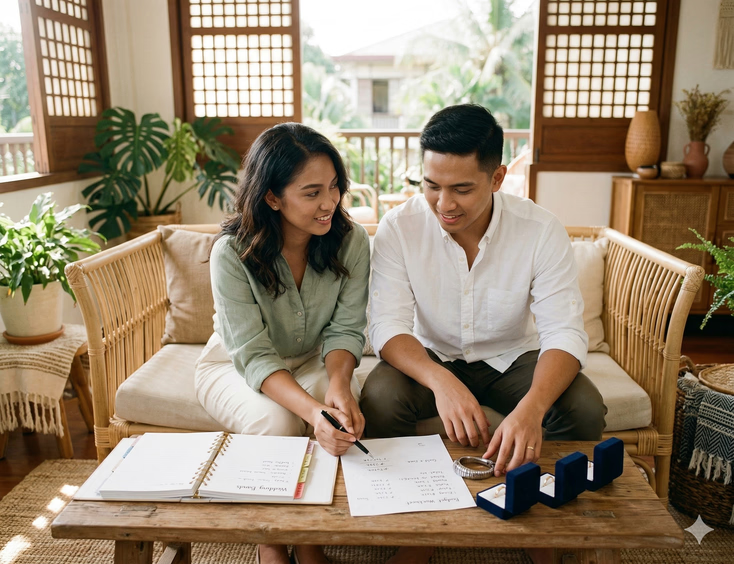
Before you look at a single ring, sit down with your partner and agree on a real number.
Not a range. Not "somewhere around." A specific ceiling — the maximum you are both comfortable spending on your wedding ring set combined, without financial stress, without touching your emergency fund, and without redirecting money you have already mentally allocated to something else.
This conversation is uncomfortable for many Filipino couples because money discussions can feel unromantic, and because there is sometimes social pressure — from family, from jewelry advertising, from the tradition of spending "one to two months' salary" on a ring — to spend more than is actually sensible.
The one-to-two months' salary guideline is a marketing invention, not a cultural requirement. Filipino weddings do not require expensive rings to be valid, meaningful, or beautiful. What they require is a ring exchanged with genuine intention — and that is available at every price point.
What to discuss in the money conversation:
- What is the total budget for both rings combined?
- Is the budget coming entirely from your own savings, or is a ninong, parent, or other family member contributing? If so, does that contribution come with any expectations about what is purchased?
- Are you prioritizing the ring budget over other wedding expenses, or is the ring one of several areas competing for limited funds?
- After the wedding, will this purchase leave you with a comfortable financial cushion for early married life?
A couple who agrees on ₱25,000 for their ring set and chooses confidently within that budget will be happier than a couple who spent ₱80,000 under social pressure and is now carrying financial anxiety into the first year of marriage.
For a realistic breakdown of what different budgets actually buy in the Philippine market, our honest wedding ring budget guide for Filipino couples gives you concrete numbers across every price range.
Step 2: Assess Your Actual Daily Life Honestly
Your wedding ring will be worn every day. Not on special occasions — every day. On days when you are in surgical gloves, on days when you are kneading dough, on days when you are typing for eight hours, on days when you are swimming in Boracay.
Before you choose any style, spend five minutes honestly describing your daily life to yourself and to your jeweler:
Questions to answer before choosing a ring style:
- What do you do with your hands at work? (Desk job, medical professional, cook, artist, manual tradesperson — each has different implications for ring style)
- Do you exercise regularly, and if so, what kind? (Gym, swimming, martial arts, team sports all have different ring implications)
- How much jewelry do you typically wear in daily life? (Someone who never wears jewelry will find an elaborate ring uncomfortable and incongruous; someone who loves jewelry can carry a more elaborate ring naturally)
- Do you have any existing skin sensitivities or metal allergies? (Nickel allergies are not uncommon among Filipinos and can make certain white gold alloys uncomfortable)
- Will you be wearing the ring in conditions that accelerate wear — saltwater, chemicals, industrial environments?
The answers to these questions rule out certain styles before aesthetic preference enters the picture at all. A Filipina nurse who wears gloves for twelve-hour shifts needs a low-profile or bezel-set ring, not a high cathedral solitaire regardless of how much she loves the look. A Filipino construction engineer who works with power tools needs a ring that won't catch, snag, or conduct electricity — which makes plain tungsten or titanium worth considering for the groom.
Lifestyle fit is not a compromise on your ring. It is the foundation of a ring you will actually wear comfortably for the rest of your life.
Step 3: Agree on Your Aesthetic Direction as a Couple
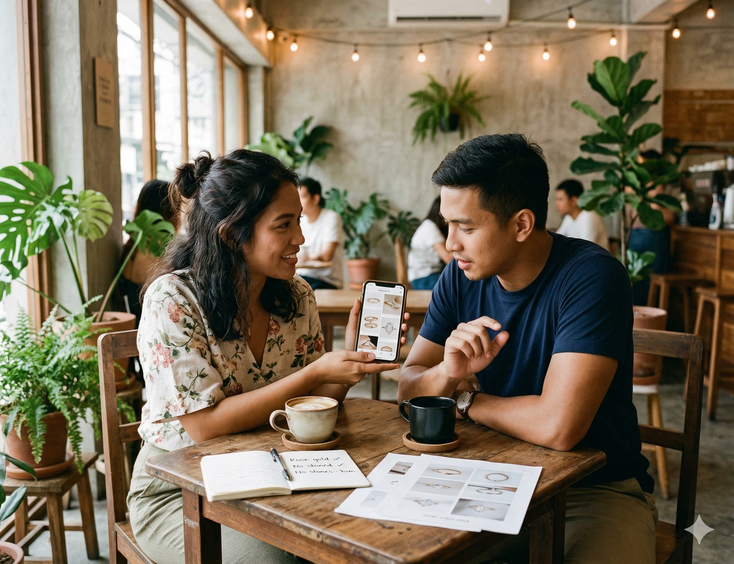
Wedding rings are a shared decision — both partners will wear them, and both partners' preferences matter. But "both partners' preferences" can point in genuinely different directions, and navigating that productively requires a structured approach.
Start with individual responses, then find the overlap:
Separately — before discussing with your partner — each of you should look at a range of ring styles and identify:
- Three to five styles you are genuinely drawn to
- One or two things you actively dislike (a metal color, a stone size, a profile shape)
- One non-negotiable, if you have one
Then compare notes. Most couples find more overlap than they expected. The areas of genuine disagreement are usually smaller and more specific than the overall impression of difference.
Common areas of Filipino couple aesthetic disagreement and how to resolve them:
She wants yellow gold; he wants white gold for himself: This is actually not a disagreement — wedding bands for each partner do not need to be the same metal. Many Filipino couples wear different metals and consider it a reflection of their individual personalities within a shared commitment. A shared design element — the same engraving, the same finish, the same width — creates connection without requiring identical metal choices.
She wants a stone; he thinks stones are impractical for his work: Her ring can have a stone; his can be a plain band. This is not a compromise — it is an acknowledgment that they have different hands, different jobs, and different aesthetic needs, and that the rings should serve the actual people wearing them.
One partner wants something elaborate; the other prefers minimalism: Look for the middle register — a ring with one design element that satisfies the desire for something more than plain, without reaching toward elaborate. A comfort-fit band with a single flush-set diamond, or a plain band with a meaningful exterior engraving, often resolves this tension elegantly.
Step 4: Understand Your Metal Options Before You Shop
Walking into a jewelry shop without understanding the difference between your metal options puts you at the mercy of whatever the sales staff chooses to emphasize. A basic understanding of the main options gives you genuine agency in the conversation.
Yellow Gold
The traditional choice for Filipino wedding rings, and still the most commonly worn. Yellow gold's warmth is particularly beautiful against the range of Filipino skin tones — from fair to morena to kayumanggi. It is available in 14k (58.5% pure gold, more durable and slightly less expensive) and 18k (75% pure gold, richer color, slightly softer). For Filipino couples who prioritize tradition and cultural continuity, yellow gold remains the natural choice.
14k vs. 18k for Filipino daily wear: 14k is harder and more scratch-resistant — relevant for physically active Filipinos. 18k has a richer, deeper color and is the preferred choice for those who prioritize appearance over maximum durability. Both are genuinely good choices; the decision depends on how you weigh these factors for your specific lifestyle.
White Gold
Yellow gold alloyed with white metals (typically palladium or nickel) and plated with rhodium to achieve a bright silver appearance. White gold has a contemporary, clean aesthetic that appeals to younger Filipino couples and those who prefer a cooler-toned metal.
Important practical note for Filipino white gold buyers: Rhodium plating wears off over time — typically one to three years of daily wear — revealing the slightly warmer underlying metal. Re-plating is a standard jewelry service, inexpensive and widely available, but it is a maintenance commitment that plain yellow or rose gold does not require. Ask your jeweler about their re-plating service and cost before purchasing a white gold ring.
Nickel allergy note: Some white gold alloys contain nickel, which causes skin reactions in some people. If you or your partner has a known nickel sensitivity, ask specifically whether the white gold offered is nickel-free (palladium white gold), or consider platinum instead.
Rose Gold
Yellow gold alloyed with copper to produce a warm pink tone. Rose gold has become enormously popular among Filipino brides in recent years — its warm, romantic quality sits beautifully against Filipino skin tones across the full spectrum.
Rose gold is slightly harder than yellow gold due to the copper content, which makes it reasonably durable for daily wear. It does not require rhodium plating. One consideration: rose gold cannot be made in a pure "white" version — if a couple wants matching metals, rose gold is for them both or neither.
Platinum
A naturally white, exceptionally dense precious metal that does not require plating and does not change color over time. Platinum is significantly more expensive than gold — typically two to three times the price — but offers unmatched durability and a prestige that appeals to Filipino couples making a long-term investment in their rings.
For Filipino couples considering platinum: it is a genuine lifetime metal. It develops a patina with wear that many people find beautiful and that can be polished away if preferred. If your budget comfortably reaches platinum territory, it is worth serious consideration. If it stretches your budget significantly, well-made 18k gold serves Filipino daily life extremely well.
Alternative Metals (Titanium, Tungsten, Silver)
For Filipino grooms particularly, alternative metals offer practical and budget advantages. Titanium and tungsten are extremely scratch-resistant, lightweight (titanium) or pleasingly substantial (tungsten), and available at a fraction of precious metal prices.
The significant caveat: these metals cannot be resized. They must be replaced if your ring size changes substantially. Silver is too soft for a daily-wear wedding ring — it scratches easily and tarnishes, which is why it is not commonly recommended for wedding bands.
Step 5: Understand Stone Options If You Want Them
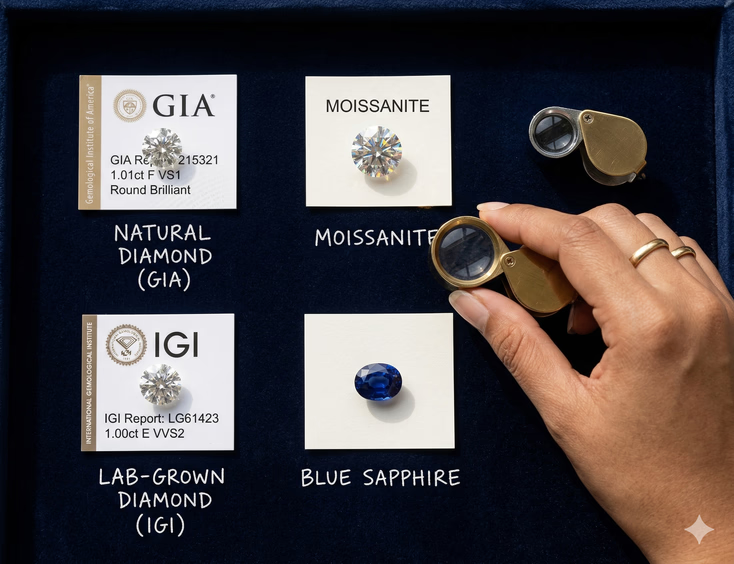
If either partner wants a stone in their ring, spend time understanding your options before you shop. The stone category has changed significantly in the Philippines in recent years, with moissanite and lab-grown diamonds now readily available from many Filipino jewelers.
Natural Diamonds
The traditional choice, and still the benchmark against which all alternatives are measured. Natural diamonds offer the deepest resale value, the strongest cultural recognition, and the undeniable romance of a stone formed by the earth over billions of years.
For Filipino couples choosing natural diamonds, the four Cs — cut, color, clarity, and carat — determine price more than any other factor. A well-cut smaller diamond will outperform a poorly cut larger one in terms of brilliance. Prioritize cut above the other three factors.
Certification matters: a diamond with a GIA or IGI grading report is a diamond whose quality has been independently verified. Any Filipino jeweler selling natural diamonds above a certain price point should be able to provide a grading certificate.
Moissanite
Silicon carbide stones that visually resemble diamonds but have a slightly higher refractive index — meaning they produce more rainbow fire than a diamond. Moissanite has become a genuinely mainstream choice among Filipino couples in recent years, particularly those working with moderate budgets who want a brilliant stone without the natural diamond price.
The honest case for moissanite in the Philippine context: the visual difference between a quality moissanite and a quality diamond is essentially invisible to the untrained eye in normal lighting conditions. For Filipino couples who want sparkle and brilliance at a fraction of diamond pricing, moissanite is a legitimate, considered choice rather than a compromise.
For the full honest assessment of whether moissanite makes sense for your specific situation, our guide on whether moissanite is worth it for Filipino couples covers everything.
Lab-Grown Diamonds
Chemically and physically identical to natural diamonds, produced in a laboratory rather than mined from the earth. Lab-grown diamonds offer significant price advantages over natural diamonds — typically 50–70% less for equivalent quality — while delivering the same visual and physical properties.
The trade-off: lab-grown diamonds have lower resale value than natural diamonds, and the price gap is expected to continue widening as production scales. If you are buying a wedding ring as a lasting emotional object rather than an investment, this trade-off is entirely manageable.
For a thorough comparison of lab-grown versus natural diamonds in the Filipino wedding context, our guide on lab-grown diamonds vs. natural diamonds for Filipino weddings gives you the complete picture.
Step 6: Get Properly Sized — on Both Hands, More Than Once
Ring sizing is the most practically consequential step in the entire process, and the one most frequently rushed.
The basic rules of Filipino ring sizing:
- Get sized on the finger you will wear the ring on — the left ring finger — not just whichever finger is most convenient
- Get sized at the end of the day, not first thing in the morning — fingers are slightly larger later in the day due to normal fluid distribution
- Get sized when you are at a comfortable temperature — fingers shrink in air conditioning and expand in heat; the Philippine climate means you will often be warm, which means your everyday ring size runs slightly larger than your air-conditioned boutique size
- Get sized on multiple occasions before committing — if your first and second measurements differ, average them or discuss with your jeweler
For stacking ring sets: If you are planning to wear multiple rings on the same finger, size with the full stack in place — the cumulative width of multiple bands affects how the size feels in wear.
For Filipino brides with active hands: Consider sizing up by a quarter size if you work in a warm environment or know your fingers swell during physical activity. A ring that fits perfectly in the morning in an air-conditioned shop may feel tight after a full workday in Quezon City heat.
Our detailed guide on wedding ring sizing for Filipino couples covers every sizing nuance in full — including how to size remotely for OFW couples and what to do if the ring arrives in the wrong size.
Step 7: Choose Your Jeweler as Carefully as You Choose Your Ring
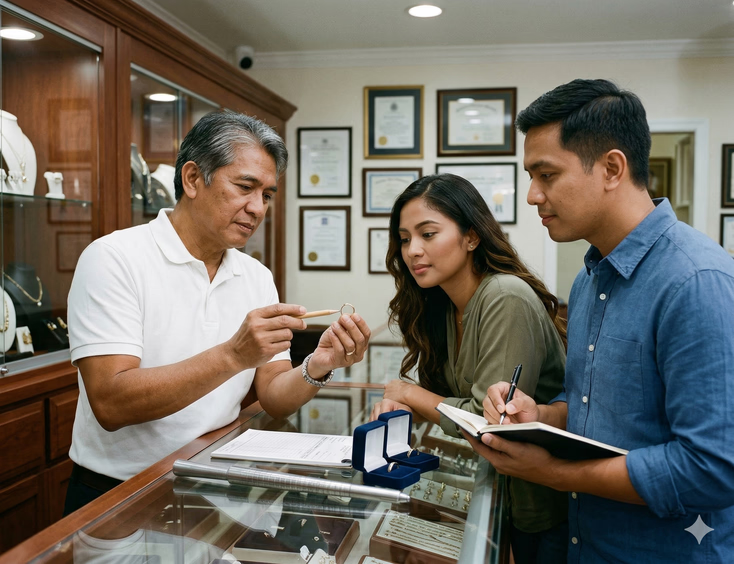
The jeweler who makes or sells your wedding ring matters as much as the ring itself. A beautiful design executed poorly by an untrustworthy jeweler is worse than a simpler design executed well by someone you genuinely trust.
What makes a Filipino jeweler trustworthy:
- Transparent about metal composition and karat — will show you the hallmark stamp and explain what it means
- Provides official receipts with complete item descriptions
- Has a clear, written warranty policy covering craftsmanship defects
- Offers professional sizing and resizing services
- Has verifiable reviews from actual past customers — not just testimonials on their own website
- Answers your questions directly and honestly, including questions about alternatives and limitations
- For custom work: provides a written work order with design specifications, timeline, and payment terms
Red flags that should make you walk away:
- Resistance to providing official receipts
- Cannot or will not show you the karat hallmark on the piece
- Dramatically lower prices than comparable pieces elsewhere, with no clear explanation
- Pressure to decide on the same visit
- No verifiable physical address or contact information
- For custom work: asks for 100% payment upfront before any work has begun
For a complete guide to protecting yourself in the Filipino jewelry market, our guide on red flags when buying wedding rings in the Philippines covers every scenario.
Step 8: Consider the Engraving Before You Buy, Not After
Most Filipino couples think about engraving after the ring is purchased — as a final personalization step. This is fine for inside-band engraving. But if you want an exterior engraving or a design element incorporated into the ring itself, this needs to be decided before production or purchase.
Ask yourself: what do you want the inside of your ring to say?
A date. A name. A Filipino word — tapat, habang buhay, mahal. A phrase from your vows. A word that only makes sense to the two of you. The inside of a wedding ring is one of the most intimate, private spaces in material life — seen only by the wearer and the person who gave it.
For a curated set of engraving ideas that resonate specifically with Filipino couples — including Filipino-language options and phrases with cultural weight — our guide on engraving ideas Filipino couples will love is the place to start.
Practical engraving note: Engraving typically adds one to two weeks to your timeline after purchase. Some jewelers offer same-day laser engraving for simpler inscriptions. Confirm the timeline and font options before committing to an inscription.
Step 9: Make the Decision — and Commit to It
After research, comparison visits, jeweler assessment, sizing, and design deliberation, there comes a point where you have enough information and the decision needs to be made.
This sounds obvious. It is, in practice, where many Filipino couples stall.
A few principles for making the final call without regret:
The best decision is the one made with sufficient information, not perfect information. You will never know everything about every ring from every jeweler in the Philippines. At some point, good-enough information plus a trusted jeweler plus a ring that genuinely feels right is the complete picture.
Trust your physical response to the ring on your hand. Not in a jewelry store photo, not in a friend's Instagram post — on your actual hand, in natural light, worn for long enough that the novelty wears off. If it still feels right after twenty minutes, that is meaningful.
The ring that feels right today in a calm moment of decision will feel right on your wedding day. The ring that felt right under the pressure of a sales pitch, or the excitement of a first visit, or the influence of a strong-opinioned ninang, is a less reliable indicator.
Once you decide, decide. The window between "we've chosen our ring" and actually paying the deposit should be short. Prolonged deliberation after a decision is made rarely changes the outcome and reliably increases anxiety.
The Question Underneath All the Steps
Every step in this guide is, ultimately, serving one question: What ring will you still be proud to wear in thirty years?
Not thirty days after the wedding, when everything is still new. Thirty years in — when you are older, when the marriage has been tested and deepened and complicated and enriched by everything that happens in a Filipino family life — when the ring has been through every ordinary Tuesday and every extraordinary crisis.
That ring is not necessarily the most beautiful one in the showcase, or the most expensive one you could afford, or the most on-trend option available right now. It is the one that was chosen honestly, with your actual life and your actual partner and your actual values as the starting point.
That is the perfect wedding ring. And the process of finding it starts with step one.
For the complete resource on Filipino wedding rings — from tradition and symbolism to styles, budgets, and where to buy — our pillar guide covers everything: The Complete Filipino Couple's Guide to Wedding Rings & Bands in the Philippines.
When you are ready to find the right jeweler, browse verified jewelry and accessories suppliers in the Philippines.
Still Searching for a Right Match?
Find Your Perfect Wedding Supplier Today!
Discover trusted wedding suppliers across the Philippines in our complete directory. Compare services and connect with the ones that fit your dream celebration.
Browse Wedding SuppliersFeatured Posts

Wedding Reception Ideas that Honor Tradition and Wow Your Guests
4 mins readFilipino Wedding Dress Guide for Style Traditions and Smart Shopping
6 mins readFilipino Wedding Cost Guide - Realistic Budgets, Percentages, and Price Drivers by Region
9 mins readPhilippines Honeymoon Guide - Best Islands, Resorts, Costs & 7–14 Day Itineraries
9 mins readFilipino Wedding Games - Traditions, Modern Twists, and Crowd-Pleasers for Every Reception
8 mins read