

Wedding Ring Sizing Guide for Filipino Couples: How to Get the Perfect Fit
Of all the things that can go wrong with a wedding ring purchase, the wrong size is the most fixable — and somehow still one of the most common problems Filipino couples encounter.
The ring arrives and it won't go past the knuckle. Or it slides off at the reception. Or it fits perfectly in the jewelry shop in January and feels uncomfortably tight by April. Or the couple ordered online, guessed at the size, and guessed wrong.
None of these situations are catastrophic. Resizing exists. Exchanges happen. But they add stress to an already full wedding planning calendar, and they are almost entirely preventable with a basic understanding of how ring sizing actually works — and why it is more nuanced than simply measuring your finger with a strip of paper and comparing it to a chart.
This guide covers everything Filipino couples need to know about getting their wedding ring size right the first time: how to measure accurately, when to measure, what affects sizing in the Philippine context specifically, how to handle sizing for stacking rings and custom orders, and what to do if a ring arrives in the wrong size.
Why Ring Sizing Is More Complicated Than It Looks
The idea of ring sizing sounds simple: measure your finger, find the corresponding number on a chart, buy that size. If that were the complete picture, this guide would be three paragraphs long.
The complication is that finger size is not a fixed measurement. It changes — sometimes significantly — based on several factors that are particularly relevant to life in the Philippines:
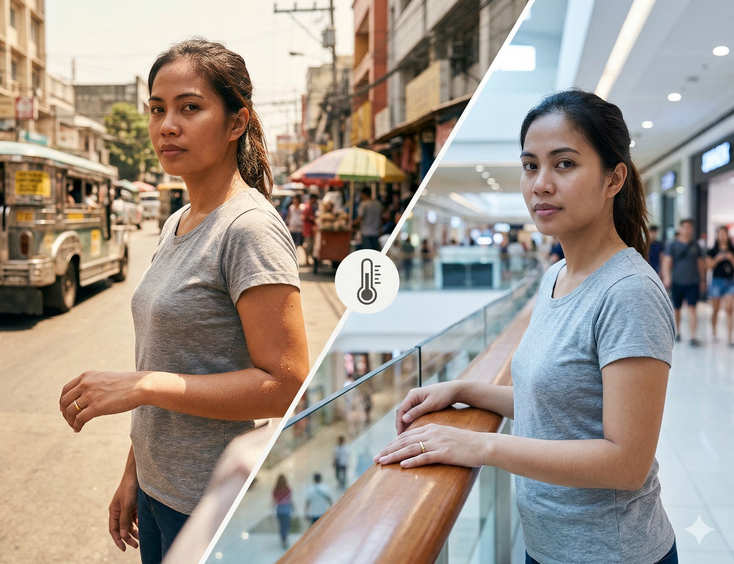
Temperature. Fingers expand in heat and contract in cold. This is a normal physiological response to temperature changes in blood vessel size. In a country where temperatures regularly reach 32–36°C and where most people move between heat outdoors and air conditioning indoors multiple times a day, a Filipino person's finger can vary by up to a full ring size between their most expanded and most contracted state.
Time of day. Fingers are typically at their smallest first thing in the morning, after sleeping in a horizontal position with little fluid accumulation in the extremities. They reach their largest in the late afternoon and evening, after a day of activity, heat exposure, and normal fluid distribution. The difference between a morning measurement and an evening measurement can be half a size to a full size.
Water retention. Sodium intake, hormonal fluctuations, and hydration levels all affect how much fluid the body retains in its extremities. For Filipino women in particular, this can cause noticeable ring size variation across a monthly cycle — some women find their rings feel tight for several days each month and loose at others.
Weight changes. Significant weight gain or loss changes finger size. This is worth noting for couples who are actively dieting or exercising for the wedding — your finger size at twelve months before the wedding may be different from your size at one month before.
Dominant hand vs. non-dominant hand. Most people's dominant hand is slightly larger than their non-dominant hand due to greater muscle development. Since Filipino Catholics wear their wedding ring on the left hand, left-handed Filipinos are wearing their ring on their dominant, larger hand — a sizing consideration worth noting.
Understanding these variables is not about making the process more complicated. It is about measuring at the right time, in the right conditions, on the right finger — so that the size you give your jeweler reflects how your hand actually lives rather than how it happened to be at one specific moment.
The Right Way to Get Your Ring Size in the Philippines
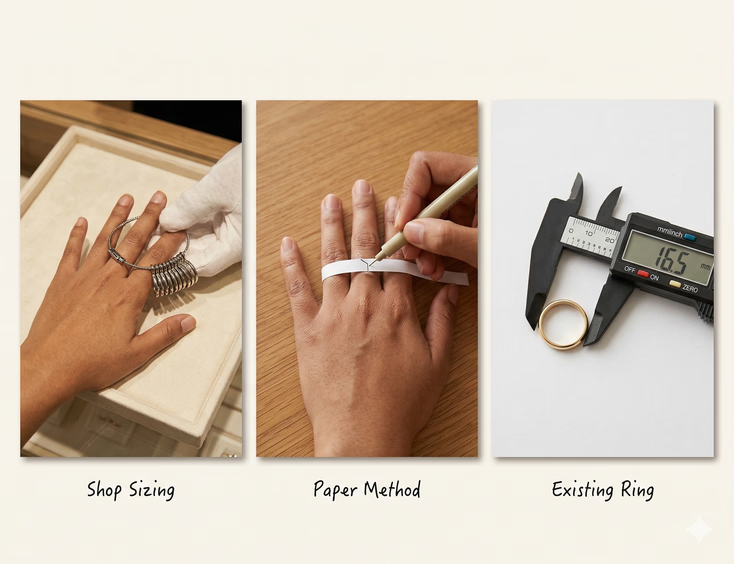
Method 1: Professional Sizing at a Jewelry Shop — The Gold Standard
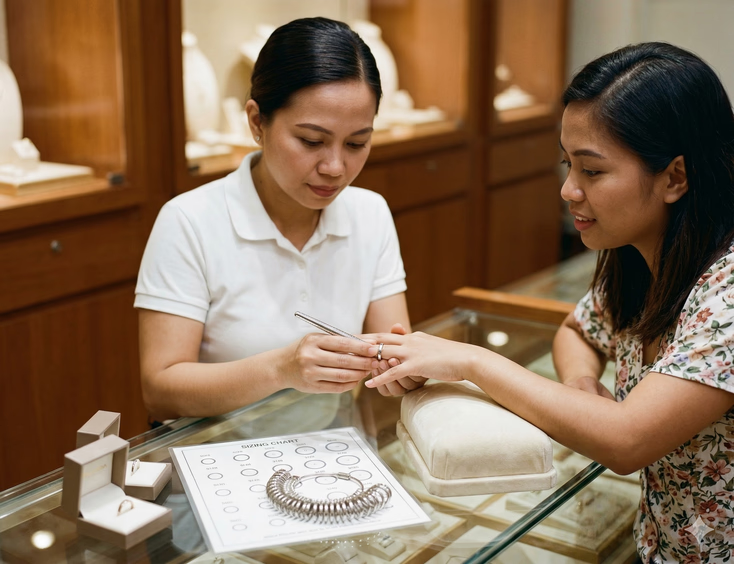
The most reliable way to find your ring size is to visit a jewelry shop and be sized by a trained staff member using professional ring sizers — a set of metal or plastic rings in graduated sizes that are slipped onto the finger to find the best fit.
How to make the most of a professional sizing visit:
Go at the right time of day. Aim for late afternoon or early evening — when your fingers are at their most typical daily size — rather than first thing in the morning when they are at their smallest.
Go at the right temperature. If possible, avoid being sized immediately after coming in from intense heat (your fingers will be expanded) or immediately after extended air conditioning (your fingers will be contracted). Give yourself fifteen to twenty minutes to reach a comfortable baseline temperature before sizing.
Size the correct finger. Ask to be sized on your left ring finger specifically — not your right ring finger, not your index finger. Finger sizes vary between fingers on the same hand, and the left ring finger is what matters for a wedding ring.
Try the sample size ring for several minutes, not several seconds. A ring that feels comfortable for the first thirty seconds may feel tight after five minutes of wear. Keep the sample on long enough to assess genuine comfort — including how it feels when you make a fist, type on a keyboard, or perform the kinds of hand movements your daily life involves.
Ask about the fit philosophy. Different jewelers have slightly different views on what constitutes a good fit. A ring should slide over the knuckle with moderate resistance — not so loose that it slides off when the hand is relaxed, and not so tight that removal requires significant effort. The knuckle is always wider than the finger base, so some resistance going over the knuckle is normal and correct.
Get sized at more than one shop. Sizing tools can vary slightly between jewelers, and it is worth confirming your measurement with a second opinion, particularly if you are planning a significant purchase.
Method 2: The String or Paper Strip Method — For Home Measurement
When a jewelry shop visit is not immediately possible — for OFW couples coordinating from abroad, for couples in areas without nearby jewelry shops, or as a preliminary measurement before a shop visit — the string or paper method gives a workable approximation.
How to do it correctly:
- Cut a thin strip of paper approximately 1cm wide and 10cm long, or use a piece of non-stretchy string or dental floss.
- Wrap it around the base of your left ring finger — snugly but not tightly. The paper should sit flat against the skin without cutting in.
- Mark where the end of the paper meets the rest of the strip — this marks the circumference of your finger at the base.
- Measure the length from the start of the strip to your mark in millimeters.
- Compare to a ring size chart. Philippine jewelry shops typically use the US sizing system (sizes 4–13 for women and men respectively) or the circumference in millimeters directly.
The critical limitation of this method: It only measures the base of your finger, not your knuckle. If your knuckle is significantly wider than your finger base — common in people with more pronounced knuckles — a ring sized to your finger base will not pass over your knuckle. In this case, size to your knuckle and expect the ring to have some movement at the base, or discuss with your jeweler about comfort-fit band options that accommodate the size difference more gracefully.
Never measure with stretchy material. Elastic, rubber bands, or stretchy tape will compress the finger and produce a measurement that is too small.
Method 3: Using a Ring You Already Own
If you own a ring that fits your left ring finger correctly — or if your partner wants to size for a surprise ring purchase — measuring an existing ring is a reliable method.
How to do it:
- Place the ring on a flat surface and measure the internal diameter — the distance across the inside of the ring at its widest point — in millimeters.
- Compare to a ring size chart using the inner diameter measurement.
Accuracy considerations: This method is only as accurate as the fit of the reference ring. A ring that fits "well enough" but is actually slightly too big or slightly too small will produce a misleading measurement. Use a ring whose fit you are genuinely confident about.
Philippine-Specific Sizing Considerations
The Heat Factor
This point deserves emphasis beyond the general temperature note above. The Philippines has one of the warmest average climates in the world, and most Filipinos spend significant portions of their day in genuine heat — commuting, working outdoors, attending outdoor events. A wedding ring sized in a heavily air-conditioned mall boutique may fit perfectly in that boutique and feel meaningfully tight on the jeepney home.
Practical guidance for Filipino ring sizing in heat:
- If you are regularly in hot environments for significant parts of your day, size slightly larger than your air-conditioned measurement — a quarter size up is often appropriate
- If you are predominantly in air-conditioned environments (office worker, stays mostly indoors), your boutique measurement is more representative
- If you are unsure, size at different times and in different temperature conditions on multiple occasions, and discuss with your jeweler what to do when the measurements vary
The best jewelers in the Philippines understand this issue and will ask about your lifestyle when discussing sizing. A jeweler who simply records your measurement without any conversation about your daily environment is missing relevant information.
Knuckle-to-Base Ratio in Filipino Hands
Filipino women, on average, have relatively slender finger bases with proportionally more pronounced knuckles — a combination that creates a genuine sizing challenge. A ring sized to the knuckle fits over the finger correctly but moves around at the base. A ring sized to the base cannot be put on or removed comfortably.
Solutions for this common Filipino sizing challenge:
Comfort-fit bands: The domed interior profile of a comfort-fit band requires less force to slide over the knuckle than a flat-interior band of the same size, allowing the ring to be sized closer to the finger base while remaining removable.
Sizing beads: Small metal beads added to the interior bottom of the ring by a jeweler, which reduce the effective inner diameter at the base without changing the knuckle-passing diameter. Invisible from outside, effective for rings that need to stay in place.
Spring inserts: A small metal spring fitted inside the band that expands for knuckle passage and contracts to grip the finger base. More mechanical than sizing beads but very effective for significant knuckle-to-base discrepancies.
Discuss this explicitly with your jeweler. Filipino jewelers who work regularly with bridal rings are familiar with this issue and will have a preferred solution. Do not accept a ring that fits your knuckle but spins freely on your finger without discussing adjustment options.
OFW Couples: Sizing Across Distance
A specific and genuinely common challenge in the Philippines: one partner is working abroad and cannot be physically present for ring shopping and sizing. Getting the sizing right without being in the same room as the jeweler requires extra care.
Reliable options for OFW couples:
Option 1: Size locally abroad and convert. Have the partner abroad visit a jewelry shop in their current country and get sized. Record the measurement in millimeters (inner circumference) rather than the local sizing system, which may differ from Philippine sizing. Provide this millimeter measurement to the Philippine jeweler.
Option 2: Use the existing ring method. If the partner abroad owns a ring that fits their left ring finger correctly, measure its inner diameter precisely and send the measurement to the Philippine jeweler.
Option 3: Size on a home trip and order then. If the OFW partner will be home before the ordering deadline, hold off on placing the custom order until they can be sized in person. For ready-made rings, the option of sizing and resizing after delivery is manageable.
Option 4: Order slightly large and resize. For custom orders where remote sizing is unavoidable, some couples order deliberately slightly larger than their estimated size — knowing resizing down is easier and less costly than resizing up — and have the ring adjusted after delivery.
Sizing for Different Ring Types
Not all rings size the same way. The type of ring you are purchasing affects how sizing works and what tolerances are acceptable.
Plain Bands
The most straightforward sizing scenario. A plain band can be resized up or down by most jewelers within a reasonable range (typically two to three sizes in either direction) without compromising the ring. The process involves cutting the band and adding or removing metal, then soldering and refinishing the cut point.
Pavé and Stone-Set Bands
Bands with stones set around the circumference — pavé bands, eternity bands — are significantly more complex to resize because the stones must be removed, the metal adjusted, and the stones reset. Many jewelers will not resize a full eternity band at all; a half eternity band can be resized more easily if the adjustment is made on the stoneless portion.
Practical guidance: If you are buying a pavé or eternity band, invest more time in getting the size right before purchase. The cost and complexity of resizing is higher than for a plain band, and some styles cannot be resized at all.
Stackable Ring Sets
When multiple rings will be worn together on the same finger, size the full stack rather than individual rings. The cumulative width of multiple bands creates a different feel than each ring worn alone — most people need to size slightly larger for a stack than for a single ring. Ideally, try on the full intended stack configuration during your sizing visit.
Custom-Made Rings
For custom rings, sizing precision is especially important because the production process involves more work than a ready-made ring, and resizing a custom piece after completion adds both cost and timeline. Get sized multiple times before confirming a size for a custom order, and explicitly confirm the size with your jeweler in writing as part of the work order.
Alternative Metal Rings (Tungsten, Titanium)
These metals cannot be resized — period. The crystal structure of tungsten and titanium does not respond to the same thermal and mechanical processes used to resize precious metals. A tungsten or titanium ring in the wrong size must be replaced, not adjusted.
For Filipino grooms choosing alternative metals: Size with exceptional care. Size multiple times. Size in different conditions. And size slightly larger rather than smaller — a ring that is slightly loose is uncomfortable but wearable; a ring that is too tight may not be removable in an emergency, which is a genuine medical concern.
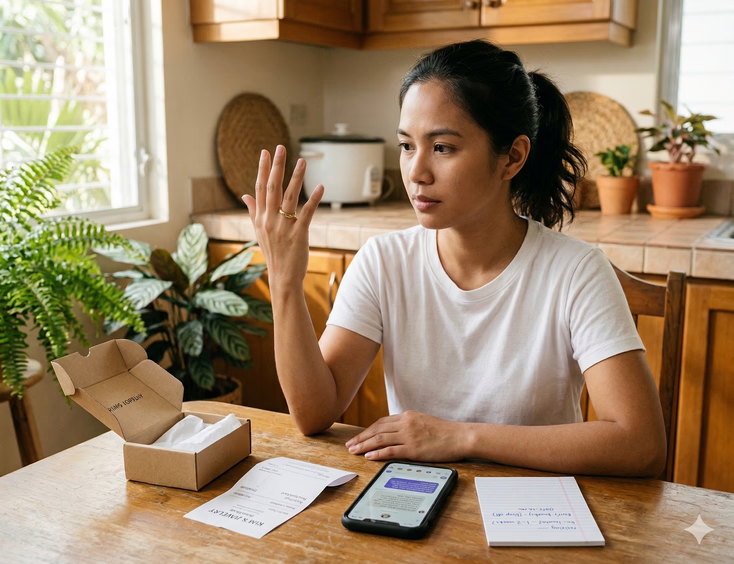
What to Do If Your Ring Arrives in the Wrong Size
Despite best efforts, rings sometimes arrive in the wrong size. Here is what to do.
Step 1: Confirm it is actually the wrong size, not just an adjustment period.
A new ring often feels unfamiliar for the first few days of wear — slightly tighter or looser than expected simply because you are not used to having something on that finger. Wear the ring for three to five days before deciding it needs resizing. If after that period it is genuinely too tight or too loose, proceed.
Step 2: Return to your jeweler immediately.
Do not wait. Every week you delay is a week closer to your wedding date. Contact the jeweler, explain the issue, and schedule a resizing appointment. A reputable jeweler will resize a ring that was sized incorrectly without significant dispute.
Step 3: Understand the resizing timeline.
Standard resizing at Philippine jewelry shops takes one to two weeks. During peak wedding season (November to February), it may take longer. Factor this into your wedding timeline — this is one reason our wedding ring shopping timeline guide recommends collecting your rings at least six to eight weeks before the wedding.
Step 4: Know the limits of resizing.
Most plain gold bands can be resized up or down by two to three sizes without visible evidence of the adjustment. Going beyond this range can weaken the ring structurally or leave visible marks at the solder point. If you need a significant size change, discuss honestly with your jeweler whether resizing is the right solution or whether a new ring in the correct size is more appropriate.
A Quick Reference: Ring Sizing Do's and Don'ts for Filipino Couples
| Do | Don't |
|---|---|
| Get sized in the late afternoon or evening | Size first thing in the morning |
| Size on your left ring finger specifically | Size on whichever finger is most convenient |
| Get sized at a comfortable indoor temperature | Size immediately after being in intense heat or cold |
| Try the sample ring for at least five minutes | Decide on size after thirty seconds |
| Get sized on multiple occasions before a custom order | Rely on a single measurement for a custom ring |
| Discuss your daily lifestyle with your jeweler | Give a size without context about your environment |
| Size the full stack for stackable rings | Size individual rings separately when planning a stack |
| Order slightly large if unsure — resizing down is easier | Order small and hope for the best |
| Confirm your size in writing on the work order | Rely on a verbal size confirmation for custom work |
The Ring That Fits Is the Ring You'll Never Want to Take Off
A wedding ring in the perfect size disappears into your daily life in the best possible way — it is always there, always comfortable, never calling attention to itself through tightness or movement or the anxiety of feeling it might slip off.
That comfort is not accidental. It is the result of taking sizing seriously, measuring in the right conditions, communicating clearly with your jeweler, and giving yourself enough time to address any adjustments before the wedding day.
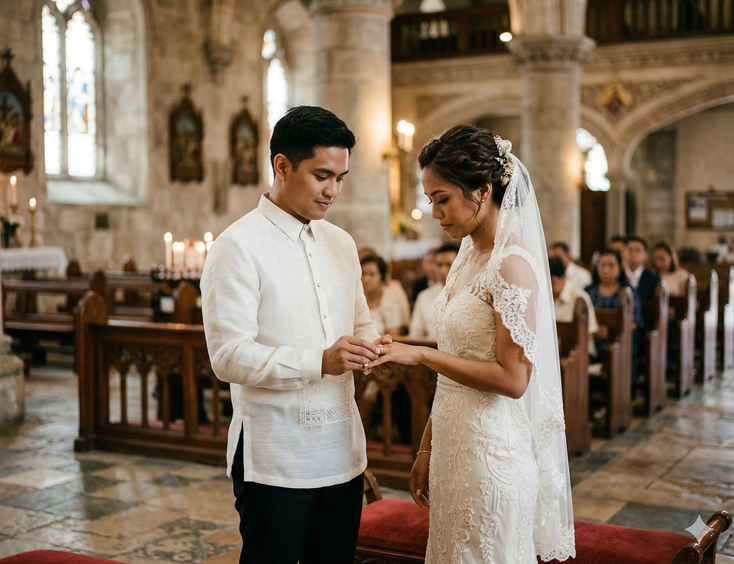
The ring you exchange at the altar deserves to fit perfectly. The process of ensuring that is straightforward — it just requires knowing what you are doing.
For everything else you need to know about choosing, buying, and wearing your wedding rings in the Philippines, our complete guide is the place to start: The Complete Filipino Couple's Guide to Wedding Rings & Bands in the Philippines.
When you are ready to find a jeweler you trust for sizing and purchase, browse verified jewelry and accessories suppliers in the Philippines.
Still Searching for a Right Match?
Find Your Perfect Wedding Supplier Today!
Discover trusted wedding suppliers across the Philippines in our complete directory. Compare services and connect with the ones that fit your dream celebration.
Browse Wedding SuppliersFeatured Posts





Wedding Reception Ideas that Honor Tradition and Wow Your Guests
4 mins readFilipino Wedding Dress Guide for Style Traditions and Smart Shopping
6 mins readFilipino Wedding Cost Guide - Realistic Budgets, Percentages, and Price Drivers by Region
9 mins readPhilippines Honeymoon Guide - Best Islands, Resorts, Costs & 7–14 Day Itineraries
9 mins readFilipino Wedding Games - Traditions, Modern Twists, and Crowd-Pleasers for Every Reception
8 mins read