

Lab-Grown Diamonds vs. Natural Diamonds for Filipino Weddings: Which Should You Choose?
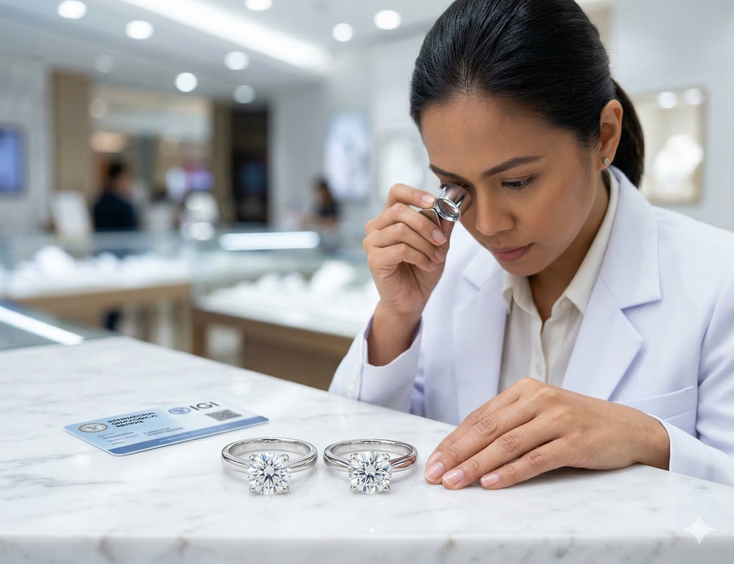
A lab-grown diamond and a natural diamond are the same stone. Same carbon structure, same hardness, same brilliance. A gemologist with standard equipment cannot tell them apart. The difference is origin — and price.
Lab-grown diamonds cost 60 to 80 percent less than natural diamonds of the same grade. Filipino couples who understand what that means make a very different purchase than couples who assume lab-grown means lesser.
This guide covers the science, the pricing, the Philippine market, and the four questions that actually determine which diamond belongs on your finger.
What Lab-Grown Diamonds Actually Are
A lab-grown diamond is a diamond. Carbon atoms arranged in a crystal lattice structure, identical to what forms under the earth's mantle over billions of years. The difference is that a laboratory replicates that process in weeks rather than millennia.
Two methods produce lab-grown diamonds commercially.
High Pressure High Temperature (HPHT). A diamond seed is placed inside a chamber that applies pressure exceeding 1.5 million pounds per square inch alongside temperatures above 1,400 degrees Celsius. Carbon dissolves and crystallizes around the seed, building a diamond layer by layer. HPHT diamonds sometimes carry a slight yellow or blue tinge depending on the nitrogen and boron content of the growth environment.
Chemical Vapor Deposition (CVD). A diamond seed sits inside a chamber filled with carbon-rich gas. Microwaves or lasers ionize the gas, causing carbon atoms to deposit onto the seed and build a diamond crystal. CVD produces diamonds in a wider range of sizes with fewer color variations than HPHT. Most colorless lab-grown diamonds sold in Philippine jewelry stores today are CVD-grown.
Neither method produces a synthetic gemstone or a simulant. Moissanite is a simulant — it looks like a diamond but carries a different chemical composition. A lab-grown diamond is chemically, physically, and optically identical to a mined diamond. The Federal Trade Commission in the United States amended its jewelry guidelines in 2018 to confirm that lab-grown diamonds qualify as real diamonds. Philippine jewelry industry standards follow the same position.
How Lab-Grown and Natural Diamonds Compare
On every property that determines a diamond's performance as a gemstone, lab-grown and natural diamonds produce identical results.
| Property | Lab-Grown Diamond | Natural Diamond |
|---|---|---|
| Chemical composition | Pure carbon (C) | Pure carbon (C) |
| Crystal structure | Cubic | Cubic |
| Mohs hardness | 10 | 10 |
| Refractive index | 2.42 | 2.42 |
| Thermal conductivity | Identical | Identical |
| Fire and brilliance | Identical | Identical |
| Grading scale | 4Cs (same as natural) | 4Cs |
| Detectable difference | Specialized equipment only | N/A |
The one technical difference visible under specialized laboratory equipment: lab-grown diamonds occasionally show distinct growth patterns under high-magnification spectroscopy that a trained gemologist with the right tools can identify. Standard jeweler's loupes, consumer diamond testers, and naked-eye examination do not reveal this difference. A jeweler holding your ring at a church blessing cannot tell which type of diamond sits in the setting.
The Price Gap in the Philippines
This is where the two diamonds diverge significantly.
Natural Diamond Prices (Philippines, current estimates)
| Carat | Color/Clarity | Estimated Philippine Retail Price |
|---|---|---|
| 0.30 ct | G, SI1 | ₱25,000 to ₱55,000 |
| 0.50 ct | G, SI1 | ₱50,000 to ₱120,000 |
| 0.75 ct | G, SI1 | ₱90,000 to ₱200,000 |
| 1.00 ct | G, SI1 | ₱150,000 to ₱350,000 |
| 1.50 ct | G, SI1 | ₱280,000 to ₱600,000 |
Lab-Grown Diamond Prices (Philippines, current estimates)
| Carat | Color/Clarity | Estimated Philippine Retail Price |
|---|---|---|
| 0.30 ct | G, SI1 | ₱6,000 to ₱15,000 |
| 0.50 ct | G, SI1 | ₱10,000 to ₱28,000 |
| 0.75 ct | G, SI1 | ₱18,000 to ₱45,000 |
| 1.00 ct | G, SI1 | ₱25,000 to ₱70,000 |
| 1.50 ct | G, SI1 | ₱45,000 to ₱110,000 |
Prices in both tables reflect stones sold through Philippine retail jewelers and include basic setting costs for a standard solitaire in 18K gold. Stones purchased loose and set separately at a Meycauayan goldsmith cost less than the retail figures above.
The gap between the two tables is not a rounding difference. A one-carat natural diamond at the mid-point of its Philippine retail range costs approximately ₱250,000. A one-carat lab-grown diamond of the same grade at its mid-point costs approximately ₱47,500. The saving on a single stone approaches ₱200,000.
Filipino couples who apply that ₱200,000 to a honeymoon, a house down payment, or their combined emergency fund are making a financial decision, not a compromised one.
For a full breakdown of how diamond costs sit within your overall ring budget, read our realistic wedding ring cost guide for the Philippines.
Certification: What Papers You Need and Why
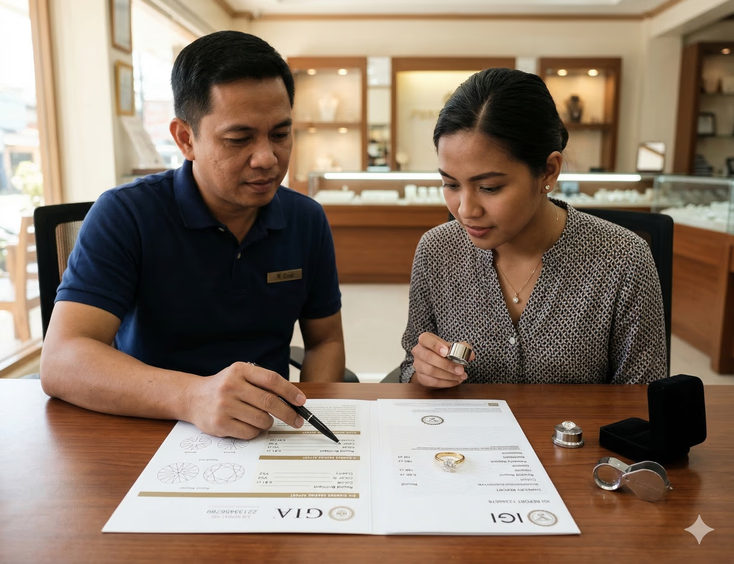
A diamond without a certificate is a stone without verified identity. This applies to both lab-grown and natural diamonds.
GIA (Gemological Institute of America) issues grading reports for both natural and lab-grown diamonds. Their lab-grown reports carry a different document design from natural diamond reports and include a notation identifying the growth method. GIA is the most recognized certificate name among Philippine jewelers and couples.
IGI (International Gemological Institute) grades lab-grown diamonds extensively and is the certificate most commonly attached to lab-grown stones sold in the Philippines. IGI reports are accepted by reputable Philippine jewelers and carry sufficient authority for resale documentation.
SGL (Solitaire Gemmological Laboratories) and other regional labs issue certificates accepted by some Philippine retailers. These carry less international recognition than GIA or IGI.
What to ask for: Any natural diamond above 0.30 carats should carry a GIA or IGI certificate. Any lab-grown diamond above 0.30 carats should carry an IGI or GIA certificate. Below 0.30 carats, a jeweler's in-house grading and a written receipt specifying color and clarity grades are acceptable.
A certificate does three things. It verifies the stone's grade matches what you paid for. It protects you in a resale or insurance claim. It gives your jeweler a documented reference for future repairs or settings.
Philippine jewelers who sell uncertified diamonds above 0.30 carats and cannot explain why are asking you to trust their verbal assessment over independent verification. That is a position worth questioning before you hand over ₱80,000.
What the Philippine Jewelry Market Currently Offers
Lab-grown diamonds have entered the Philippine jewelry market in meaningful volume in recent years. Before that, moissanite was the primary diamond alternative stocked by Philippine jewelers. The two now coexist, serving different buyer profiles.
Manila retailers. Independent ateliers and multi-brand stores in BGC, Makati, and Quezon City now stock lab-grown diamonds alongside natural stones. Several Manila jewelers have built dedicated lab-grown diamond product lines after noticing that couples in the ₱30,000 to ₱80,000 ring budget could access stones previously available only to couples spending ₱200,000 and above.
Mall stores. Philippine mall-based jewelry chains have been slower to adopt lab-grown diamonds than independent jewelers. Some chains stock them in limited designs. Others continue to focus on natural diamonds. This is changing — mall retailers respond to demand, and Filipino couple demand for lab-grown diamonds has grown consistently in recent years.
Meycauayan goldsmiths. Custom lab-grown diamond rings from Meycauayan represent the lowest-cost path to a certified lab-grown stone in a quality setting. You source a certified stone from a verified supplier, bring it to a Meycauayan goldsmith with your setting design, and pay wholesale labor rates for the finished ring. Filipino couples comfortable with this two-step process access the best value in the country.
For guidance on navigating Meycauayan as a buyer, read our Meycauayan wedding ring buyer's guide.
Online. Philippine-based online jewelry sellers on Shopee, Lazada, and social media increasingly list lab-grown diamonds. Verification is essential. Ask every online seller for the stone's IGI or GIA certificate number, which you can verify independently on the issuing lab's website before purchase.
Browse verified Philippine jewelry suppliers, including those specializing in lab-grown diamonds, on our Jewelry & Accessories supplier directory.

The Investment Question Filipino Couples Ask
Filipino couples — and their families — frequently raise this point: natural diamonds hold their value, lab-grown diamonds don't. The reality is more specific than that framing suggests.
Natural diamond resale value. Natural diamonds lose 20 to 40 percent of their retail value the moment you walk out of the jewelry store. A ₱250,000 natural diamond ring resells on the Philippine secondhand market for ₱100,000 to ₱180,000 under most conditions. Exceptional stones — D color, IF clarity, above two carats with GIA certification — retain value better than mid-grade stones but still depreciate from retail price. Natural diamonds are not liquid assets. They are durable goods that hold value better than most consumer purchases.
Lab-grown diamond resale value. Lab-grown diamond prices have fallen significantly as global production volume has increased. A lab-grown diamond purchased today will likely resell for significantly less than its purchase price in five years. The Philippine secondary market for lab-grown diamonds is currently thin — fewer buyers, lower prices, longer selling periods than natural diamonds.
The practical conclusion. Filipino couples who buy wedding rings as financial investments rather than personal jewelry face the same basic reality with both stone types — neither performs like a stock or a property. The gap between the two is that natural diamonds depreciate from retail more slowly than lab-grown diamonds on the current trajectory. Couples who factor long-term value into their ring decision should understand that advantage belongs to natural diamonds, while acknowledging that neither stone is a reliable store of wealth.
Couples who buy a ring to wear for decades and don't plan to sell it will find this distinction less meaningful than couples who think of the ring as a recoverable asset.
What Your Family Will Think
The Filipino family conversation about lab-grown diamonds follows a predictable pattern. Someone raises the question. A debate follows. The couple explains. The family forms a position.
What the ring looks like to guests: Identical to a natural diamond ring of the same grade. No wedding guest, relative, or ninong distinguishes lab-grown from natural by looking at the ring on your finger. Both produce the same brilliance and fire under the same lighting conditions.
What older relatives think: Filipino parents and grandparents who equate diamond rings with permanence and sacrifice may resist lab-grown diamonds on principle. Their position often comes from the belief that a natural diamond required real effort to acquire, and that this effort carries meaning. This is a cultural conversation rather than a gemological one. Bringing the IGI certificate, showing them the stone's grade, and explaining that they are holding a chemically identical diamond tends to move the conversation productively.
How other couples respond: Filipino couples in the 25 to 35 age range have normalized lab-grown diamonds at a faster pace than older generations. If your wedding community consists primarily of peers, expect less friction than if your family's opinion drives the social dynamic around your ring choice.
The disclosure question: Telling people your ring contains a lab-grown diamond is your choice. It is not legally required and carries no social obligation. Some couples disclose proactively because they're proud of the decision. Others treat it as private. Neither approach is wrong.
Environmental Considerations
Diamond mining carries documented environmental costs: land disruption, water use, carbon emissions from heavy mining equipment, and in some regions, labor practices that international watchdog organizations have flagged.
Lab-grown diamond production requires significant energy — the HPHT and CVD processes run at extreme temperatures and pressures continuously. The environmental benefit of lab-grown over mined diamonds depends substantially on the energy source powering the production facility. A lab running on renewable energy produces a genuinely lower-carbon diamond. A lab running on coal-powered electricity narrows that advantage considerably.
Filipino couples making environmental arguments for lab-grown diamonds should ask their jeweler whether the stone carries any documentation of the production facility's energy sourcing. Few Philippine retailers currently provide this level of detail, but the question is worth asking as the market matures.
Ethically sourced natural diamonds carry Kimberley Process certification, which tracks the diamond's origin to reduce conflict stone trading. Ask for Kimberley Process documentation when buying a natural diamond from any Philippine jeweler.
Who Should Choose Lab-Grown
Couples who want a larger, higher-grade stone on a realistic budget. A one-carat D-color, VVS1 lab-grown diamond costs ₱35,000 to ₱80,000 from a Philippine jeweler. The same stone in natural costs ₱400,000 to ₱800,000. If graded quality and visual impact matter more than stone origin, lab-grown delivers the better result per peso spent.
Couples who've compared both in person and prefer the value allocation. Filipino couples who visit a jeweler, view both stone types side by side, confirm they look identical under store lighting, and choose to allocate the saving elsewhere have made a rational and informed decision.
Couples buying rings on a defined budget with no family contribution. Many Filipino couples fund their own wedding without financial support from parents or relatives. Within a self-funded budget, lab-grown diamonds allow a higher-grade, larger stone than natural diamonds at the same price point.
Couples who plan to upgrade later. A lab-grown diamond ring purchased at ₱45,000 today can serve as a wearing ring for five to ten years while the couple saves toward a natural diamond if they decide to upgrade on a milestone anniversary. The lab-grown ring's lower cost means the financial commitment stays proportionate to where the couple is in their financial life.
Couples who prioritize grade over origin. A D-color, internally flawless lab-grown diamond looks superior under all viewing conditions to a J-color, SI2 natural diamond at the same price point. Couples who want the best visual result per peso favor lab-grown at mid-range budgets.
Who Should Choose Natural
Couples where one partner feels a specific connection to natural diamonds. Some brides have wanted a natural diamond since they were teenagers. That preference is not irrational sentimentality — it's a genuine value that deserves respect. A ring your partner loves wearing beats a ring that represents the optimal financial decision.
Couples treating the ring as a long-term value asset. Natural diamonds depreciate from retail but hold a functioning secondary market in the Philippines. If resale value matters to you — because your financial situation might change, or because you plan to pass the ring to a future generation — natural diamonds carry that advantage.
Couples receiving family contributions earmarked for a natural diamond. Filipino families who contribute financially to a couple's rings sometimes specify that the contribution goes toward a natural diamond. Accepting the contribution and the specification, or having a transparent conversation about alternatives, is a decision for the couple and their family rather than a question a guide resolves.
Couples with access to a trusted Philippine jeweler who sources certified natural diamonds at competitive prices. Independent Manila jewelers and Meycauayan goldsmiths who work directly with diamond importers sometimes offer natural diamonds at prices closer to the wholesale end of the retail range. If your jeweler sources well and prices fairly, the gap between lab-grown and natural narrows.
Couples who want the rarity narrative. Natural diamonds formed over billions of years. Some couples and families attach meaning to that rarity regardless of its practical implications for the ring's appearance. This is a values question rather than a gemological one, and values questions have no wrong answer.
The Four Questions That Decide It
Strip away the market information, the family dynamics, and the environmental data. Four questions determine which diamond fits your specific situation.
Question 1: Does your partner care about stone origin? If your partner has a clear preference for a natural diamond, start there and find the best natural diamond your budget allows. If your partner is open to either type, move to the next question.
Question 2: What does your budget allow at your preferred carat weight and grade? Decide your carat weight target and your preferred color and clarity grade. Check prices for both lab-grown and natural at those specifications using the tables in Section 3. If natural falls within your ceiling, you have a choice. If natural exceeds your ceiling and lab-grown fits comfortably, the budget makes your decision.
Question 3: Have you seen both stones in person? Do not commit to either stone type from a photograph or a screen. Visit a jeweler who stocks both, view them under store lighting and natural light, and confirm your reaction to each. Some couples see lab-grown and natural diamonds side by side and cannot distinguish them. Others notice subtle differences in person that photos never reveal.
Question 4: How much does your family's opinion weigh in this decision? Filipino couples who make ring decisions independently of family opinion navigate this choice differently than couples whose families hold significant influence over wedding decisions. Assess your specific family dynamic honestly before you buy, because a ring that creates ongoing family friction costs more than its price tag suggests.
Answer those four questions and your decision emerges from your own situation rather than from a guide's general recommendation.
For couples considering moissanite as a third option alongside both diamond types, read our guide on moissanite for Filipino couples.
For strategies on getting the most value from whichever stone you choose, read our guide on how to save on wedding rings in the Philippines without sacrificing quality.
Browse verified jewelry suppliers across the Philippines on our Jewelry & Accessories supplier directory.
For a broader overview of the entire ring-buying process, return to our complete guide to wedding rings in the Philippines.
Still Searching for a Right Match?
Find Your Perfect Wedding Supplier Today!
Discover trusted wedding suppliers across the Philippines in our complete directory. Compare services and connect with the ones that fit your dream celebration.
Browse Wedding SuppliersFeatured Posts


Wedding Reception Ideas that Honor Tradition and Wow Your Guests
4 mins readFilipino Wedding Dress Guide for Style Traditions and Smart Shopping
6 mins readFilipino Wedding Cost Guide - Realistic Budgets, Percentages, and Price Drivers by Region
9 mins readPhilippines Honeymoon Guide - Best Islands, Resorts, Costs & 7–14 Day Itineraries
9 mins readFilipino Wedding Games - Traditions, Modern Twists, and Crowd-Pleasers for Every Reception
8 mins read