


Red Flags When Buying Wedding Rings in the Philippines (How to Avoid Scams & Fake Jewelry)
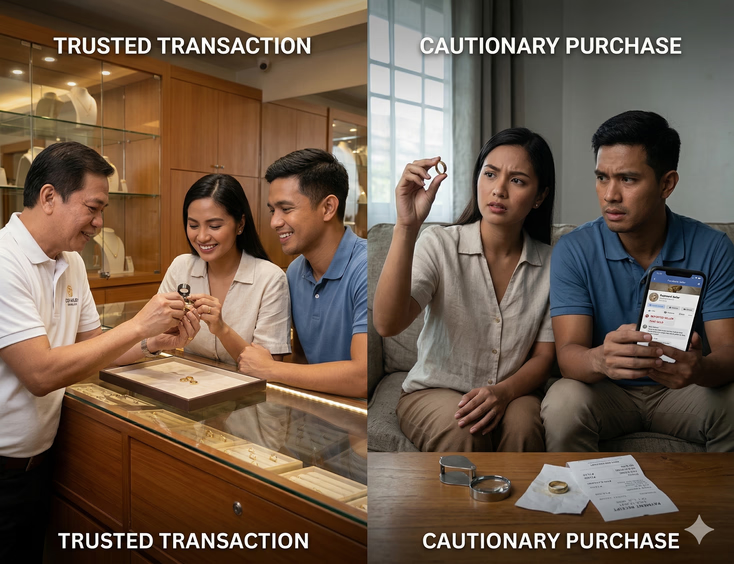
Every year, Filipino couples lose money — sometimes significant amounts of money — to jewelry purchases that were not what they appeared to be.
Some are outright scams: rings sold as 18k gold that are gold-plated brass. Diamonds that are cubic zirconia. Custom orders paid in full that are never delivered. Social media sellers who disappear after the bank transfer clears.
Others are subtler: a ring sold as 14k gold that is actually 10k. A "certified diamond" whose certificate was printed at home. A custom jeweler whose "three-week timeline" becomes six months of excuses. A mall kiosk that charges boutique prices for mall-kiosk quality.
None of these situations are inevitable. They happen to Filipino couples not because the couples are naive or careless, but because they did not know what specific warning signs to look for — and because scammers and low-quality sellers have learned exactly how to present themselves to couples who are excited, time-pressured, and emotionally invested in finding beautiful rings.
This guide exists to close that information gap. It covers every major red flag across every buying scenario Filipino couples encounter — mall shops, independent jewelers, social media sellers, online platforms, and custom orders — with specific, actionable guidance on how to protect yourself without becoming so suspicious that you cannot enjoy the process of finding your rings.
The goal is not paranoia. The goal is informed confidence.
Why Filipino Couples Are Particularly Vulnerable to Jewelry Scams
Understanding why this problem is prevalent in the Philippine jewelry market helps calibrate the right level of vigilance.
The excitement factor. Engagement and wedding planning produce a specific kind of emotional state — joyful, forward-looking, slightly overwhelmed — that makes careful scrutiny harder. Scammers and low-quality sellers understand this and target couples in peak planning mode, when the desire to check something off the list overrides the patience to check it thoroughly.
The trust culture. Filipino culture places high value on personal relationships and interpersonal trust. A seller who comes recommended by a friend of a cousin, who is warm and friendly in their messaging, who calls you ate or kuya — this person feels trustworthy in the Filipino social context. That social fluency is sometimes genuine. Sometimes it is deployed deliberately to bypass the skepticism that should apply to any significant financial transaction.
The digital marketplace expansion. The explosive growth of Shopee, Lazada, Facebook Marketplace, and Instagram as jewelry retail channels has dramatically expanded access — and dramatically complicated the verification of seller legitimacy. A professional-looking Facebook page with hundreds of positive comments can be created and populated in a weekend. It tells you very little about the quality or trustworthiness of what you are actually buying.
The knowledge gap. Most Filipino couples buying their first wedding rings do not know what a karat hallmark stamp looks like, what a legitimate diamond certificate says, what fair market pricing is for a specific configuration of metal and stone, or what a legal official receipt must contain. Sellers who operate in bad faith rely on this knowledge gap entirely.
This guide closes it.

Red Flags at Physical Jewelry Shops (Mall and Independent)
Physical shops — whether in SM, Abreeza, a local mall, or an independent boutique — are the most regulated part of the Philippine jewelry market and the lowest-risk buying environment. But low risk is not no risk. These red flags apply to any physical jewelry purchase.
Red Flag 1: The Shop Cannot Show You the Karat Hallmark on the Piece Itself
Every legitimate piece of gold jewelry should carry a hallmark stamp — a small mark on the metal itself (usually on the inside of the band) indicating its karat purity. In the Philippines:
- 10k gold = 417 hallmark
- 14k gold = 585 hallmark
- 18k gold = 750 hallmark
- Platinum = 950 or PT950 hallmark
If a sales staff member tells you a ring is 18k gold but cannot show you the 750 stamp on the ring itself — or tells you "it's there but very small" and cannot direct you to it with a loupe — this is a problem. The hallmark is not optional. A ring without a verifiable hallmark is a ring whose metal content cannot be confirmed.
What to do: Ask specifically to see the hallmark stamp. Ask for a loupe if needed. If the stamp is absent or unclear, walk away or move to a different piece.
Red Flag 2: Refusal to Provide an Official Receipt with Full Item Description
A legitimate jewelry purchase in the Philippines should produce an official receipt (OR) — a BIR-registered receipt that is a legal document. The OR should include:
- The name and TIN of the seller
- The date of purchase
- A description of the item: metal type, karat, approximate weight, and stone details if applicable
- The price paid
A seller who tells you they "don't have official receipts" or who offers only a handwritten acknowledgment receipt (AR) rather than a BIR-registered OR is either operating outside legal registration requirements or deliberately avoiding a paper trail. Neither is acceptable for a significant jewelry purchase.
Why this matters beyond legality: The official receipt is your documentation if you need to return, exchange, or make a warranty claim. Without it, you have no enforceable record of what you purchased and what you paid.
Red Flag 3: Verbal-Only Assurances About Stone Quality
If a ring contains a diamond or gemstone, any claim about that stone's quality — carat weight, color grade, clarity grade — should be backed by written documentation, not just the sales staff member's word.
For diamonds above a certain size (typically 0.30ct and above), a GIA (Gemological Institute of America) or IGI (International Gemological Institute) grading report is the standard. This is a document issued by an independent laboratory, not by the seller, that independently verifies the stone's specifications.
A sales staff member who says "it's a VS1 clarity, G color" without a certificate to support this claim is making an unverifiable assertion. You have no way to confirm it is true, and they have no accountability if it is not.
What to ask: "Does this stone come with a grading certificate?" For smaller stones where full GIA certification is not standard, ask for whatever documentation exists — even a seller's own stone specification card is better than a verbal claim alone.
Red Flag 4: Pricing Dramatically Below Market Without Explanation
If a ring's price is significantly lower than what you have seen for comparable specifications at other shops — same metal karat, same stone size and quality, similar craftsmanship — ask why.
Sometimes there is a legitimate reason: the shop has lower overhead, is running a genuine sale, or sources differently. A good jeweler will explain this readily. But dramatic underpricing without explanation often signals one of two things: the piece is not what it is claimed to be (lower karat than stated, lower-quality stone, or both), or the business model relies on volume sales with quality shortcuts.
The benchmark test: Before shopping for your wedding rings, do enough comparison research to know what fair market price looks like for your specifications. Our realistic wedding ring budget guide gives you this baseline. Use it.
Red Flag 5: High-Pressure Sales Tactics
A jeweler who uses urgency, scarcity, or emotional pressure to accelerate your purchasing decision is a jeweler who does not trust their product to sell itself on its merits.
Specific pressure tactics to watch for:
- "This is the last one in this size — someone else was looking at it yesterday"
- "The price goes up next week — you should buy today"
- "Your wedding is coming, you don't want to wait"
- "Most couples at your budget choose this one" (said while steering you toward a higher-priced option)
A genuinely good jeweler who is confident in their product and their pricing will give you time to think, encourage you to compare, and welcome you back on a second visit. Pressure to decide on the same day is almost always a sign that the seller is more interested in closing than in serving.
Red Flags with Social Media and Online Jewelry Sellers
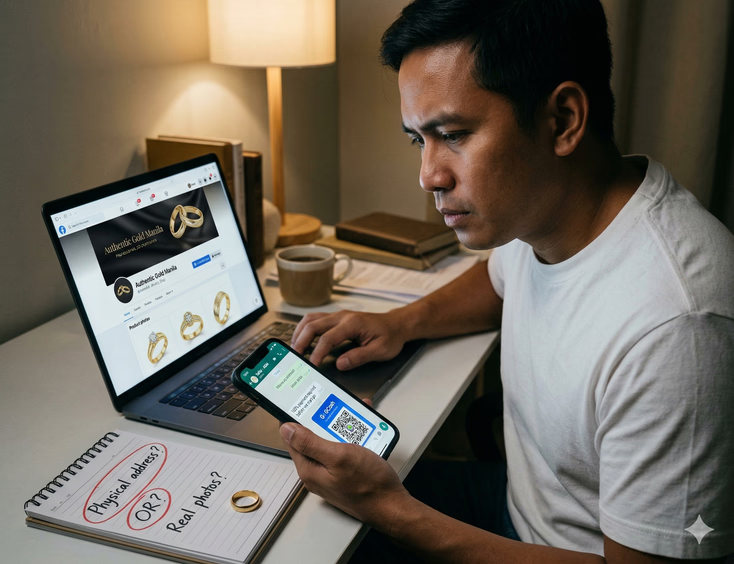
This is the highest-risk buying environment in the Philippine jewelry market, and the one where the most significant losses occur. The barriers to presenting oneself as a legitimate jewelry business on Facebook or Instagram are essentially zero — a phone, a ring, and a ring light are enough to build a professional-looking storefront.
Red Flag 6: No Verifiable Physical Address or Contact Information
A legitimate jewelry business has a location. It may be a workshop, a studio, or a home-based setup — but it exists somewhere, and the seller should be willing to tell you where.
A seller who communicates only through a Facebook page DM, has no address listed anywhere, and whose phone number cannot be verified through a simple search is a seller you cannot locate if something goes wrong with your purchase.
Minimum verification for online sellers:
- A physical address (even a home address for legitimate home-based jewelers)
- A mobile number that answers when called — not just responds to messages
- A visible portfolio of completed work with clients who can be independently contacted
Red Flag 7: Only Stock Photos or Renders — No Photos of Actual Completed Work
Stock photos and 3D ring renders are what you see when a seller does not have actual completed work to show you. They may be beautiful. They tell you nothing about what this seller actually produces.
A legitimate jewelry maker — even a new one — has photos of rings they have actually made, on actual hands, in real light. These photos may not be as polished as professional studio shots. That is fine. What matters is that they are real: actual metal, actual craftsmanship, actual evidence of what leaves this person's hands.
How to verify: Ask specifically for photos of completed pieces similar to what you are ordering, with client permission to share them. Ask to see the rings in progress if it is a custom order — a legitimate jeweler will send you photos of the wax model, the cast piece, and the finished ring. Silence or resistance at any of these stages is a warning sign.
Red Flag 8: Requests for 100% Payment Upfront Before Any Work Begins
For custom jewelry orders, a deposit is standard and legitimate — typically 50% of the total, paid when the design is confirmed and production begins. This deposit protects the jeweler's materials cost and time investment.
A request for 100% payment before any work has begun — before you have seen a design proposal, a wax model, or any evidence of production — is not standard practice. It is the payment structure of a seller who intends to disappear, delay indefinitely, or deliver something very different from what was agreed.
The 50% rule: Never pay more than 50% upfront for a custom jewelry order from any seller — physical shop, independent jeweler, or online. Pay the balance only when you have the ring in your hands and have confirmed it matches the agreed specifications.
Red Flag 9: Testimonials Without Verifiable Reviews
A Facebook page with 200 five-star reviews and effusive testimonials in the comments sounds reassuring. Look more closely.
Questions to ask about online reviews:
- Are the reviewers real accounts with full profiles, posts, and histories — or accounts created recently with no content?
- Do the reviews describe specific details about the purchase (timeline, design process, quality on arrival) — or are they generic ("Highly recommend! 10/10!")?
- Can you independently contact any of the reviewers through their profiles to verify the experience?
- Are there any negative reviews, and if so, how did the seller respond?
A completely clean review record with no negative feedback, on a page that has been operating for several years, is actually slightly suspicious — it suggests either careful curation of feedback or review manipulation. A seller with 95% positive reviews and a few negative ones that they responded to professionally is more credible than one with perfect scores across the board.
Red Flag 10: Sellers Who Become Defensive or Evasive When Asked Basic Questions
Before committing to any purchase, ask the seller these basic questions:
- What is the exact karat of the gold?
- What is the approximate weight of the finished ring in grams?
- Do you provide an official receipt?
- What is your return or replacement policy if the ring does not match what was agreed?
- Can I see photos of similar completed pieces?
- What is the production timeline, and what happens if there are delays?
A legitimate seller answers every one of these questions directly, completely, and without irritation. A seller who becomes defensive, vague, or dismissive when asked basic questions about their product and process is telling you something important. That response is itself the red flag.

Red Flags Specific to Custom Wedding Ring Orders
Custom orders involve the highest financial stakes and the longest timeline of any ring-buying scenario — which makes the red flags specific to this process worth covering separately.
Red Flag 11: No Written Work Order
Any custom jewelry order above a minimal value should be accompanied by a written work order — a document that specifies:
- The design in detail (with a sketch or render attached)
- Metal type and karat
- Stone specifications if applicable
- Ring size for each piece
- Timeline for completion
- Payment terms (deposit amount, balance due on delivery)
- Policy for revisions and delays
A jeweler who wants to proceed based on a verbal agreement and a bank transfer, with no written documentation of what was ordered, is a jeweler who has no accountability if the finished piece does not match your expectations. Written documentation protects both parties — a legitimate jeweler has no reason to resist it.
Red Flag 12: Vague or Constantly Shifting Timelines
A custom jeweler who quotes "around three to four weeks" and then, as the deadline approaches, offers a new "around three to four more weeks" without clear explanation is either overbooked, disorganized, or running multiple clients' deposits simultaneously without the capacity to fulfill them.
What legitimate timeline management looks like:
- A specific delivery date confirmed in writing at the time of order
- Proactive communication about progress — photos of the work in stages
- Advance notice (not day-of notice) if a genuine delay occurs, with a specific revised timeline and an explanation
- Follow-through on the revised timeline
A jeweler who consistently communicates only when you initiate contact, always has a new reason for delay, and never provides unsolicited progress updates is a jeweler you should be concerned about — even if the eventual ring turns out fine.
Red Flag 13: Rings Delivered Without Hallmark Stamps
A custom-made ring should carry the same hallmark stamps as any manufactured ring. If a custom jeweler delivers a ring with no karat stamp — citing reasons like "it's handmade so there's no stamp" or "the design doesn't allow for it" — this is not acceptable.
Philippine law requires gold jewelry to be stamped with its karat purity. A reputable custom jeweler stamps their work as a matter of professional practice, not just legal compliance. A ring delivered without a hallmark cannot be verified for metal content, which means you are taking the jeweler's word for what you paid for.
How to Protect Yourself: A Pre-Purchase Checklist
Before paying for any wedding ring purchase — mall boutique, independent jeweler, or online seller — run through this checklist:
| Check | What to Verify |
|---|---|
| Hallmark | Is the karat stamp visible on the piece itself? |
| Official receipt | Will the seller provide a BIR-registered OR with full item description? |
| Stone documentation | For significant stones: is there a grading certificate from an independent laboratory? |
| Pricing benchmark | Have you compared this price to at least two other sources for equivalent specifications? |
| Physical presence | Does the seller have a verifiable physical address and working contact number? |
| Real portfolio | Have you seen photos of actual completed pieces — not renders or stock photos? |
| Written agreement | For custom orders: is there a written work order with design specs, timeline, and payment terms? |
| Payment structure | For custom orders: are you paying no more than 50% upfront? |
| Return policy | Is the warranty and return policy stated in writing? |
| Reviews | Are the reviews verifiable, specific, and from real accounts? |
A purchase that passes all ten of these checks is a purchase made with eyes open. A purchase that fails two or more of them deserves serious reconsideration.
What to Do If You Have Already Been Scammed
If you have made a jewelry purchase and now have reason to believe it was fraudulent — the ring is not the metal it was sold as, the custom order has not been delivered and the seller is unresponsive, or the stone is not what was represented — here are your options in the Philippines.
For metal fraud (wrong karat): Have the ring independently tested by a different jeweler or by an accredited testing facility. The result is documentable evidence. With an official receipt in hand, you have grounds for a consumer complaint.
For undelivered custom orders: File a complaint with the DTI (Department of Trade and Industry) Consumer Protection Group. The DTI handles consumer complaints involving non-delivery, misrepresentation, and other commercial fraud. If the amount is significant, a small claims court filing is also an option.
For social media scammers: Report the account to the platform (Facebook, Instagram) and file a complaint with the NBI Cybercrime Division or PNP Anti-Cybercrime Group. If a bank transfer was involved, report the receiving account to the bank's fraud division — some banks can flag or freeze accounts associated with reported fraud.
The honest caveat: Recovery of funds from a committed scammer is difficult and often incomplete. The far better outcome is prevention — which is why this entire guide exists.
A Final Note: Healthy Skepticism Is Not the Same as Distrust
Reading a guide like this can make the Philippine jewelry market sound like a minefield. It is not. The majority of Filipino jewelers — in malls, in independent shops, and online — are legitimate, skilled craftspeople who take genuine pride in their work and the trust Filipino couples place in them.
The red flags in this guide are not present in most jewelry transactions. They are the signals worth knowing precisely because they are not everywhere — and because when they do appear, recognizing them quickly protects you from the minority of bad actors who rely on couples not knowing what to look for.
Buy from verified jewelers. Ask the questions. Get things in writing. Give yourself enough time to do all of this without pressure.
The rings you exchange on your wedding day deserve to be exactly what you believe them to be — in their material, their quality, and the integrity of the people who made them.
For the complete resource on Filipino wedding rings — from symbolism and styles to budgets and where to buy with confidence — start with our pillar guide: The Complete Filipino Couple's Guide to Wedding Rings & Bands in the Philippines.
Find verified and trusted jewelry and accessories suppliers in the Philippines — jewelers whose legitimacy you don't have to guess at.
Still Searching for a Right Match?
Find Your Perfect Wedding Supplier Today!
Discover trusted wedding suppliers across the Philippines in our complete directory. Compare services and connect with the ones that fit your dream celebration.
Browse Wedding SuppliersFeatured Posts





Wedding Reception Ideas that Honor Tradition and Wow Your Guests
4 mins readFilipino Wedding Dress Guide for Style Traditions and Smart Shopping
6 mins readFilipino Wedding Cost Guide - Realistic Budgets, Percentages, and Price Drivers by Region
9 mins readPhilippines Honeymoon Guide - Best Islands, Resorts, Costs & 7–14 Day Itineraries
9 mins readFilipino Wedding Games - Traditions, Modern Twists, and Crowd-Pleasers for Every Reception
8 mins read