

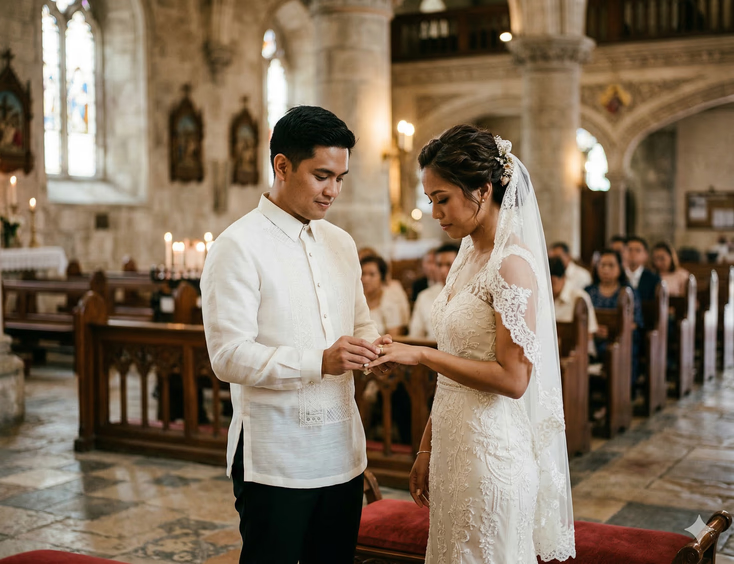
Top Wedding Ring Styles Filipino Couples Are Choosing
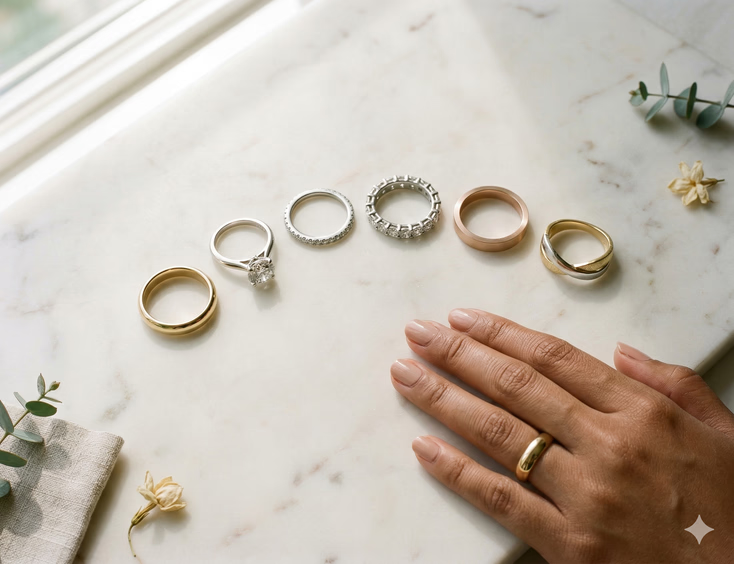
Wedding ring trends in the Philippines have shifted more in the last three years than in the previous decade.
It used to be straightforward: most Filipino couples chose a plain yellow gold band, perhaps with a small diamond solitaire for the bride, and that was that. The ring was chosen quickly, often from the nearest mall jewelry shop, and the decision was driven almost entirely by budget and what was in stock.
That is no longer the full picture.
Today's Filipino couples — particularly those in their mid-20s to mid-30s — are approaching their wedding rings with the same intentionality they bring to their venue and their gown. They are researching metals, comparing stone cuts, asking about ethical sourcing, and choosing styles that reflect who they actually are rather than what was simply available. Social media has played a role, certainly — Pinterest boards and Instagram saves have introduced Filipino couples to styles they would never have encountered in a mall showcase. But it goes deeper than aesthetics. There is a growing sense among Filipino couples that the ring, precisely because it will be worn every day for the rest of their lives, deserves a more thoughtful choice.
This guide covers the styles that are genuinely resonating with Filipino couples right now — not just what looks good in a photo, but what works for Filipino lifestyles, Filipino skin tones, Philippine weather, and the full reality of daily wear. We'll cover everything from the enduring classics to the trends that have arrived and earned their staying power, with honest guidance on who each style suits best.
Before the Styles: What Makes a Ring Work for Filipino Daily Life
Before diving into specific styles, it is worth establishing the practical filter through which every Filipino couple should evaluate their ring choice.
Climate. The Philippines is hot and humid for most of the year. Fingers swell in heat, which affects comfort and fit. Certain metals and settings accumulate grime faster in humid conditions. A ring that looks beautiful in a temperature-controlled jewelry boutique needs to hold up in jeepney queues, beach trips, and summer weddings in Batangas.
Skin tone. Filipino skin tones range across a warm, beautiful spectrum — from fair maputi to rich morena to deep kayumanggi. Metal color reads differently against different skin tones. Yellow gold tends to warm against morena and kayumanggi skin in a way that is widely considered flattering. White gold and platinum create a cooler, more contemporary contrast. Rose gold has a particular softness against warm Filipino skin tones that has made it enormously popular in recent years.
Lifestyle. Many Filipino professionals work with their hands — in kitchens, in clinics, in construction, in the arts. A ring with a high, prominent stone setting that catches on gloves, equipment, or fabric is a practical problem, not just an aesthetic preference. Low-profile settings and flush-set stones exist precisely for this reason.
Budget reality. Filipino couples are practical people. The most beloved ring is not necessarily the most expensive one — it is the one that was chosen thoughtfully within a real budget and worn with genuine pride. Every style in this guide exists across multiple price points.
Style 1: The Classic Plain Gold Band — Still the Most Worn Ring in the Philippines
Let's start where most of the Philippines actually is.
The plain gold band — smooth, unadorned, available in yellow, white, or rose gold — remains the most commonly chosen wedding ring among Filipino couples. Not because couples lack imagination, but because this ring earns its ubiquity. It is comfortable, durable, low-maintenance, culturally resonant, and genuinely timeless in a way that transcends trend cycles entirely.
Why Filipino couples choose it:
- Practical for all occupations and lifestyles — no protruding stones to catch or scratch
- Works across every budget (a well-made 14k yellow gold plain band can be found from ₱3,000–₱8,000 for a simple piece)
- Ages beautifully — gains character with scratches and patina over decades
- Culturally familiar — generations of Filipino families have exchanged plain bands, and there is something meaningful about that continuity
Who it suits: Plain bands suit virtually everyone, but they are particularly well-chosen for couples who work with their hands, prefer understated style in all areas of life, or want their ring to be a background presence — always there, never demanding attention.
The plain band today: The plain band is not standing still. Filipino couples are increasingly choosing plain bands with subtle distinctions: a slightly domed profile (the court or comfort fit band) rather than flat; a matte or brushed finish rather than high polish; or a very faint milgrain edge — a border of tiny beaded metal detail — that adds handcrafted character without adding visual complexity. These micro-details are invisible from across the room but deeply satisfying to the person wearing the ring every day.
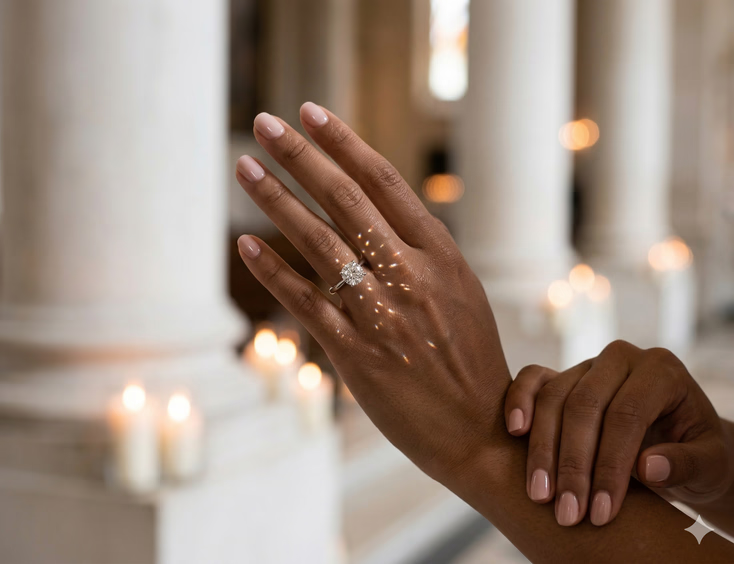
Style 2: The Solitaire Engagement-Style Band — The Enduring Bride's Choice
For Filipino brides who want a stone, the single solitaire remains the most requested style — a plain or tapered band with one center stone, typically a round brilliant diamond, moissanite, or white sapphire.
The solitaire's longevity is not accidental. A single stone, well-chosen, is impossible to date. A round brilliant cut diamond in a simple four or six-prong setting looked elegant in 1985, looks elegant now, and will look elegant decades from now. For a ring that will be worn for decades, that kind of timelessness has genuine value.
What Filipino brides are choosing right now:
- Round brilliant cut — still the most popular overall; maximum light return, deeply familiar
- Oval cut — the single fastest-growing stone shape among Filipino brides; the elongated shape creates the illusion of a larger stone and flatters the finger
- Cushion cut — soft, romantic, slightly vintage in feel; gaining ground among Filipino brides who want something less conventional than round
- Emerald cut — chosen by Filipino brides who want a more architectural, modern look; requires a higher-quality stone since the step-cut faceting makes inclusions more visible
Stone alternatives to diamond: An increasing number of Filipino couples are choosing moissanite or lab-grown diamonds for their solitaire, driven by both budget considerations and a growing awareness of ethical sourcing. Moissanite in particular has gained significant ground in the Philippines — it offers near-identical visual brilliance to diamond at a fraction of the price, and jewelers in Manila, Cebu, and beyond are now stocking it routinely. For a thorough look at whether moissanite makes sense for your situation, our guide on whether moissanite is worth it for Filipino couples lays out the honest case for and against.
Setting considerations for Filipino lifestyles: Filipinas who work in medicine, food service, childcare, or any hands-on profession should think carefully about setting height. A high cathedral solitaire setting is beautiful but catches on everything — gloves, hair, fabric, sleeping partners. A bezel setting (where the stone is encircled by a rim of metal rather than held by prongs) or a low-profile prong setting offers the same stone with significantly less practical friction.
Style 3: The Pavé Band — When the Band Itself Becomes the Statement
The pavé band — a ring set with a continuous row of small stones along the band surface, held by tiny prongs or beads of metal — has moved from being a primarily Western trend to a firmly established choice among Filipino brides who want brilliance without a prominent center stone.
Pavé comes from the French word for "paved" — the stones are set so closely together that they appear to pave the surface of the band in light.
Why Filipino brides love it:
- The distributed sparkle of many small stones reads as brighter and more lively than a single stone of equivalent total carat weight
- Lower profile than a solitaire — sits closer to the finger
- Works beautifully as a standalone wedding band or stacked with a plain band
- Particularly striking in white gold or platinum against morena skin
What to watch for: Pavé settings require more maintenance than plain bands. The tiny prongs holding each stone can loosen over time, particularly with physically active daily wear. Filipino couples choosing a pavé band should factor in the cost of periodic professional cleaning and prong inspection — typically once a year from a trusted jeweler. A well-made pavé band from a reputable jeweler is worth the maintenance; a poorly set one from an unknown seller is a stone-loss waiting to happen.
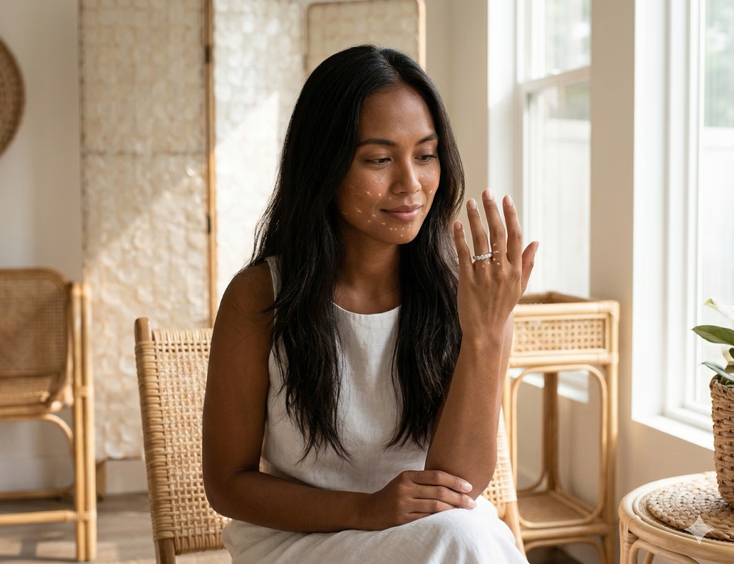
Style 4: The Eternity Band — A Growing Trend Among Filipino Brides
An eternity band — a ring set with stones running continuously all the way around the full circumference — is growing in popularity among Filipino brides, particularly as a wedding band to be worn alongside or instead of a traditional solitaire engagement ring.
The symbolism is obvious and appeals deeply to Filipino Catholic sensibility: stones with no beginning and no end, circling the finger completely, echoing the ring's own circular meaning of eternal love.
Full eternity vs. half eternity: A full eternity band has stones around the entire ring. A half eternity band has stones only on the top half — the portion visible when the hand is relaxed. Filipino brides with active lifestyles often prefer the half eternity for practical reasons: the underside of the ring stays comfortable and smooth, and there are no stones to loosen under palm pressure.
Price note: Full eternity bands cost significantly more than half eternity bands because they require more stones. For budget-conscious couples who love the look of a full eternity, a half eternity band viewed from above is virtually indistinguishable and considerably more practical for Filipino daily life.
Style 5: Minimalist and Flat Bands — The Gen Z and Millennial Filipino Choice
This style deserves its own dedicated treatment — and it gets one in our full guide on why minimalist wedding rings are trending among Gen Z and millennial Filipino couples. But it belongs in this overview because it represents one of the most significant stylistic shifts in Filipino wedding ring preferences in recent years.
The minimalist band is characterized by:
- Extreme simplicity of form — flat profile, clean edges, no ornamentation
- Often very thin (1.5mm–2mm width), which reads as intentionally understated rather than budget-limited
- Matte or brushed finish rather than high polish
- Chosen in white gold, yellow gold, or rose gold with equal frequency
- Sometimes designed to stack — bought as part of a two or three-ring set to be worn together or separately
Why younger Filipino couples are choosing this: Filipino Gen Z and millennial couples are, broadly, more minimalist in their aesthetic sensibility than previous generations. They are influenced by Scandinavian and Japanese design culture as much as by Western bridal tradition. They want a ring that integrates seamlessly into their daily wardrobe — something that looks as right with a linen shirt on a Tuesday as it does with formal wear on a Saturday. They are also, frequently, more budget-conscious and more inclined to direct spending toward experiences (honeymoon, first home) rather than jewelry.
The minimalist band is not a compromise. For the couples who choose it, it is the clearest possible expression of their values.
Style 6: Stackable Ring Sets — The Modern Filipino Bride's New Approach
Stacking — wearing multiple thin rings on the same finger simultaneously — has become one of the most discussed wedding ring trends among Filipino brides.
The concept: instead of one wedding band, the bride wears a set of two, three, or even four slim bands together. The rings may be identical (a set of matching plain bands in the same metal), complementary (one plain, one pavé, one with a small stone), or deliberately mismatched in a curated way.
We cover the full stacking trend in detail in our guide on stackable wedding rings and the modern Filipino bride, but the key appeal points are:
- Versatility — individual rings from the stack can be worn separately on ordinary days and together for more formal occasions
- Gradual investment — some couples start with one or two rings and add to the stack on anniversaries
- Personalization — each ring in a stack can carry its own meaning, engraving, or stone
- The "bridal set" reinvented — instead of an engagement ring plus one wedding band, a Filipino bride builds a stack that tells the story of her relationship over time
For Filipino couples considering a stack: Start simple. One plain band and one pavé or stone-accent band is already a compelling stack. Resist the urge to buy a five-ring set all at once — the most meaningful stacks are built over time.
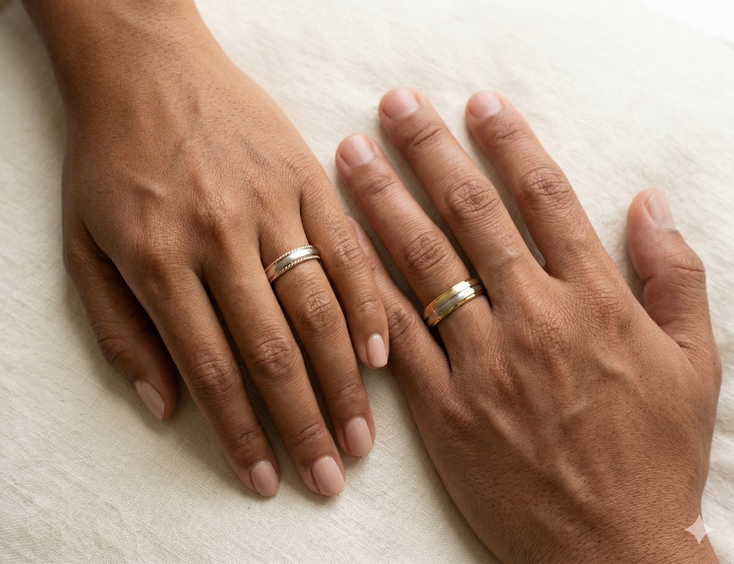
Style 7: Two-Tone and Mixed Metal Rings — For Couples Who Want Both
Two-tone rings — typically yellow gold paired with white gold, or rose gold paired with yellow gold — have carved out a consistent following among Filipino couples who find themselves genuinely torn between metal colors.
The appeal is practical as much as aesthetic: a two-tone band works with both yellow gold and white gold jewelry in the rest of the wardrobe. It transitions between formal and casual wear more easily. And visually, the contrast between warm and cool metal tones within a single ring creates a quiet complexity that a single-metal band cannot replicate.
Common two-tone configurations Filipino couples choose:
- Yellow gold band with a white gold center section or stone setting
- Rose gold band with yellow gold edges (the warmth-on-warmth combination is particularly striking against Filipino skin tones)
- White gold band with a yellow gold interior (visible only to the wearer — a private, intimate detail)
One practical caution: Two-tone rings are slightly more complex to resize and repair than single-metal bands because working on one metal layer without disturbing the other requires additional skill. Choose a jeweler with clear two-tone experience for this style.
Style 8: Rings with Meaningful Engravings Built Into the Design
This is less a visual style and more a design philosophy that is reshaping how Filipino couples think about wedding rings — and it is worth including here because it changes the brief you bring to your jeweler.
An increasing number of Filipino couples are moving away from purely decorative surface design toward rings where the meaning is built in from the start: a word, a date, a phrase, or a symbol incorporated into the ring's visible exterior design rather than hidden inside.
Examples of this approach:
- A band with the couple's wedding date engraved in a fine font on the outer surface
- A ring with a tiny cross motif set flush into the band — a nod to Filipino Catholic faith that is visible but not ostentatious
- A band engraved with a single Filipino word (tapat, habang buhay, mahal) along the outer surface in a clean, modern typeface
- His-and-hers bands where each ring carries one word of a phrase that only completes when the two rings are placed side by side
For ideas on what to engrave and how to make the inside of a ring as meaningful as the outside, our guide on engraving ideas Filipino couples will love is a thorough starting point.
Matching Sets vs. Non-Matching Bands: What Filipino Couples Are Choosing Now
For most of Filipino wedding ring history, matching sets — the bride and groom wearing near-identical bands from the same design family — were the default expectation. And many couples still choose this, finding something genuinely meaningful in the visual symmetry of wearing rings that clearly belong together.
But a growing number of Filipino couples are choosing complementary but non-matching bands. The idea: each partner's ring reflects their individual personality and lifestyle, while sharing one design element — the same metal, the same finish, the same stone, or the same engraving — that connects them.
A practical example: the bride chooses a slim pavé white gold band; the groom chooses a wider plain white gold band with a brushed finish. Different rings, same metal, same jeweler, same day. Each partner wears something they genuinely love, and the connection between the rings is visible to those who look for it without being forced.
This approach respects the reality that a Filipina bride and her groom may have quite different aesthetic preferences and completely different daily wear requirements for their ring — and that a marriage founded on mutual respect probably shouldn't begin with one partner wearing a ring they find uncomfortable.
A Quick Reference: Styles by Lifestyle and Preference
| If you are... | Consider... |
|---|---|
| Working with your hands daily (medical, culinary, trades) | Plain band, bezel-set solitaire, flat minimalist band |
| Wanting maximum sparkle on a moderate budget | Pavé band, moissanite solitaire, half eternity band |
| A minimalist who dislikes jewelry generally | Flat thin band in matte finish, ultra-slim plain band |
| Building a long-term jewelry investment | 18k gold solitaire with certified diamond, full eternity band |
| Wanting something distinctly Filipino | Band with Filipino word engraving, custom design with indigenous motif |
| Undecided between styles | Stackable set — start with one, build over time |
| Wanting matching rings that feel personal | Complementary non-matching bands in the same metal |
How to Move From Style Inspiration to an Actual Decision
Browsing styles is the easy part. Making the final decision — especially when you genuinely love three different options — is harder. Here is a practical process:
1. Identify your non-negotiables first. Not your preferences — your actual requirements. If you work in a hospital and wear gloves eight hours a day, a high solitaire setting is off the table regardless of how beautiful it is. Start with constraints, then move to desires.
2. Wear a test ring for a day before buying. Many jewelers in the Philippines will allow you to take a display ring home briefly, or will let you wear a sample size band around the store for thirty minutes. A ring that felt comfortable in an air-conditioned boutique for five minutes may feel different after a full day.
3. See your shortlisted styles on your own hand, in natural light. Jewelry store lighting is designed to make every stone look spectacular. Step outside or look at the ring near a window before deciding.
4. Give yourself at least two visits before committing. Feelings about rings change between visits. The ring you were certain about on Monday sometimes looks different on Thursday. If it still feels right on the second visit, that is meaningful.
5. Ask your jeweler the practical questions. How is this maintained? Can it be resized? What does the warranty cover? A style decision made without understanding the maintenance reality is an incomplete decision.
For the full picture on timing your ring purchase wisely, our guide on when Filipino couples should start shopping for wedding rings gives you a practical timeline from engagement to wedding day.
Finding the Right Jeweler for Your Chosen Style
Not every jeweler in the Philippines does every style equally well. A shop that excels at plain bands may not have the stone-setting expertise for a quality pavé band. A boutique with a strong solitaire range may not have experience with custom two-tone work.
When you have identified your preferred style, ask specifically: "Do you have examples of completed pieces in this style that I can see?" Not renders. Not catalog photos. Actual finished rings that came out of their workshop or were sourced through their suppliers.
Browse verified jewelry and accessories suppliers in the Philippines to find jewelers trusted by Filipino couples — from established mall boutiques to independent custom ateliers who specialize in the styles that matter most to you.
The Ring That Lasts Is the One That Was Actually Chosen
There is a version of wedding ring shopping where you walk into the nearest jewelry store, point at something in the second row of the display case, and walk out twenty minutes later. Some people are genuinely happy with that process and the ring it produces.
But for most Filipino couples, the ring deserves the same care and intention they bring to every other major decision in their lives — because it is, in the end, the one tangible object from their wedding day that they will carry with them through every ordinary Tuesday for the rest of their marriage.
Whatever style you choose — the classic plain band worn by your lolo and lola, the oval moissanite solitaire your ninang hasn't stopped complimenting, or the matte minimalist stack that is entirely, unmistakably you — choose it because it reflects who you are and who you are becoming together.
That is the style that will always be in fashion.
For everything from symbolism to budgets to where to buy across the Philippines, our complete resource covers it all: The Complete Filipino Couple's Guide to Wedding Rings & Bands in the Philippines.
Still Searching for a Right Match?
Find Your Perfect Wedding Supplier Today!
Discover trusted wedding suppliers across the Philippines in our complete directory. Compare services and connect with the ones that fit your dream celebration.
Browse Wedding SuppliersFeatured Posts


Wedding Reception Ideas that Honor Tradition and Wow Your Guests
4 mins readFilipino Wedding Dress Guide for Style Traditions and Smart Shopping
6 mins readFilipino Wedding Cost Guide - Realistic Budgets, Percentages, and Price Drivers by Region
9 mins readPhilippines Honeymoon Guide - Best Islands, Resorts, Costs & 7–14 Day Itineraries
9 mins readFilipino Wedding Games - Traditions, Modern Twists, and Crowd-Pleasers for Every Reception
8 mins read