


Funny and Lighthearted Vow Renewal Vows for Pinoy Couples
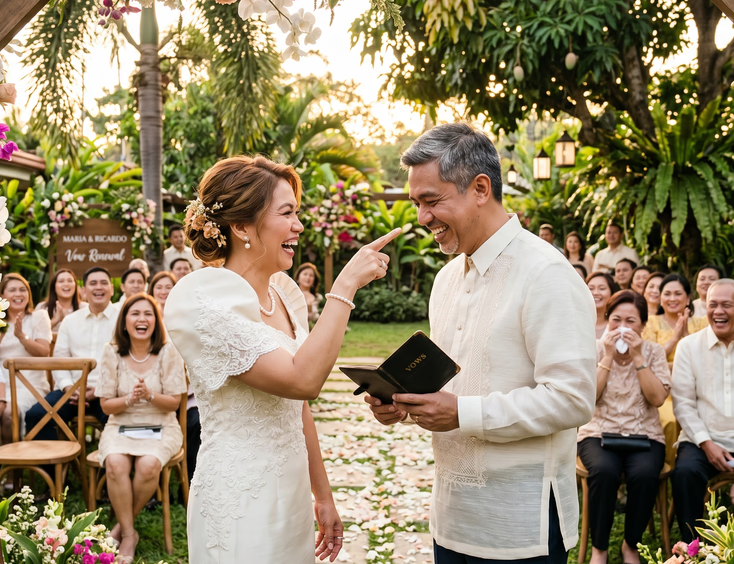
Not every Filipino vow renewal needs to make the audience cry. Some marriages run on humor. The couple survives twenty years partly because they keep finding each other funny, partly because they have made peace with each other's quirks, and partly because laughter handles what tears cannot.
For these couples, the standard emotional vow template feels off. The husband does not actually talk to his wife in soaring romantic language. The wife does not actually tell her husband she sees him as a noble warrior. The marriage runs on inside jokes about whose turn it is to take out the trash, who hid the last piece of leche flan, and whose family member is going to bring up that one topic at the next reunion.
Lighthearted vow renewal vows let the couple's actual voice come through. The guests laugh. The couple laughs. The marriage gets honored in the language it actually lives in.
This guide covers how to write funny vow renewal vows that work, what makes humor land, what mistakes to avoid, and sample structures Filipino couples can adapt.
What Makes Humor Work in Vows
Funny vows that land share a few qualities. They are specific rather than generic. They draw from the actual marriage rather than from internet jokes. They balance the humor with enough warmth that the audience leaves feeling something rather than just amused.
Generic humor fails. "Marriage is tough, am I right?" gets a polite chuckle from one or two guests and lands flat. Specific humor works. "I have spent twenty years pretending I do not hear you when you tell me to turn the rice cooker off, and I have spent twenty years coming home to perfectly cooked rice anyway. I want everyone here to know that I see it. I have always seen it. Thank you."
The second one works because it points to a real habit. Anyone who has watched the couple cook together recognizes the moment. The humor lives in the specifics.
For the broader question of how to write vows that capture the marriage, the how to write wedding vow renewal vows that capture years of marriage covers the general structure these lighthearted vows build on.
The Test for Funny Vows
Before reading any line aloud at the ceremony, run it through three quick tests.
The grandchild test. If the couple's eight-year-old grandchild repeated the line back at the next family dinner, would the line still work? If yes, it stays. If the humor depends on adult innuendo or content that should not be repeated by children, it gets cut.
The lola test. Would the couple's lola, watching from the front row, laugh or wince? If lola laughs, the joke works. If lola winces, the joke does not.
The warmth test. After the laughter dies down, does the line leave the audience feeling warmer toward the couple? Or does it leave them feeling like the speaker took a quiet shot at their spouse? Humor that warms works. Humor that scores points does not.
Lines that pass all three tests usually land. Lines that fail one or more usually do not.
Common Mistakes to Avoid
A few patterns show up in lighthearted vow drafts that do not work.
Roasting the spouse. Some writers default to making the spouse the punchline. "My wife snores so loudly the neighbors complain." The line might be true. It might even get a laugh. But it lands as criticism dressed up as humor, especially when the spouse has to stand there hearing it in front of the family. Cut the lines where the spouse is the target of the joke. Replace them with lines where the speaker is the target.
Internet jokes and viral references. Memes age quickly. Vows printed and read at a ceremony in front of family land differently than a witty post online. Trust the couple's own material rather than borrowing from the internet.
Too many jokes back to back. Vows that read like a stand-up set get exhausting. The audience needs space between jokes to feel something. Aim for two or three genuinely funny moments inside a vow that runs two to three minutes total. The rest should be warm, even if the warmth carries a smile.
Inside jokes that need explanation. Some couples have private references that work in conversation but require five minutes of context to make sense to anyone else. Skip these. The vows need to land for the family in the room, not just for the spouse.
Punching down at the in-laws or extended family. Comments about the mother-in-law, the lazy brother, or the cousin who always shows up late might be true. They do not belong in the vows. The renewal is not the place to settle family scores.
For couples weighing the broader balance between humor and weight, the how to write wedding vow renewal vows that capture years of marriage covers when humor strengthens vows and when it undermines them.
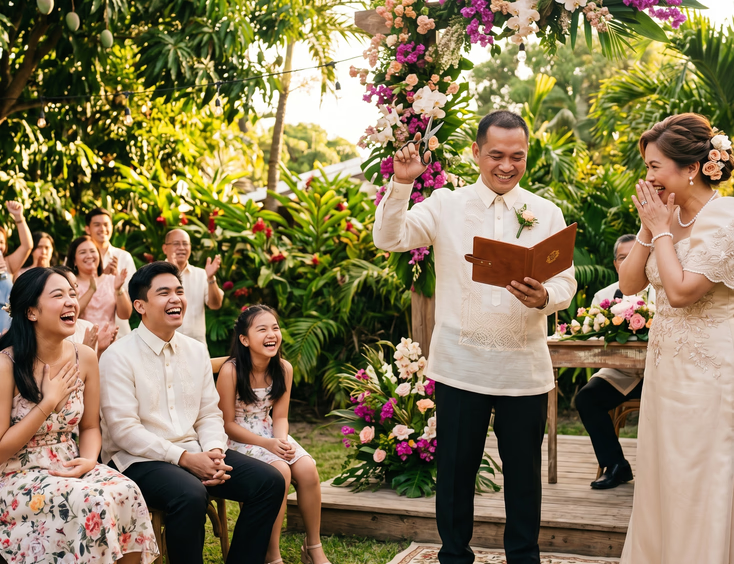
Sample Funny Vows for Husbands
The samples below run two to three minutes spoken aloud. Adapt the specifics to fit the actual marriage.
Sample 1: Acknowledging the Daily Quirks
"Mahal, I have spent fifteen years married to you, and I want to take this opportunity to publicly admit some things I have never admitted out loud.
I have known where the missing scissors are the entire time. I put them in the third drawer of the kitchen because that is where you said they belong, and I never told you because I wanted to see how long it would take you to find them. You found them last Tuesday. I am sorry.
I also want to acknowledge that you have been right about every major financial decision we have ever made. Every single one. I have spent fifteen years arguing with you about these decisions and then quietly doing what you said anyway. The house we live in, the school we sent the kids to, the car we did not buy in 2017. All you. I want to thank you for letting me argue with you anyway, because I would not have it any other way.
Seriously though, you are the best part of my life. You make me laugh every day, even on the days when I do not want to laugh. I am promising you the rest of my years, all of them, and I am promising to keep pretending I do not hear you when you ask me to take out the trash, because that is part of our love language now. Mahal kita."
Sample 2: The Self-Deprecating Husband
"Twenty years ago, I stood in front of you and promised to be a good husband. I have spent twenty years trying to figure out what that means. I am still working on it.
I have learned a few things along the way. I have learned that 'I'm fine' does not mean fine. I have learned that the right answer to 'does this look okay' is never the obvious one. I have learned that you do not actually want me to fix your problems, you want me to listen to your problems, and that took me about ten years to fully understand.
What I have not learned yet is how you put up with me. The man you married did not know how to load a dishwasher. He could not fold laundry. He thought 'helping with the kids' meant watching them while you did everything else. You taught him. You taught him patiently, mostly. Occasionally with a raised voice, which he deserved.
I am here today to acknowledge in front of everyone who knows us that you have built a better husband out of the raw materials you started with. The credit for whatever I have become belongs to you. I am promising you the rest of the work. There is still plenty of work to do. Mahal kita, and thank you for not giving up on the project."
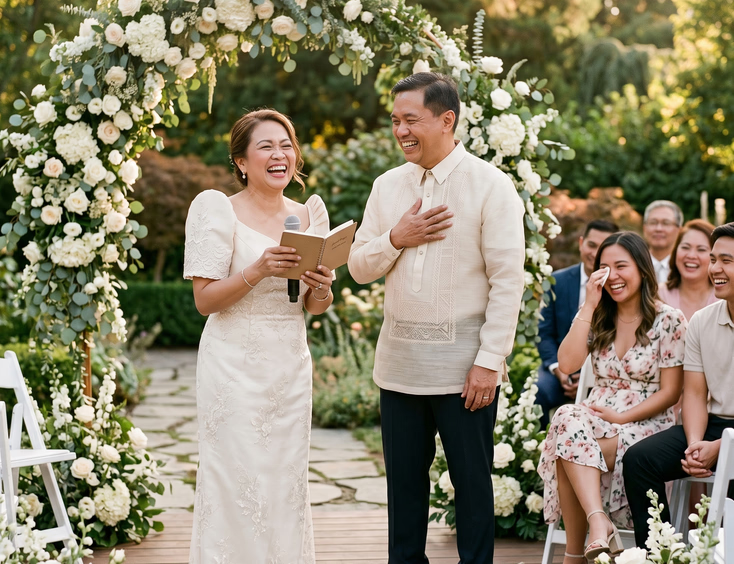
Sample Funny Vows for Wives
Sample 1: Acknowledging the Marriage Truce
"Mahal, twenty-five years ago, I married you knowing exactly two things about your habits. One, you snore. Two, you sing in the shower badly. I figured I could handle both of these. I was right about one of them.
The snoring I have adjusted to. The singing I am still working on. Twenty-five years later, you still cannot hold a tune, and you still sing in the shower every morning anyway. The kids have learned to recognize you by the sound. The neighbors have stopped commenting. The dog left, but that was unrelated.
What I want to say in front of everyone here is that the bad singing has become one of my favorite sounds. I do not know when that happened. Probably around year fifteen, when I realized the bathroom sounded too quiet on the mornings you were away. I missed the singing. I missed you.
I am promising you the rest of my years, the rest of my mornings, the rest of the bad singing. Keep singing. Even when you cannot. Especially when you cannot. Mahal kita."
Sample 2: The Long-Married Realist
"Hon, we have been married thirty years, and at this point I think we both know who is in charge of what. I am in charge of remembering everyone's birthdays, the kids' allergies, where the important documents are, and what we did three weekends ago. You are in charge of opening jars, reaching the top shelves, and remembering the score of every basketball game from 1998.
We have made it work. I want to publicly acknowledge that this has been my plan all along. I cannot reach the top shelves, and you cannot remember our anniversary without three reminders. We need each other.
Thirty years in, I want to also acknowledge that I have stopped trying to change you. The way you eat rice. The way you organize your tools. The way you laugh too loud at your own jokes. I have made peace with all of it. Some of it I now find endearing, which would have surprised me ten years ago.
I am promising you the rest of my years. I will keep remembering things you forget. You keep opening jars. We will keep building this thing together. Mahal kita, even when you are loudly laughing at your own jokes in the kitchen at six in the morning."
Mixing Humor and Tenderness
The strongest funny vows are not entirely funny. They use humor as the dominant register, but they land emotional moments at the right points. The audience laughs for most of the vows, then quiets for the final lines that turn warm.
The structure that works:
Open with a specific funny observation about the marriage.
Build through two or three more lighthearted moments.
Shift, usually about two-thirds of the way through, into a more direct expression of love or commitment.
Close with a line that lands warm without abandoning the playful tone entirely.
The shift point matters. It signals to the audience that the speaker means what they are about to say, even if everything before it was for laughs. Without the shift, the vows feel like a comedy bit. With the shift, the vows feel like the speaker just couldn't help being funny on the way to saying what they really meant.
When Humor Is the Wrong Choice
Some vow renewals do not benefit from humor. Couples who survived recent hardship, like the loss of a child or a serious illness, often find that lighthearted vows feel mismatched to the moment. The marriage may run on humor in daily life, but the ceremony itself can carry the weight without it.
The vow renewal vows for couples who survived hardship together covers how to write vows when the marriage's recent history calls for a different register.
Some Filipino couples also choose a more solemn tone for milestone anniversaries like the silver or golden, even when their marriage is full of humor in private. The formality of the milestone calls for vows that match. Lighter, conversational vows might work better for tenth or fifteenth anniversaries, while more reflective vows often fit twenty-fifth or fiftieth.
Coordinating Funny Vows Between Spouses
If both partners plan to write funny vows, coordinate ahead of time on tone and length. Two sets of funny vows can work, but they can also feel like a comedy double act if not balanced well.
Some couples decide that one partner will write funny vows while the other writes more reflective vows. The contrast adds dimension to the ceremony. The husband's funny vows make the audience laugh. The wife's reflective vows make the audience tear up. The combination lands harder than two of either.
Couples who both want to write funny vows should agree on length, and on whether each set of vows includes the same emotional shift at the end. Without coordination, the second set of funny vows often feels redundant. With coordination, the two sets can complement each other.
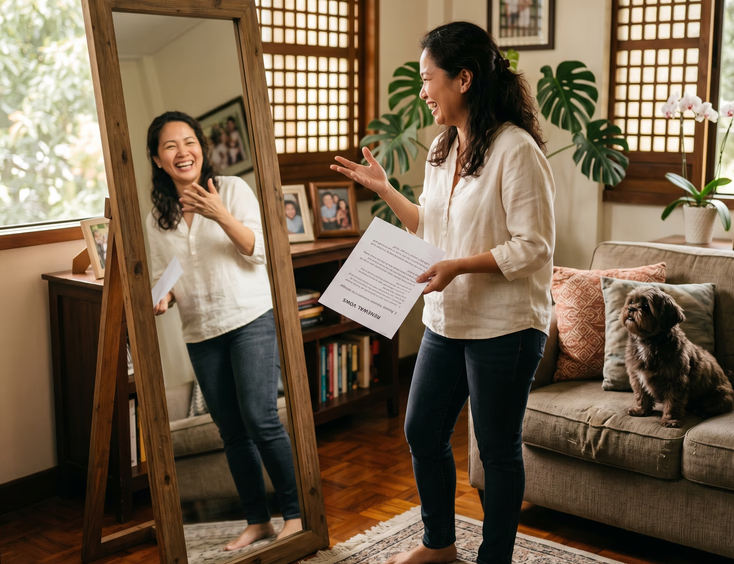
Reading Funny Vows Aloud
Comic timing matters more for funny vows than for any other type. The same joke that lands with the right pause falls flat when rushed.
Practice reading funny vows aloud at least five times before the ceremony. Find the natural pause points after the punchlines. Mark them on the printed page. The audience needs about two beats after a joke to laugh before the next line begins.
Practice in front of one trusted family member. The listener can tell you which jokes land and which feel forced. Cut the jokes that do not land. The vows do not need to be packed with jokes. Two or three strong ones beat eight weak ones.
Some speakers find that the audience reaction throws off their rhythm. When guests laugh louder than expected, the speaker rushes through the next line to get past the laughter. Slow down instead. Let the laughter run its course. Continue when the room has quieted.
What the Audience Expects
Filipino vow renewal audiences usually arrive expecting an emotional ceremony. Tears, vows that bring up the years, and a few quiet moments. When the vows are funny instead, the audience initially does not know what to do. The first few jokes might land with hesitant laughter as guests check whether they are allowed to laugh.
The speaker can signal that humor is welcome through the opening line. A confident, clearly funny first line tells the audience the vows will be lighthearted. Once guests realize they can laugh, the rest of the vows usually land more easily.
Some couples also brief their officiant about the tone of the vows so the officiant's introduction matches. An officiant who sets up the vow exchange with solemn language followed by lighthearted vows creates a mismatch the audience can feel.
When the Reception Carries the Humor
Some Filipino couples decide to keep the ceremony itself reflective and save the humor for the reception. The vows during the ceremony stay emotionally weighted, while the reception toasts, the slideshow, and the program lean into the comedic stories.
This split often works well for milestone anniversaries. The ceremony marks the years with weight. The reception celebrates with humor. Family members deliver funny toasts. The slideshow includes embarrassing photos from across the marriage. The couple gets to lean into both registers without either feeling out of place.
The vow renewal toasts and speeches: what to say as a child, sibling, or best friend covers how family members can deliver lighthearted contributions at the reception.
The Goal of Funny Vows
The goal is not to entertain. The goal is to honor the actual marriage in the actual language the marriage uses. For couples whose marriage runs on laughter, lighthearted vows are not a quirky choice. They are the only honest choice. The vows match the relationship.
Sit down. Write the vows in the voice of the marriage. If that voice is funny, write funny vows. If the writing process keeps pulling toward emotional weight, follow the pull. Trust what the marriage actually sounds like. The vows that capture it will land, regardless of register.
For the broader planning context, the complete Filipino couple's guide to renewing your I do covers how the vows fit into the larger ceremony and reception.
Still Searching for a Right Match?
Find Your Perfect Wedding Supplier Today!
Discover trusted wedding suppliers across the Philippines in our complete directory. Compare services and connect with the ones that fit your dream celebration.
Browse Wedding SuppliersFeatured Blog Posts


Filipino Wedding Entourage - Roles, Order of March, and Modern Etiquette
6 mins readCivil Weddings in the Philippines - Requirements, Costs, and Step-by-Step Process
9 mins readCivil Wedding Requirements in the Philippines - Complete Checklist
6 mins readCost of Wedding in the Philippines - 5 Essential Things You Need to Know
7 mins readPrincipal Sponsors (Ninong/Ninang) - How Many, How to Ask, What They Really Do
4 mins readVeil, Cord, Candle & Coins - Roles, Options, and When They Happen
4 mins readEntourage for a Traditional Pinoy Wedding - Complete Roles and Guide
6 mins readComplete List of Civil Wedding Requirements in the Philippines
8 mins readHow to Choose Wedding Ninongs and Ninangs - Ask Yourself These 3 Important Questions
5 mins read