

What Do Wedding Rings Mean in Filipino Catholic Weddings? Symbolism & Ceremony Explained
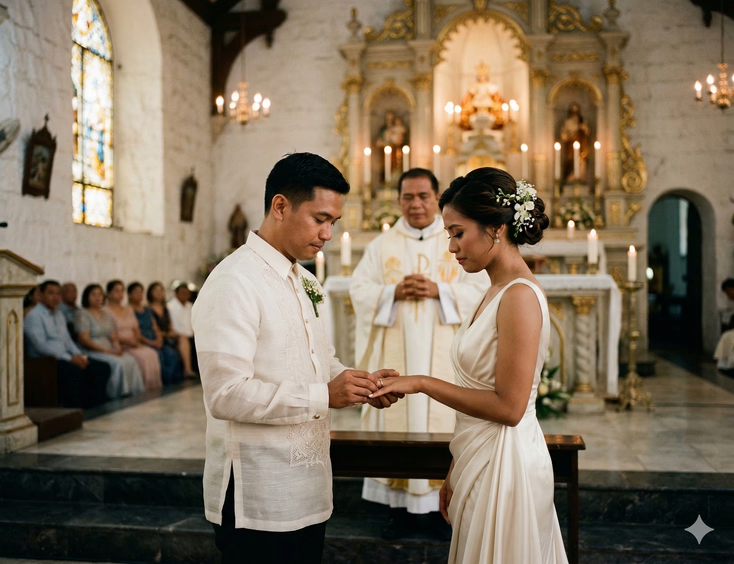
There is a moment in every Filipino Catholic wedding that even the most composed ninong cannot watch without feeling something.
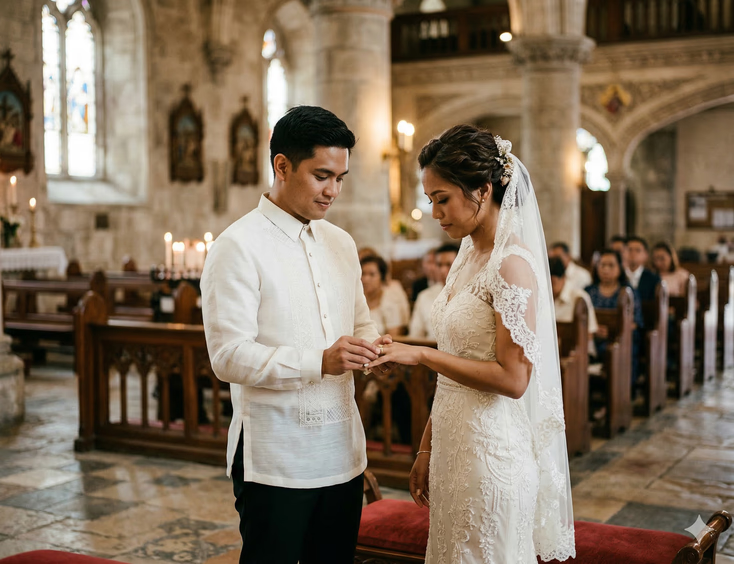
The priest has finished the vows. The church is quiet — the kind of quiet that only happens when a hundred people are collectively holding their breath. The groom picks up the ring. His hands, which have probably been steady all morning, are not entirely steady now. He slides it onto her finger. She does the same for him. And in that exchange of two small circles of metal, something permanently changes between two people.
Most Filipino couples have witnessed this moment dozens of times before their own wedding — at the kasal of titos and titas, older cousins, officemates, barkada. They know what it looks like. But surprisingly few stop to ask what it actually means. Why a ring? Why that finger? Why does the priest bless it with holy water first? What are those specific words he says, and why do they matter?
If you're preparing for your own Filipino Catholic wedding, understanding the meaning behind the ring exchange doesn't just satisfy curiosity — it transforms the moment from a ceremonial gesture into something you feel in your chest. This guide explains everything: the theology, the tradition, the symbolism, and the living cultural weight that the wedding ring carries in Filipino Catholic life.
The Wedding Ring as a Sacramental Symbol in the Catholic Church
To understand what the wedding ring means in a Filipino Catholic wedding, you have to start with what the Catholic Church teaches about marriage itself.
For the Catholic Church, marriage is not a contract. It is a sacrament — one of the seven sacred rites through which God's grace enters the world and the lives of the faithful. The Catechism of the Catholic Church teaches that the Sacrament of Matrimony is a covenant: a permanent, exclusive, life-giving bond between a man and a woman, modeled on the covenant between Christ and the Church.
This distinction matters enormously for understanding the ring.
In Catholic sacramental theology, a sacrament always has an outward sign — something visible and tangible — that points to an invisible, spiritual reality. Baptism uses water. The Eucharist uses bread and wine. In matrimony, the outward signs include the spoken vows, the joining of hands, and — the wedding ring.
The ring is not decoration. It is not tradition for tradition's sake. It is a sacramental symbol: a visible, wearable declaration that this couple has entered into a covenant before God that is permanent (hindi maaaring bawiin), faithful (tapat), and open to life.
When the priest blesses the rings during the Rite of Marriage, he is not performing a ritual formality. He is invoking God's consecration over objects that will become daily, physical reminders of a sacred promise. The Rite of Marriage in the Catholic Church includes this blessing:
"Bless, O Lord, these rings which we bless in your name, so that those who wear them may always have a deep faith in each other, peace, and love, and may live together always in your love."
After the blessing, the couple exchanges the rings with these words:
"Take this ring as a sign of my love and fidelity, in the name of the Father, and of the Son, and of the Holy Spirit."
Every word in that formula is deliberate. "Sign" — not gift, not token, but sign: a sacramental pointer to something greater. "Love and fidelity" — the two pillars of the marriage covenant. And the Trinitarian formula — "in the name of the Father, and of the Son, and of the Holy Spirit" — places the entire exchange within the presence of God as divine witness.
The Catholic Bishops' Conference of the Philippines (CBCP) guides Filipino parishes in the celebration of matrimony with particular sensitivity to local culture. Some dioceses use slightly adapted formulas or include additional blessings — which is worth asking your parish priest about during your pre-wedding meetings and Pre-Cana sessions.
The Ring Exchange in a Filipino Catholic Wedding: What Happens and Why
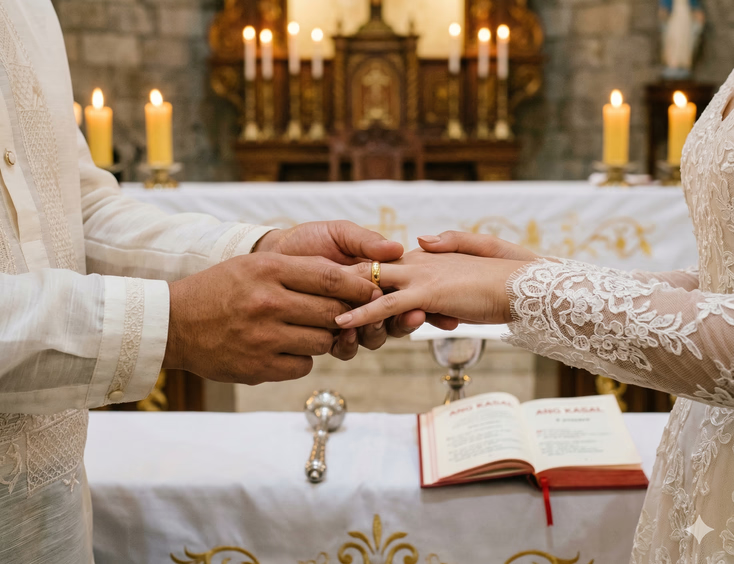
For couples who want to be fully present during their ceremony rather than just moving through choreography, here is what actually happens during the ring exchange — and why each step exists.
The Rings Are Presented on the Arras Tray or Ring Pillow
Before the exchange begins, the rings have typically been held by the ring bearer (often a young child from the family — a role taken very seriously by Filipino families) or placed on the ceremonial tray alongside the arras coins. Their presentation before the altar is itself a small act of offering — these objects are being brought before God before they are given to each other.
The Priest Blesses the Rings
The priest takes the rings and sprinkles them with holy water. This blessing is not superstition — it is the Church formally consecrating these objects as sacramental signs. Holy water, in Catholic tradition, represents purification and the grace of Baptism. Sprinkling the rings with it connects the marriage covenant to the couple's baptismal identity: they are not just two people making a promise, they are two baptized Catholics entering a sacrament.
The Groom Places the Ring on the Bride's Finger
The groom takes the bride's ring and places it on her left ring finger while saying the vow formula. This act — the giving, not just the wearing — is significant. The ring is a gift from one spouse to the other, and the act of placing it is an act of deliberate, witnessed commitment.
The Bride Places the Ring on the Groom's Finger
In modern Philippine Catholic practice, the bride also places a ring on the groom's finger with the same words. This mutual exchange — both partners giving and receiving — reflects the equality and reciprocity at the heart of the marriage covenant. Both spouses are giving themselves fully and receiving the other fully. The rings on both hands make this visible.
The Words Are Spoken in Front of Witnesses
The Trinitarian formula spoken during the ring exchange — "in the name of the Father, and of the Son, and of the Holy Spirit" — means that God himself is invoked as witness to this act. In Filipino Catholic culture, where the bayanihan spirit of community witness runs deep, this is also why the church is filled with family, friends, ninongs, and ninangs. The ring exchange is not a private moment. It is a public, communal, and divine act.
Which Finger, and Which Hand? The Filipino Catholic Wedding Ring Tradition
This is one of the most commonly asked questions — and one worth answering clearly.
Filipino Catholics wear the wedding ring on the ring finger of the left hand.
This tradition follows Western Catholic practice, which the Philippines inherited through over three centuries of Spanish colonial rule and Catholic evangelization. The left ring finger has been associated with marriage in the Western tradition partly through the romantic — though anatomically incorrect — belief in the Vena Amoris, or "vein of love": the idea that a vein runs directly from this finger to the heart. The anatomy is a myth, but the sentiment has persisted for centuries across cultures, and Filipinos have fully embraced it.
It is worth noting that some older Filipinos, particularly those from provincial or more traditional backgrounds, may observe slightly different customs around ring placement or may have grown up seeing rings worn on the right hand in certain contexts. There are also Filipino communities influenced by other cultural traditions where right-hand wearing is practiced. But for the Filipino Catholic wedding ceremony itself, the left ring finger is standard.
What about the engagement ring?
Most Filipino brides wear both their engagement ring and wedding band on the same left ring finger after the ceremony. During the ceremony itself, many brides temporarily move the engagement ring to the right hand before the exchange, then return it above the wedding band afterward. Some couples choose to have a ring guard or soldered set made to keep both rings together permanently. There is no single prescribed rule — this is a personal and practical choice.
The Deeper Symbolism: What the Ring's Shape and Circle Actually Mean
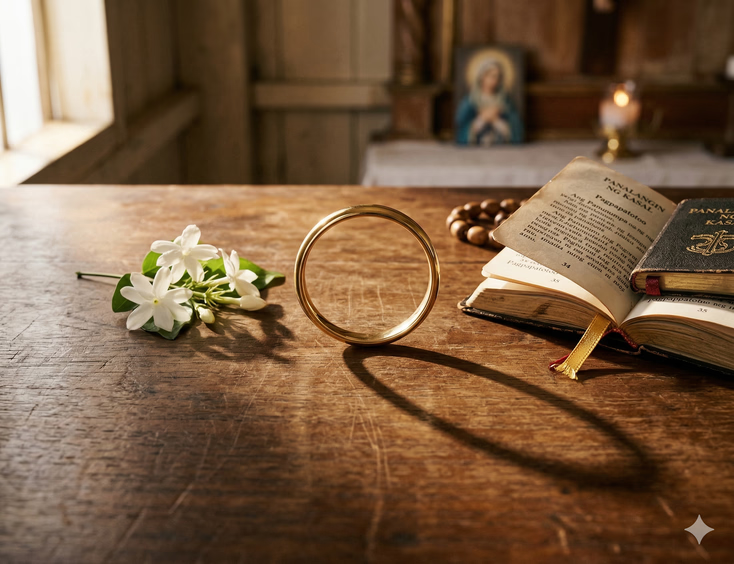
Strip away the gold, the gemstones, and the price tag, and what remains is a circle. That shape is not accidental — and in Catholic and Filipino tradition, it carries layered meaning.
The Circle as Eternity
A circle has no beginning and no end. In the context of the marriage covenant, this is profoundly intentional. The Catholic Church teaches that marriage, once validly consummated, is permanent — "what God has joined together, let no one separate" (Matthew 19:6). The ring's circular shape is a daily, wearable declaration of that permanence. It does not say "I love you today." It says "habang buhay" — for life.
The Unbroken Loop as Fidelity
A circle cannot be partially committed to. You cannot have half a circle — the loop either closes or it doesn't. Filipino Catholic tradition reads this as a symbol of katapatan: faithfulness that does not have exits built into it. The ring on the finger is a visible reminder, every single day, of a promise that was made without reservation.
The Metal as Value and Durability
Gold has been the traditional choice for wedding rings across cultures, including in the Philippines, for centuries. Gold does not tarnish, does not rust, and does not corrode — properties that make it a natural metaphor for a love meant to endure. In practical terms, gold also holds up remarkably well to the rigors of daily wear in the Philippines' warm, humid climate, which is one reason it has remained the preferred metal even as white gold, rose gold, and platinum have entered the market.
Today's Filipino couples choose different metals without diminishing the symbolism. The material changes; the meaning remains.
The Daily Wearing as a Living Vow
Perhaps the most underappreciated aspect of the wedding ring's symbolism is simply that it is worn every day. Not displayed in a case or brought out for anniversaries — worn. On the hand that shakes hands with colleagues, stirs pots, carries groceries, holds children. The ring follows you through ordinary life precisely because the marriage covenant is not a special-occasion promise. It is an everyday one.
The Ring Among the Symbols: How It Fits Into the Filipino Catholic Wedding Ceremony
Filipino Catholic weddings are among the most symbolically layered wedding ceremonies in the world. The ring does not stand alone — it is one of three principal unity symbols that together tell the full story of what the couple is committing to.
| Symbol | Filipino Term | What It Represents |
|---|---|---|
| 💍 The Rings | Ang Singsing | Eternal love, fidelity, and the public covenant before God |
| 🪙 The Wedding Coins | Ang Arras | Shared prosperity, mutual provision, and financial stewardship of the family |
| 🕯️ The Veil and Cord | Ang Belo at Yugal | Unity, covering and protection, and the binding of two lives into one |
Each symbol has its own moment in the ceremony, its own sponsors, and its own meaning. But there is one distinction that sets the ring apart from the arras and the veil and cord:
The ring is the only unity symbol that stays with the couple permanently.
The arras coins are placed in a ceremonial box and often kept as a keepsake. The veil is removed after the ceremony. The cord is untied. But the rings remain on the fingers — from the moment of exchange, through the reception, through every day of the marriage that follows.
This permanence is theologically and culturally significant. The ring does not mark a moment. It accompanies a life.
For a deeper look at how the arras and the ring relate to each other — two distinct symbols that are often confused — read our guide on the difference between the arras and the wedding ring in Filipino Catholic ceremonies.
"Habang Buhay": The Emotional and Cultural Weight of the Wedding Ring in Filipino Life
Theology explains what the ring means in principle. Filipino life explains what it means in practice.
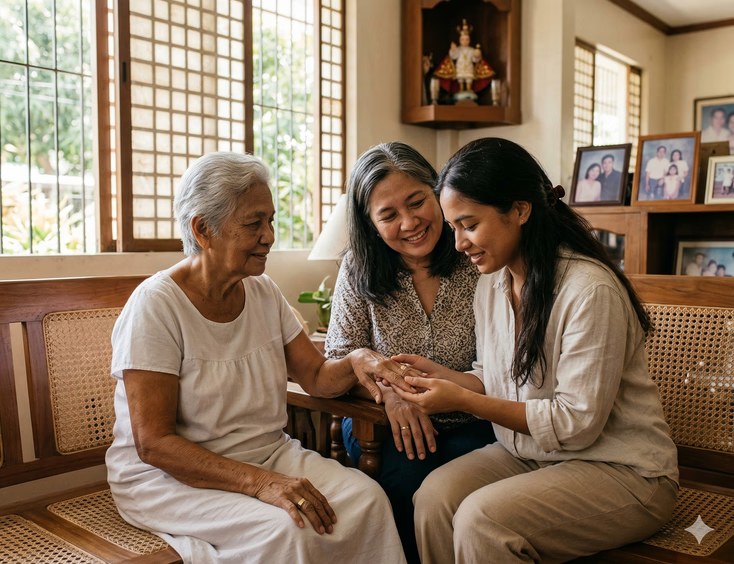
In Filipino culture, the wedding ring carries a weight that extends beyond the two people wearing it. A Filipino wedding is never just about the couple — it is a family event, a community event, a pamilya event. The ring, exchanged in front of parents, grandparents, siblings, ninongs, ninangs, and a churchful of witnesses, is received by the Filipino community as a promise made not just between spouses, but before everyone who loves them.
This is why removing a wedding ring in Filipino culture is never a casual act. It is read as a statement. Filipino spouses — including the millions of OFWs working far from home in the Middle East, Hong Kong, Singapore, and beyond — are known for keeping their rings on precisely because of what its presence (and absence) communicates. The ring is a visible extension of the marriage, present even when the spouse is not.
The Filipino tradition of passing rings down as heirlooms adds another dimension. A lola's wedding ring, worn for fifty years and then given to a granddaughter on her wedding day, is not just jewelry. It carries the accumulated weight of a life lived in fidelity. It is a physical object that bridges generations, connecting the marriage covenant of one couple to the next.
And then there is the ring in grief. Many Filipino widows and widowers continue to wear their wedding rings for years — sometimes for the rest of their lives — after their spouse passes. The ring does not stop meaning something when the person who gave it is gone. If anything, it means more.
What This Means for You: Practical Takeaways for Filipino Catholic Couples
Understanding the symbolism of the wedding ring changes how you approach every practical decision around it — from what you choose to what you spend to what you engrave on the inside.
Let the meaning guide your choice of style. A ring that will be worn every day for the rest of your life should feel right for daily life, not just for the ceremony. Whether that means a simple, durable plain band or a more elaborate design, choose something you will genuinely want to wear — because the whole point is that you wear it.
Take the ring exchange seriously during your wedding rehearsal. Many couples breeze through the rehearsal without paying attention to this moment. Don't. Practice the words. Know which hand, which finger. Understand what you are saying when you say "sign of my love and fidelity." When the real moment comes, you will feel the difference.
Consider what you engrave. The inside of a wedding ring is one of the most intimate, private spaces in the world — seen only by the person who wears it and the person who gave it. What you put there matters. A date, a phrase, a word that only you two understand — it transforms the ring from a symbol in general into a symbol of your specific, particular love. For meaningful ideas, our guide on engraving ideas Filipino couples will love is a good place to start.
Find a jeweler who understands what they are making. A wedding ring is not the same as a fashion accessory. When you are shopping for yours — whether in a mall boutique, an independent atelier, or online — look for a jeweler who takes the craft and the occasion seriously. Browse verified and trusted jewelry and accessories suppliers in the Philippines to find jewelers who work with Filipino couples every day and understand the weight of what they are crafting.
Discuss the ring exchange during Pre-Cana. The Church's marriage preparation program (Pre-Cana or Marriage Encounter) is the right place to deepen your understanding of what you are about to do. Ask your parish priest or preparation facilitator to walk you through the specific rite of your diocese. Some parishes have beautiful reflections on each of the unity symbols — the ring included — that are worth sitting with before your wedding day.
A Circle With No End
The wedding ring is a small thing. Two bands of metal, perhaps set with a stone, costing somewhere between a few thousand and many thousands of pesos. In the grand scale of a Filipino wedding — the venue, the catering, the entourage, the flowers, the dress — it is easy to let the ring become just another item on the checklist.
But on the day itself, in that quiet church, when the moment comes and the ring slides onto the finger — almost no one is thinking about the budget or the setting or the karat weight. They are thinking about the person in front of them. They are thinking about the words they just said. They are thinking, whether they articulate it this way or not, about forever.
The ring holds all of that. The sacrament, the covenant, the family witness, the daily fidelity, the habang buhay — it holds all of it inside a circle with no beginning and no end.
Choose yours thoughtfully. Wear it with intention. And on the day you exchange it, be fully present for what it means.
For everything you need to know about choosing, buying, and wearing your wedding rings in the Philippines — from budgets and metals to where to shop and what's trending — our complete guide has you covered: The Complete Filipino Couple's Guide to Wedding Rings & Bands in the Philippines.
Still Searching for a Right Match?
Find Your Perfect Wedding Supplier Today!
Discover trusted wedding suppliers across the Philippines in our complete directory. Compare services and connect with the ones that fit your dream celebration.
Browse Wedding SuppliersFeatured Posts



Wedding Reception Ideas that Honor Tradition and Wow Your Guests
4 mins readFilipino Wedding Dress Guide for Style Traditions and Smart Shopping
6 mins readFilipino Wedding Cost Guide - Realistic Budgets, Percentages, and Price Drivers by Region
9 mins readPhilippines Honeymoon Guide - Best Islands, Resorts, Costs & 7–14 Day Itineraries
9 mins readFilipino Wedding Games - Traditions, Modern Twists, and Crowd-Pleasers for Every Reception
8 mins read