

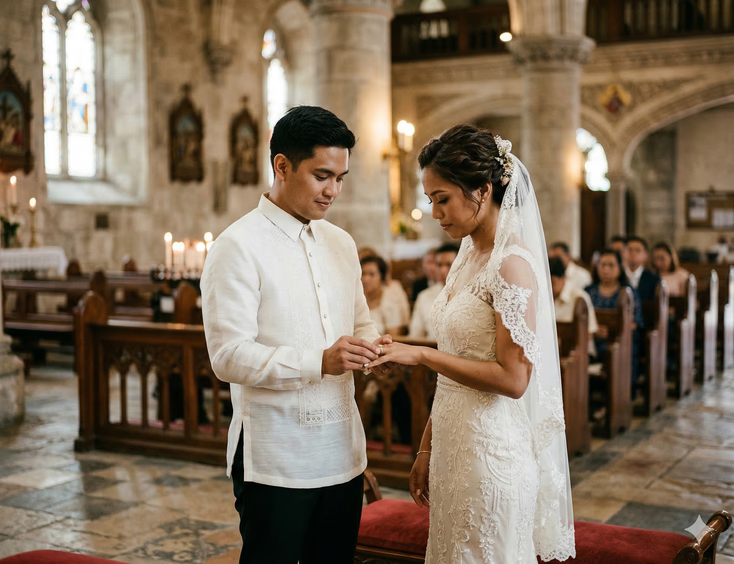
Wedding Rings for Muslim Filipino Couples: What's Permissible and What's Trending
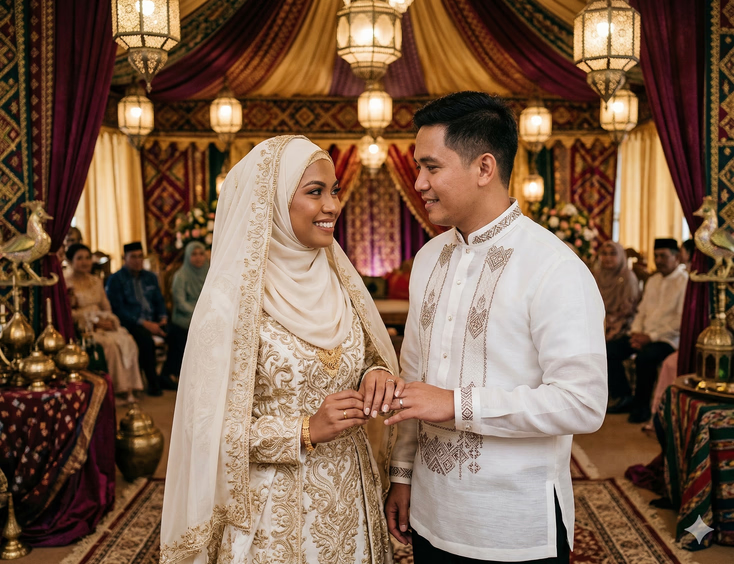
The question of wedding rings in Muslim Filipino culture is one that sits at the intersection of Islamic jurisprudence, Filipino cultural tradition, and the rapidly evolving preferences of a younger generation of Bangsamoro and Muslim Filipino couples navigating all three simultaneously.
It is also a question that most wedding content in the Philippines ignores entirely.
The overwhelming majority of Filipino wedding content — including most of what exists online — is written from an implicitly Catholic perspective. The arras, the veil and cord, the Pre-Cana requirements, the parish priest: these are the defaults of Philippine wedding media. Muslim Filipino couples planning their weddings — in Mindanao, in the Bangsamoro Autonomous Region, in the Muslim communities of Tawi-Tawi, Lanao, Cotabato, and in the Muslim Filipino diaspora across Metro Manila and beyond — are largely left to navigate the ring question without dedicated, reliable guidance.
This guide is written specifically for them.
It covers what Islamic scholarship actually says about wedding rings, where the different positions among scholars sit, how Muslim Filipino culture has historically approached the ring question, what is actually happening among younger Muslim Filipino couples today, and practical guidance for couples who have decided to exchange rings and want to do so thoughtfully and within their faith framework.
A note on scope and humility: Islamic jurisprudence on many practical matters — including wedding rings — is an area where legitimate scholarly disagreement exists. This guide presents the major scholarly positions honestly and does not advocate for one over another. Couples with specific religious questions are encouraged to consult their imam, their local ulama, or a scholar they trust within their own madhhab (school of Islamic jurisprudence).
What Islamic Scholarship Actually Says About Wedding Rings
The first thing to establish clearly is that wedding rings are not mentioned in the Quran. They are also not mentioned in the Sunnah in a way that establishes them as a required or recommended practice in Islamic marriage. The exchange of wedding rings as a marriage symbol is not part of the original Islamic marriage ceremony — the nikah — and was not a practice of the Prophet Muhammad ﷺ or his companions.
This is the foundation from which Islamic scholarly discourse about wedding rings proceeds.
The Mahr — The Islamic Marriage Gift
What Islam does prescribe — as an obligatory component of the nikah — is the mahr (also written mehr or mahar): a gift from the groom to the bride that is her exclusive property, given as a condition of the marriage contract.
The mahr can take many forms. It can be money, gold, property, a service, or any object of value that both parties agree upon. It is not a bride price paid to the family — it belongs entirely and exclusively to the bride, to keep, to use, or to dispose of as she sees fit.
In some Muslim cultures globally, and among some Muslim Filipino couples, a gold ring or a piece of gold jewelry has been given as the mahr — or as part of the mahr. In this context, a ring has a clear and unambiguous Islamic foundation: it is the obligatory gift to the bride, formalized as part of the marriage contract.
This is distinct from a "wedding ring" in the Western or Filipino Catholic sense — a symbol exchanged mutually between both spouses as a sign of their covenant. The mahr ring, if that is the form the mahr takes, is given by the groom to the bride only and carries a different legal and symbolic weight.
The Main Scholarly Positions on Wedding Rings in Islam
Islamic scholars have approached the question of wedding rings from several angles, and the positions span a meaningful range.
Position 1: Wedding rings are permissible (mubah) as a cultural practice
This is arguably the most widely held position among contemporary Islamic scholars globally, and the one most likely to be encountered by Muslim Filipino couples consulting mainstream Islamic resources. Under this view, wedding rings are a neutral cultural custom — neither prescribed by Islam nor prohibited by it. They are permissible as long as certain conditions are met (discussed below). Wearing a ring does not constitute an act of worship or religious ritual, so adopting the practice as a cultural expression of marriage is acceptable.
Scholars who hold this position typically cite the principle of ibahah — the default permissibility of things not explicitly prohibited — as the basis for their ruling.
Position 2: Wedding rings are makruh (discouraged) because they imitate non-Muslim practices
Some scholars — particularly those with a more conservative orientation — consider wedding rings discouraged because they represent tashabbuh (imitation) of non-Muslim, specifically Western or Christian, marriage customs. The concern is not about the ring itself but about the adoption of a practice that is not rooted in Islamic tradition and that may, over time, blur the distinct identity of Muslim marriage practices.
This position is a minority view among contemporary scholars but is sincerely held and deserves respectful acknowledgment rather than dismissal.
Position 3: The specific prohibition on gold rings for men
This is the position on which there is the greatest scholarly consensus, across madhhabs: gold rings are prohibited (haram) for Muslim men. This ruling is based on authentic hadith in which the Prophet Muhammad ﷺ prohibited men from wearing gold.
This has direct practical implications for Muslim Filipino grooms considering wedding rings. A gold wedding ring — the default for Filipino weddings — is not permissible for a Muslim groom. This is not a matter of scholarly dispute; it is a well-established ruling across the major schools of Islamic jurisprudence.
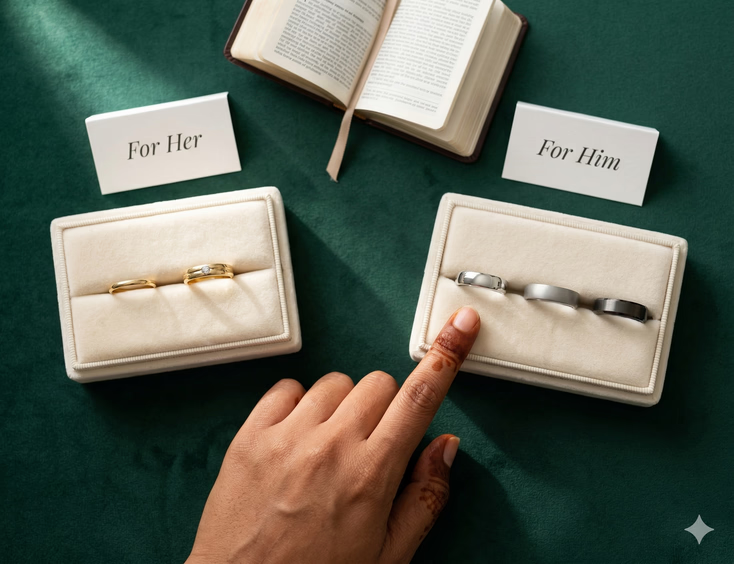
What this means for Muslim Filipino grooms: If you are wearing a wedding ring, it must not be made of gold. Silver, platinum, titanium, tungsten, stainless steel, and other non-gold metals are permissible alternatives.
Position 4: No prohibition on gold rings for women
There is broad scholarly consensus that gold jewelry — including gold rings — is permissible for Muslim women. A Muslimah bride wearing a gold wedding ring is not doing anything prohibited under Islamic law. The prohibition on gold applies specifically to men.
Conditions Under Which Wedding Rings Are Permissible for Muslim Filipino Couples
For Muslim Filipino couples who have concluded — after consulting their own religious guidance — that exchanging wedding rings is permissible within their practice, the following conditions represent the mainstream scholarly framework for that practice:
For the bride:
- Any metal is permissible, including gold, silver, platinum, and others
- The ring should not contain any symbols, imagery, or inscriptions that are prohibited in Islam (crosses, images of living beings, names of deities other than Allah)
- Wearing the ring should not be understood as an act of religious worship — it is adornment, not ritual
For the groom:
- Gold is prohibited — the ring must be made of a non-gold metal (silver, platinum, titanium, tungsten, stainless steel, or other permissible materials)
- The same conditions about prohibited symbols and inscriptions apply
- Silver is the most commonly cited permissible metal for Muslim men's rings, supported by hadith indicating that the Prophet ﷺ wore a silver ring used as a seal
For both:
- The ring should not be understood as having any inherent magical, protective, or spiritual power — Islamic theology prohibits the attribution of such powers to objects
- The exchange of rings does not constitute or replace any part of the nikah — the marriage is contracted through the ijab and qabul (offer and acceptance) in the presence of a wali and witnesses, not through the ring exchange
The Nikah and the Ring: Understanding the Ceremony Context
For Muslim Filipino couples, it is important to understand that the ring exchange — if it happens at all — is not part of the nikah itself. The nikah is contracted through:
- The ijab — the offer, typically made by the wali (guardian) of the bride or the bride herself in some scholarly opinions
- The qabul — the acceptance by the groom
- Two Muslim witnesses of sound mind
- The mahr — agreed upon and formally declared as part of the contract
The ring, if exchanged, happens outside this contractual structure — typically as a separate ceremonial gesture before or after the nikah proper, often in the presence of family.
This is a meaningful distinction for Muslim Filipino couples to understand: the ring has no legal or religious function in the nikah. The marriage is complete without it. Whatever significance the ring carries is cultural and personal, not religious and contractual.
Muslim Filipino Wedding Ring Traditions: What Has Been Practiced
Muslim Filipino communities — across the Maranao, Maguindanao, Tausug, Yakan, Sama, and other Bangsamoro peoples — have their own rich wedding traditions that predate and exist alongside any practice of exchanging Western-style wedding rings.
Traditional Bangsamoro weddings are elaborate, multi-day affairs involving the pamamanhikan (family negotiations and bride price discussions), the nikah ceremony, and the kenduri (feast). These ceremonies are dense with meaning and tradition — the mas kawin (mahr), the pasalamatan (thanksgiving), the intricate malong and sinaluan textiles worn by the couple, the music of the kulintang.
Western-style wedding rings were not historically part of these traditions. Their adoption by Muslim Filipino couples is a relatively recent development, shaped by broader Filipino cultural influence, exposure to global wedding culture through media and the internet, and the significant Muslim Filipino diaspora communities in Metro Manila and abroad who navigate both Muslim Filipino and mainstream Filipino cultural norms simultaneously.
For older and more traditional Muslim Filipino families — particularly in rural Bangsamoro communities — the wedding ring may be seen as a foreign custom of limited relevance to their own rich ceremonial tradition. For younger, urban Muslim Filipino couples, it is increasingly incorporated as a personal and meaningful element of their wedding celebration.
Both positions are legitimate. Neither represents a failure to honor Islamic or Bangsamoro identity.

What Younger Muslim Filipino Couples Are Actually Choosing Today
The Muslim Filipino wedding landscape has shifted significantly in recent years, and the ring question reflects this shift clearly.
The Growing Popularity of Rings Among Urban Muslim Filipino Couples
Among younger Muslim Filipino couples — particularly those in Metro Manila, Davao, Cagayan de Oro, and other urban centers — the exchange of wedding rings at or around the nikah ceremony is increasingly common. Several factors drive this:
Social media and global wedding culture. Instagram, Pinterest, and TikTok have exposed younger Muslim Filipino couples to wedding ring aesthetics from Muslim communities worldwide — including the thriving halal wedding industries of Malaysia, Indonesia, Turkey, and the Gulf states, where tasteful wedding jewelry is widely embraced within an Islamic framework.
The Malaysian and Indonesian influence. The large, well-documented Muslim wedding cultures of Malaysia and Indonesia — Southeast Asian Muslim nations with strong cultural ties to the Philippines, particularly Mindanao — provide visible models of contemporary Islamic practice that comfortably incorporates wedding jewelry. Younger Filipino Muslims look to these communities as culturally proximate references for what a modern Islamic wedding can look like.
Urban Muslim Filipino identity navigation. Young Muslim Filipinos in Metro Manila and other non-Muslim majority cities navigate a daily reality where Filipino wedding culture is everywhere — in office colleagues' weddings, in television, in social media. Many choose to incorporate elements of the broader Filipino wedding tradition into their own celebration in ways that remain within their Islamic framework, and the ring is often one of these elements.
What Muslim Filipino Grooms Are Choosing for Their Rings
Given the prohibition on gold for Muslim men, grooms who choose to wear a wedding ring have clear practical parameters. The options most commonly chosen by Muslim Filipino grooms:
Silver. The most religiously supported option, given the hadith about the Prophet's ﷺ silver seal ring. Plain silver bands are widely available, affordable, and carry the additional merit of being a metal with prophetic precedent. The practical limitation: silver is softer than gold and tarnishes with regular wear, requiring periodic polishing. For a ring worn daily in the Philippine heat and humidity, this is worth factoring in.
Platinum. A white metal that does not tarnish, does not require plating, and has a prestige and durability that silver cannot match. Platinum is permissible for Muslim men and is increasingly the choice of Muslim Filipino grooms who want a ring with long-term wearability at a premium price point.
Titanium. Lightweight, extremely durable, hypoallergenic, and available in a range of finishes from polished to matte. A practical and affordable option for Muslim Filipino grooms who want a contemporary-looking ring that will hold up to daily life. Cannot be resized, which is worth noting.
Tungsten. Extremely scratch-resistant, substantial in feel, and available in matte and polished finishes. Popular among Muslim Filipino grooms who prefer the weight and durability of a more substantial ring. Also cannot be resized.
Stainless steel. The most budget-accessible option. Available in a wide range of styles and finishes, including some with Islamic geometric motifs. Quality varies significantly — invest in surgical-grade stainless steel for durability.
What Muslim Filipina Brides Are Choosing
Muslimah brides have the full range of metal options available to them, and Muslim Filipino brides are choosing across the full spectrum of what their non-Muslim Filipino counterparts choose — with some distinctly Islamic aesthetic preferences emerging.
Yellow gold remains the most popular choice, consistent with both Filipino cultural tradition and the Islamic permissibility of gold for women. Many Muslim Filipino brides receive gold jewelry — rings, bracelets, necklaces — as part of their mahr or as wedding gifts, and a gold wedding ring fits naturally within this context.
Geometric and arabesque designs. A growing number of Muslim Filipino brides are choosing rings that incorporate Islamic geometric motifs — the intricate patterns that characterize Islamic art and architecture. These designs are available from some specialty jewelers and from the growing market of Muslim-owned jewelry businesses catering specifically to the halal wedding market. A ring with an arabesque pattern or a geometric star motif is both beautiful and distinctly expressive of Muslim identity.
Rings with Arabic calligraphy. Some Muslim Filipino couples engrave their rings with Quranic verses, the shahada, or meaningful Arabic phrases. This requires care: the shahada and Quranic text carry sacred status in Islamic practice, and rings bearing sacred text should be handled with appropriate respect — removed before entering the bathroom, for example. Some scholars advise against engraving the shahada on jewelry worn constantly for this reason. Discuss with your imam or a trusted scholar before choosing a Quranic engraving.
Modest, low-profile settings. Many Muslimah brides, particularly those who observe hijab, prefer understated jewelry that does not draw excessive attention. The minimalist ring trend that resonates with younger Filipino couples generally aligns naturally with the Islamic principle of avoiding israf (excess and extravagance) — and a beautiful, simple band in quality gold is entirely consistent with both preferences.
Rings as Mahr: A Meaningful Option for Muslim Filipino Couples
As mentioned earlier, giving a ring as the mahr — or as part of the mahr — has deep Islamic legitimacy and can be a beautiful way for Muslim Filipino couples to connect the wedding ring to its most meaningful possible function within an Islamic framework.
If you are considering this approach:
The mahr must be of agreed and real value. A ring given as mahr should be made of genuine precious metal — gold or silver — of a quality and weight that represents real value. A gold-plated or costume jewelry ring is not an appropriate mahr because it misrepresents its value.
The mahr is exclusively the bride's property. A ring given as mahr belongs entirely and irrevocably to the bride. It is not a "shared" symbol in the way a Western wedding ring is conceptualized — it is her property, hers to keep, wear, sell, or give away as she sees fit.
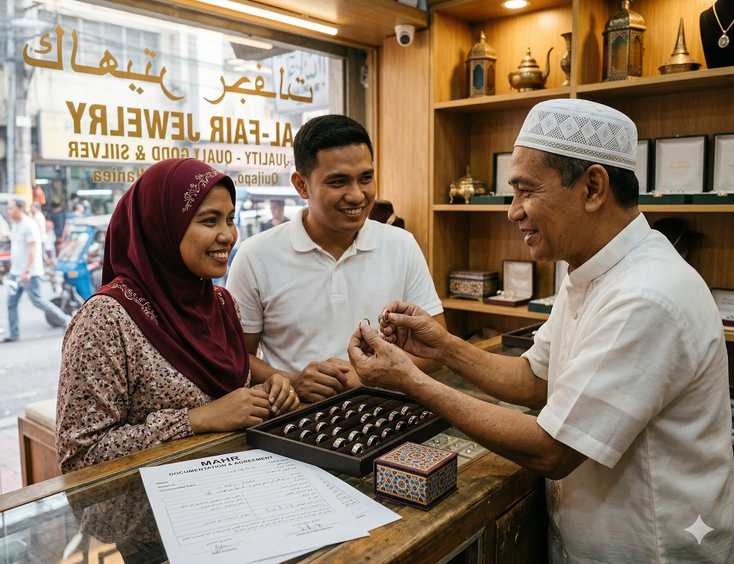
The mahr amount should be agreed and declared during the nikah. If a ring is the mahr, its value should be stated clearly in the marriage contract. Some couples have the ring appraised before the nikah to establish its documented value.
A ring as mahr does not preclude a separate wedding ring exchange. Some Muslim Filipino couples give a gold ring as mahr and then also exchange separate wedding bands — a different ring from a different occasion in the ceremony. Others give the mahr ring as the only ring exchanged. Both approaches are practiced.
Practical Guidance for Muslim Filipino Couples Buying Wedding Rings
Finding Jewelers Who Understand Your Needs
Most mainstream Philippine jewelry shops — mall boutiques and independent jewelers alike — are not specifically oriented toward Muslim Filipino couples and may not immediately understand the prohibition on gold for men or the significance of the mahr in the transaction.
What to communicate to any jeweler:
- The groom requires a non-gold metal — silver, platinum, titanium, or tungsten
- If the ring will serve as mahr, you need documentation of its appraised value
- If you want Islamic geometric or Arabic calligraphic designs, ask whether the jeweler has experience with these or can source them
- You may want to avoid any ring designs that incorporate non-Islamic symbols
Muslim-owned jewelry businesses in the Philippines — some of which operate in Quiapo, in Muslim-majority areas of Mindanao, and increasingly through social media — are often better positioned to understand these requirements without extensive explanation. Seeking out a Muslim Filipino jeweler for your wedding rings is worth the additional research.
Engraving Considerations for Muslim Filipino Couples
If you want to engrave your wedding rings, the content of the engraving deserves careful thought within an Islamic framework:
Recommended engraving options:
- The wedding date in numerals or Arabic numerals
- Each other's names in Arabic or Filipino script
- Short Arabic phrases: "Barakallahu lakuma" (May Allah bless you both) is a traditional Islamic wedding blessing; "Masha'Allah" is another option
- A meaningful phrase in Filipino, Maranao, Maguindanaon, Tausug, or another language significant to your heritage
Engraving the shahada or Quranic ayat: This requires specific scholarly consultation and is not recommended without it. The sacred status of these texts and the practical considerations of wearing them on a ring that is worn continuously through all situations — including the bathroom — create complications that some scholars consider prohibitive.
Where to Shop for Muslim Filipino Wedding Rings
Quiapo, Manila. The Quiapo district has a significant Muslim Filipino commercial presence, including jewelry sellers catering to Muslim Filipino customers. Gold jewelry and silver pieces are available here from sellers familiar with Muslim Filipino wedding customs.
Bangsamoro and Mindanao markets. In Cotabato City, Marawi, Zamboanga, and Tawi-Tawi, local jewelry markets carry pieces — including traditional gold jewelry and silver work — that are relevant to Muslim Filipino wedding traditions. Meranaw gold craftsmanship in particular has a long and distinguished tradition.
Muslim-owned online jewelers. A growing number of Muslim Filipino jewelry makers operate through Facebook, Instagram, and Shopee, catering specifically to Muslim Filipino bridal couples. These sellers are more likely to understand the specific requirements without explanation and to offer designs with Islamic aesthetic elements.
Mainstream Philippine jewelry shops. Standard mall jewelry shops can serve Muslim Filipino couples for the bride's gold ring and for non-gold options for the groom — particularly platinum and titanium — but will require you to communicate your specific requirements clearly.
Browse verified jewelry and accessories suppliers in the Philippines to find jewelers who can serve Muslim Filipino couples with the specific requirements and aesthetic sensibilities this guide has outlined.
A Word on Respect, Diversity, and Getting This Right
Muslim Filipino couples represent an enormous diversity of practice, tradition, regional identity, and religious observance. A Tausug couple from Tawi-Tawi, a Maranao couple from Marawi, and a Muslim Filipino couple from a Metro Manila diaspora community may have significantly different relationships to the wedding ring question — shaped by their specific cultural tradition, their family's practice, their imam's guidance, and their own personal convictions.
This guide has tried to present the relevant Islamic scholarly positions, the cultural context, and the practical options honestly — without prescribing a single right answer. Because there is not one.
What there is: enough information to have an informed conversation with your partner, your family, and your religious community about what is right for your wedding, your faith, and your life together.
The ring — or the absence of a ring — is not what makes a Muslim Filipino marriage valid, meaningful, or blessed. The nikah does that. What the ring can do, for couples who choose it thoughtfully and within their faith framework, is mark the occasion with a tangible symbol of a commitment that begins at the altar and is meant to last a lifetime.
For the complete resource on wedding rings in the Philippines — across traditions, budgets, styles, and buying options — our pillar guide covers it all: The Complete Filipino Couple's Guide to Wedding Rings & Bands in the Philippines.
Still Searching for a Right Match?
Find Your Perfect Wedding Supplier Today!
Discover trusted wedding suppliers across the Philippines in our complete directory. Compare services and connect with the ones that fit your dream celebration.
Browse Wedding SuppliersFeatured Posts




Wedding Reception Ideas that Honor Tradition and Wow Your Guests
4 mins readFilipino Wedding Dress Guide for Style Traditions and Smart Shopping
6 mins readFilipino Wedding Cost Guide - Realistic Budgets, Percentages, and Price Drivers by Region
9 mins readPhilippines Honeymoon Guide - Best Islands, Resorts, Costs & 7–14 Day Itineraries
9 mins readFilipino Wedding Games - Traditions, Modern Twists, and Crowd-Pleasers for Every Reception
8 mins read