

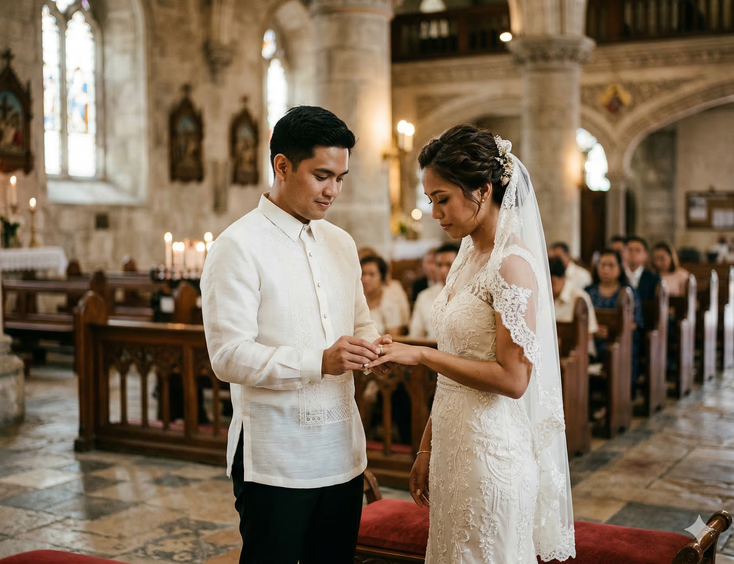
Civil Wedding Rings in the Philippines: Do You Still Need a Ring for a Courthouse Wedding?

Civil weddings in the Philippines have a reputation they do not entirely deserve.
In the popular imagination — shaped largely by decades of Filipino film and television where the civil wedding is either a rushed compromise or a temporary placeholder before the "real" church wedding — a courthouse ceremony is a lesser version of the real thing. Functional. Practical. Devoid of the ritual weight of a full Catholic nuptial mass.
This picture is inaccurate, and it is worth correcting before anything else in this guide.
A civil wedding in the Philippines is a legally complete marriage. The couple who exchanges vows before a judge, a mayor, or a civil registrar is as fully and legally married as the couple who walked out of San Agustin Church in Intramuros with a hundred guests watching. The law does not distinguish. The Family Code of the Philippines does not distinguish. The marriage is valid, complete, and carries every right and responsibility that marriage under Philippine law entails.
What a civil wedding does not have is the sacramental dimension that the Catholic Church adds to the ceremony — and for Filipino Catholic couples, that difference matters in ways this guide will address honestly. But the legal reality is clear: a civil wedding is a real wedding.
Which brings us to the question this guide is built around: in a civil wedding in the Philippines — whether at a city hall, a local civil registry office, or in front of a judge — do you actually need wedding rings?
The answer is more nuanced than yes or no, and understanding that nuance helps Filipino couples make a genuinely informed decision about what their civil wedding ceremony should include.
The Legal Answer: What Philippine Law Actually Requires
Let's start with the clearest possible statement of the legal position.
Philippine law does not require the exchange of wedding rings for a civil marriage to be legally valid.
The Family Code of the Philippines (Executive Order No. 209) defines the essential and formal requisites of marriage. The essential requisites are legal capacity and consent freely given. The formal requisites are a marriage license (with specific exceptions), a marriage ceremony conducted by a solemnizing officer, and at least two witnesses. Wedding rings are not listed among the essential or formal requisites.
This means: a civil wedding ceremony in the Philippines can be legally completed and result in a fully valid marriage without any rings being present, exchanged, or mentioned.
The solemnizing officer — whether a judge, a mayor, a municipal civil registrar authorized to solemnize marriages, or another officer with legal authority to do so — conducts the ceremony according to a standard civil marriage rite. This rite involves the declaration of consent by both parties, witnessed by at least two people. It does not require a ring exchange.
This is the complete legal answer. Rings are legally optional in a Philippine civil wedding.
The Practical Answer: What Actually Happens at Philippine Civil Weddings
Legal optionality and practical reality are not always the same thing. Here is what actually happens at civil weddings in the Philippines.
At City Hall and Municipal Civil Registry Offices
The standard civil wedding at a Philippine local government unit — city hall, municipal hall, or civil registry office — typically follows a brief, structured ceremony conducted by the mayor, civil registrar, or an authorized solemnizing officer.
In practice, most of these ceremonies include a ring exchange as a standard part of the ceremony script, even though it is not legally required. The reason is simple: most couples who come to a civil wedding ceremony bring rings, expect to exchange them, and the ceremony script accommodates this as a matter of course.
However — and this is important — the solemnizing officer will not refuse to marry you if you do not have rings. The ceremony will proceed. The marriage will be valid. The ring exchange is an included element, not a gating requirement.
What this means for couples: If you want rings in your civil ceremony, bring them. If you don't — whether by choice or because of circumstances — the ceremony proceeds without them.
Weddings Solemnized by a Judge
Judges solemnize marriages in their courts as part of their official functions, typically in chamber or in the courtroom. The atmosphere is typically brief and formal. Some judges follow a standard script that includes a ring exchange; others do not include it unless the couple specifically requests it.
If you are being married by a judge and want a ring exchange included, confirm this with the judge's office in advance. Do not assume it will happen automatically — and do not assume it won't. Ask directly.
Civil Weddings Held at Other Venues
Philippine law allows civil weddings to be held at locations other than government offices — a home, a garden, a function room — as long as a legally authorized solemnizing officer conducts the ceremony. These weddings can be as elaborate or as simple as the couple chooses, and the ceremony can be customized significantly more than a standard city hall ceremony.
For couples having a civil wedding at a venue of their choosing, the ring exchange is entirely at the couple's discretion. It can be made as central to the ceremony as in a Catholic wedding, or omitted entirely. The ceremony structure is flexible in a way that a standard government office civil wedding is not.

Why Many Filipino Couples Choose Civil Weddings — And What That Means for the Ring Decision
Understanding why a Filipino couple is having a civil wedding rather than a Catholic church wedding often clarifies what the ring decision should be for them specifically. The reasons are varied, and each carries different implications.
Reason 1: Legal Marriage First, Church Wedding Later
This is the most common civil wedding scenario among Filipino Catholic couples. The couple legally marries at the civil registry — often quietly, with minimal guests — and then celebrates the sacramental marriage in a Catholic church ceremony at a later date, sometimes months or years later.
This arrangement happens for practical reasons: the church wedding date is not yet available, the couple needs to be legally married for immigration purposes (a very common reason for OFW couples), or the church preparation requirements have not yet been completed.
The ring question for this scenario: Many couples in this situation choose not to exchange rings at the civil ceremony, reserving that moment for the church wedding where the ring exchange carries its full sacramental weight. Others exchange simple rings at the civil ceremony and then use those same rings — or new ones — at the church ceremony.
There is no wrong answer here. The Catholic Church does not require that the rings used in the sacramental ceremony be new — a ring already worn from the civil wedding can be blessed and exchanged in the church ceremony with full sacramental validity.
One practical consideration: If you plan to have both a civil and a church wedding, discuss with your parish priest what the ring exchange at the church ceremony will look like. Some priests ask couples who are already legally married to frame their church ceremony as the celebration of the sacrament rather than a repetition of the legal marriage — and the ring exchange in that context may be handled differently.
Reason 2: The Couple Is Not Catholic or Is Not Having a Religious Wedding
For Filipino couples who are not Catholic, who belong to other Christian denominations or other faiths, or who prefer a secular ceremony for personal reasons, the civil wedding may be their only wedding ceremony rather than a precursor to a religious one.
The ring question for this scenario: The ring exchange has exactly as much significance as the couple gives it. Without the sacramental framework of the Catholic Rite of Marriage, the ring remains a powerful cultural and personal symbol — one that most Filipinos associate with marriage regardless of religious context — but its specific meaning is defined by the couple rather than by Church teaching.
For non-Catholic Filipino couples having a civil-only wedding, exchanging rings is simply a meaningful choice, not a theological one. Most couples in this situation do exchange rings, because the cultural association between rings and marriage in the Philippines is strong and widely shared regardless of religious background.
Reason 3: Practical Constraints — Budget, Timeline, or Legal Necessity
Some Filipino couples have a civil wedding because it is the fastest, most practical path to legal marriage — whether because of budget constraints, timeline pressures, immigration requirements, or other practical considerations.
The ring question for this scenario: Budget constraints are real, and this guide will not pretend otherwise. If financial pressure is the reason for a civil wedding, the ring budget may be very limited. That is completely manageable.
A plain, well-made gold band in 14k yellow gold can be purchased in the Philippines from as little as ₱3,000–₱6,000 per ring. Two rings for a civil wedding at a combined budget of ₱8,000–₱15,000 is entirely achievable without sacrificing quality or meaning. The ring does not need to be elaborate to carry weight — as we explore in our guide on why minimalist wedding rings are trending among Filipino couples, a simple band chosen with genuine intention is often more meaningful than an elaborate one chosen to impress.
What Kind of Ring Makes Sense for a Civil Wedding?
If you have decided to exchange rings at your civil wedding — whether at city hall or at a venue of your choice — what kind of ring makes sense for the occasion and context?
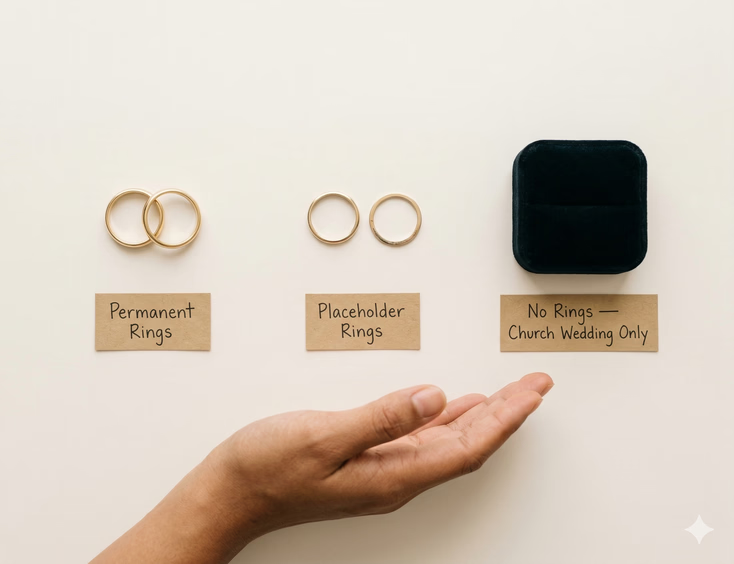
Option 1: Your Permanent Wedding Rings
Many couples who have a civil-only wedding simply buy the rings they intend to wear permanently and exchange them at the ceremony. This is the most straightforward approach and the one that treats the civil ceremony with the full weight it deserves — the rings exchanged at the civil ceremony are the rings, full stop.
Who this suits: Couples for whom the civil wedding is their only ceremony. Couples who want to treat the civil ceremony as a complete and equal celebration of their marriage rather than a legal formality. Couples who do not plan a subsequent church wedding.
Option 2: Placeholder Rings Now, "Real" Rings at the Church Wedding
Some Filipino Catholic couples exchange simple, inexpensive bands at the civil ceremony — treating them as placeholders — and then exchange more carefully chosen rings at the church wedding.
The honest assessment of this approach: It is practical and common, but worth examining honestly. If the civil ceremony is treated as a legal formality and the church wedding as the "real" wedding, the ring exchange at the civil ceremony can feel hollow — going through the motions rather than marking a genuine moment.
An alternative framing that some Filipino Catholic couples find more meaningful: the rings exchanged at the civil ceremony are the legal-covenant rings; the rings exchanged at the church ceremony are the sacramental-covenant rings. Different dimensions of the same marriage, marked separately. This framing can give both exchanges genuine significance rather than making one feel like a rehearsal for the other.
Option 3: No Rings at the Civil Ceremony, Rings at the Church Wedding
For Filipino Catholic couples who are legally marrying first and celebrating the sacrament later, skipping the ring exchange at the civil ceremony entirely is a completely valid choice — and for some couples, the most honest one.
If the ring exchange is understood as a sacramental act — the moment when the couple makes their covenant before God in the context of the Catholic Rite of Marriage — then having a separate ring exchange at a city hall ceremony may feel redundant or even incongruous with that understanding.
What the Catholic Church says: The Church does not prohibit couples from having had a civil ceremony before their church wedding. What it requires for the marriage to be sacramental is that the couple freely consent to marriage in the presence of a priest or deacon and two witnesses, following the prescribed Rite of Marriage. The ring exchange is part of that rite. Whether rings were also exchanged at a prior civil ceremony is irrelevant to the sacramental validity of the church ceremony.
Civil Wedding Rings and the Catholic Church: What Filipino Couples Need to Know
For Filipino Catholic couples navigating both a civil wedding and a planned church wedding, there are a few specific Church-related considerations worth understanding.
The Church's Position on Civil Marriages
The Catholic Church in the Philippines recognizes that many Catholics are civilly married before their sacramental wedding. This is not treated as an irregular situation requiring extraordinary intervention — it is simply the reality of many Filipino Catholic couples' legal and practical circumstances.
What the Church does require is that a Catholic who intends to marry sacramentally has not previously contracted a valid sacramental marriage with someone else. A civil marriage to the same person the couple is now marrying sacramentally is not an impediment. The church wedding is the sacrament; the civil wedding was the legal contract.
Pre-Cana and Civilly Married Couples
Filipino Catholic couples who are already civilly married when they begin their church wedding preparation (Pre-Cana) should inform their parish priest of this situation at the outset. Most parishes are completely familiar with this scenario and handle it routinely. The Pre-Cana requirements are the same regardless of civil marriage status.
The Ring Exchange at the Church Wedding for Already-Civilly-Married Couples
As noted earlier, couples who already exchanged rings at their civil ceremony can use those same rings at the church wedding ceremony. The rings will be blessed by the priest as part of the Rite of Marriage, and the exchange will carry full sacramental significance. The prior wearing of the ring does not diminish the blessing or the exchange.
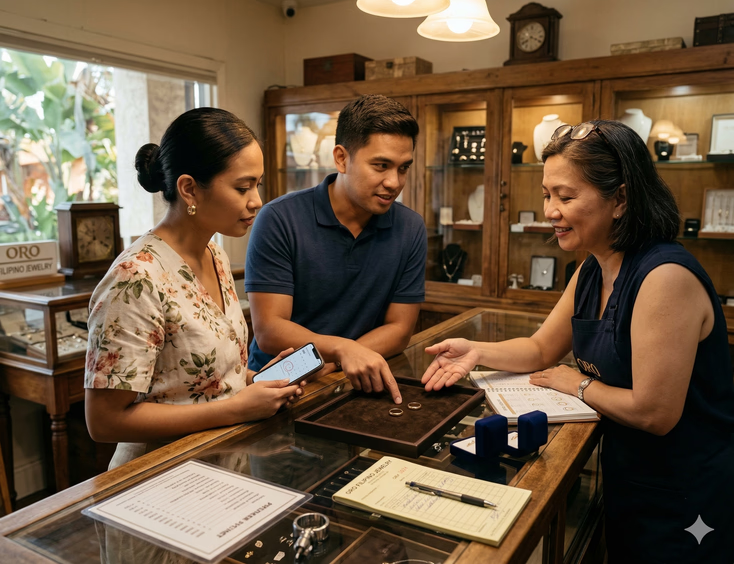
Buying Wedding Rings for a Civil Wedding: Practical Guidance
If you have decided to exchange rings at your civil wedding — whether as permanent rings or as part of a two-ceremony plan — here is practical guidance specific to this context.
Timeline for Civil Wedding Ring Shopping
Civil weddings are often planned on shorter timelines than church weddings — sometimes weeks rather than months. If your civil wedding is coming up quickly:
- For ready-made plain bands: Most Philippine jewelry shops can complete a same-day or next-day purchase for in-stock sizes. Engraving adds three to ten business days.
- For custom rings: You need at least six to eight weeks. If your civil wedding is sooner than that, ready-made is the right choice.
- For online purchases: Allow at least two to three weeks for delivery plus any sizing issues.
For a complete timeline guide across all ring-buying scenarios, our wedding ring shopping timeline applies equally to civil wedding ring purchases.
Budget Considerations for Civil Wedding Rings
Civil weddings in the Philippines are often budget-conscious affairs. Here is a realistic picture of what well-made wedding rings cost at the accessible end of the market:
| Configuration | Approximate Cost (per ring) | Where to Find |
|---|---|---|
| Plain 14k yellow gold band, 2mm–3mm | ₱3,000–₱8,000 | Mall jewelry shops, independent jewelers, Meycauayan |
| Plain 18k yellow gold band, 2mm–4mm | ₱6,000–₱18,000 | Mall boutiques, established independent jewelers |
| Plain sterling silver band | ₱500–₱2,000 | Available widely; not recommended for permanent daily wear |
| Moissanite accent band, 14k gold | ₱8,000–₱20,000 | Specialty jewelers, select online sellers |
The honest recommendation: Even for a budget civil wedding, invest in at least 14k gold for any ring you intend to wear permanently. Sterling silver tarnishes and scratches too readily for daily wear. Gold-plated rings lose their plating quickly. A small, plain, genuine gold band costs more upfront but lasts indefinitely — and if this ring will be your permanent wedding ring, it deserves to be made of a material that honors that permanence.
For a full breakdown of what wedding ring budgets buy across the Philippines, our realistic wedding ring budget guide gives you the complete picture.
Where to Buy Civil Wedding Rings in the Philippines
The same sources that serve couples planning church weddings serve civil wedding couples equally well:
- Mall jewelry shops — convenient, warranty-backed, with ready-made inventory in common sizes
- Independent local jewelers — often more flexible on timeline and customization for simple pieces
- Meycauayan workshops — excellent value for plain gold bands if you have time to make the trip or coordinate remotely
- Verified online sellers — workable for simple plain bands from sellers with strong verified track records, with appropriate lead time
Browse verified jewelry and accessories suppliers in the Philippines to find trusted jewelers who work with couples across all ceremony types and budgets.
The Question Worth Sitting With
Beyond the legal requirements, beyond the logistics, and beyond the budget considerations, there is one question that deserves an honest answer before your civil wedding:
What do you want this ceremony to mean?
If you want your civil wedding to be a complete, full-weight celebration of your commitment to each other — witnessed by people you love, marked by the exchange of rings that you will wear for the rest of your lives — then yes, get rings. Make the moment. Let it be what it is: a real wedding.
If you are having a civil wedding for practical reasons and saving the full ceremony experience for a later church wedding, decide consciously what role the ring exchange plays in each ceremony — and let both decisions be deliberate rather than default.
And if rings feel genuinely unnecessary for your civil ceremony — because the legal consent is what matters to you and the ring is a symbol you associate specifically with the religious dimension you are saving for later — then that too is a considered, defensible position.
The law does not require the ring. What matters is that whatever you decide, you decide it with your partner, on purpose, with full understanding of what each choice means.
That is what makes a wedding — civil or otherwise — a real one.
For everything you need to know about wedding rings in the Philippines — from symbolism to styles to where to buy — our complete guide covers it all: The Complete Filipino Couple's Guide to Wedding Rings & Bands in the Philippines.
Still Searching for a Right Match?
Find Your Perfect Wedding Supplier Today!
Discover trusted wedding suppliers across the Philippines in our complete directory. Compare services and connect with the ones that fit your dream celebration.
Browse Wedding SuppliersFeatured Posts




Wedding Reception Ideas that Honor Tradition and Wow Your Guests
4 mins readFilipino Wedding Dress Guide for Style Traditions and Smart Shopping
6 mins readFilipino Wedding Cost Guide - Realistic Budgets, Percentages, and Price Drivers by Region
9 mins readPhilippines Honeymoon Guide - Best Islands, Resorts, Costs & 7–14 Day Itineraries
9 mins readFilipino Wedding Games - Traditions, Modern Twists, and Crowd-Pleasers for Every Reception
8 mins read