

The Complete Guide to Interfaith Marriage in the Philippines: Legal, Religious, and Cultural Everything You Need to Know
Interfaith couples in the Philippines face a specific set of decisions that other couples do not. The legal system, the Catholic Church, Muslim personal law, and the expectations of Filipino families all pull in different directions. This guide covers every major dimension of interfaith marriage in the Philippines so you can plan with clarity and confidence.
The State of Interfaith Marriage in the Philippines
The Philippines is one of the most religiously diverse countries in Southeast Asia. Around 85 percent of Filipinos identify as Catholic. About 6 to 7 percent practice Islam, concentrated in Mindanao and parts of the Sulu Archipelago. The remaining population includes Born Again Christians, Iglesia ni Cristo members, Protestants, Buddhists, Aglipayans, and those with no religious affiliation.
This mix produces a significant number of interfaith couples every year. Some navigate their differences with ease. Others spend months, sometimes years, working through family pressure, religious requirements, and logistical complexity before they can legally marry.
Two things determine how complicated your interfaith marriage process will be: which religions are involved and whether you marry civilly, religiously, or both.
The Legal Foundation: Marriage Law in the Philippines
The Family Code Governs All Marriages
Presidential Decree 1083, the Code of Muslim Personal Laws, governs marriages where both parties are Muslim. For everyone else, the Family Code of the Philippines sets the rules.
Under the Family Code, a marriage is valid when two legally capacitated individuals consent to marry before an authorized solemnizing officer, with a valid marriage license, and in the presence of at least two witnesses.
Religious ceremonies conducted by authorized clergy count as legal marriages. A Catholic priest, a Protestant minister, an Iglesia ni Cristo minister, and an imam all qualify as solemnizing officers under Philippine law, provided they register their authority with the Office of the Civil Registrar General.
A civil wedding performed by a judge or mayor also produces a legally binding marriage.
The Marriage License Requirement
Both of you must secure a marriage license from the Local Civil Registrar of the city or municipality where either of you has lived for at least six months. The process requires:
- Certificate of Legal Capacity to Contract Marriage (for foreign nationals)
- Birth certificates authenticated by the Philippine Statistics Authority
- Certificate of No Marriage Record (CENOMAR) from the PSA
- Community tax certificates
- Completion of a Family Planning and Responsible Parenthood seminar
The marriage license is valid for 120 days from the date of issuance. You must use it within that window or restart the application.
Muslims who marry under the Code of Muslim Personal Laws follow a separate registration process through the Shari'a courts and the National Commission on Muslim Filipinos.
Can You Have Two Separate Ceremonies?
Yes. Many interfaith couples hold two separate ceremonies: one civil and one religious, or one for each faith tradition. The legal marriage is recorded once. The second ceremony carries cultural and spiritual significance but does not create a second legal marriage.
The sequencing is up to you. Some couples sign the civil documents at the registry and hold the religious ceremony separately. Others hold a religious ceremony on the same day with the civil documents signed immediately before or after.
The Catholic Church's Position on Interfaith Marriage
What the Church Calls a Mixed Marriage
The Catholic Church distinguishes between two types of interfaith unions. A mixed religion marriage involves a Catholic and a baptized non-Catholic Christian. A disparity of cult marriage involves a Catholic and someone who is not baptized at all. Muslims, most Buddhists, and individuals with no religious affiliation fall into the second category.
Both types require a dispensation from the local bishop before the Church recognizes the marriage.
Dispensation From Canonical Form
Canon law requires Catholics to marry in a canonical form: before a priest or deacon and two witnesses, in a Catholic church. If you want to marry in a non-Catholic ceremony or a civil venue, you need a dispensation from canonical form.
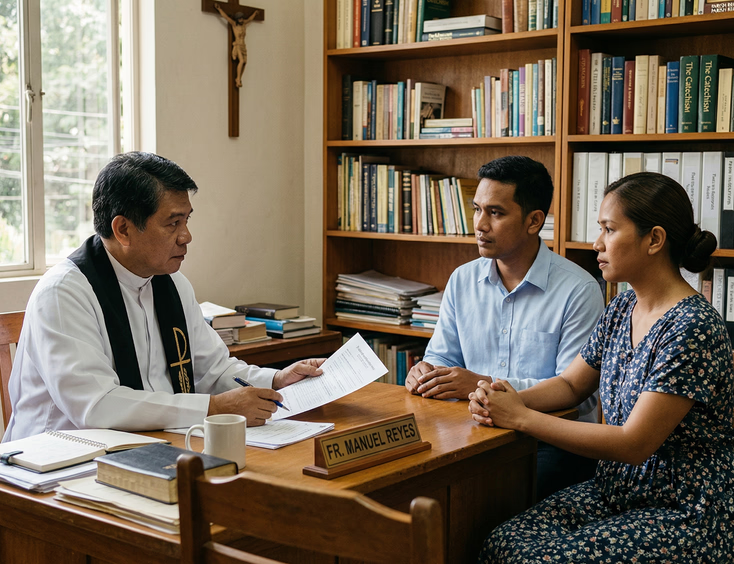
Your parish priest processes this request. The diocese reviews it. Approval is not automatic, but it is granted in many cases where legitimate pastoral reasons exist.
Without this dispensation, a Catholic who marries outside the Church is not considered validly married by the Church, even if the marriage is legally valid under Philippine civil law.
Pre-Marriage Requirements for Catholic Interfaith Couples
The Catholic partner must promise to remain Catholic and to raise children in the Catholic faith. The non-Catholic partner does not make this promise but must be informed of it.
Both of you must complete the canonical interview with the parish priest, the Pre-Cana or Marriage Preparation Seminar required by the diocese, and any additional requirements the parish sets.
The non-Catholic partner does not need to convert. The Church does not require it, and no priest can make conversion a condition for the dispensation.
Which Catholic Diocese Sets the Rules?
Each diocese in the Philippines has its own processing timeline and documentary requirements for interfaith marriage. The Archdiocese of Manila, for example, may have different specific steps than the Diocese of Cebu or the Diocese of Davao. Contact your parish directly and ask for the interfaith marriage requirements list early. Processing can take two to four months.
Catholic and Muslim Weddings: The Most Complex Pairing
A Catholic and Muslim pairing involves two entirely separate legal and religious systems. Read the full breakdown in our guide to Catholic and Muslim weddings in the Philippines.
The short version: under Philippine civil law, you can marry once and recognize that marriage legally. Under the Code of Muslim Personal Laws, a Muslim man may marry a Kitabiyya, a woman from the People of the Book, which includes Christians. A Muslim woman, however, cannot marry a non-Muslim under Islamic law without her partner's conversion.
The Catholic Church requires its own dispensation process for a Catholic marrying a Muslim, since a Muslim is unbaptized and the union falls under the disparity of cult category.
Most Catholic-Muslim couples in the Philippines choose a civil wedding as the legal foundation and hold separate religious blessings or ceremonies for each faith.
Catholic and Born Again Christian Weddings
Born Again Christianity has grown significantly in the Philippines, particularly in Metro Manila, Cebu, and urban centers across Luzon and Visayas. The Couples for Christ movement, Victory Church, and various evangelical denominations draw a large membership base.
The Catholic Church classifies a Born Again Christian as a baptized non-Catholic. The marriage falls under the mixed religion category, which is less restrictive than disparity of cult. The dispensation process is the same, but the pastoral requirements may feel less intense for the couple.
The Born Again partner's church may or may not bless a marriage to a Catholic. Many evangelical pastors in the Philippines are open to it. Some are not. The Born Again partner should speak with their pastor early in the planning process.
For a detailed walkthrough of the ceremony, documentation, and family dynamics involved, read our guide to Catholic and Born Again Christian weddings in the Philippines.
Catholic and Protestant Weddings
Protestants, including Methodists, Presbyterians, Lutherans, and members of the United Church of Christ in the Philippines, are baptized Christians. The Catholic Church treats this as a mixed religion marriage.
The Protestant church's openness to the union depends on the denomination and the individual pastor. The United Church of Christ in the Philippines, for example, has performed joint ceremonies with Catholic elements. More conservative Protestant denominations may decline to officiate a joint ceremony with a Catholic priest.
Some couples hold a Catholic ceremony with the dispensation in place and invite the Protestant pastor to offer a blessing or a reading during the Mass. Others hold a Protestant ceremony and apply for the dispensation from canonical form so the Catholic partner's marriage is recognized by the Church.
Our detailed guide to Catholic and Protestant weddings in the Philippines covers both ceremony formats, what each church allows, and how couples are making the decision.
Non-Religious Partners Marrying a Catholic
A growing number of Filipinos identify as non-religious, agnostic, or atheist. If you are not baptized and your partner is Catholic, the Church classifies your marriage as a disparity of cult union.
The Catholic partner needs a dispensation to marry you. The priest will conduct the canonical interview with both of you. You will be asked about your beliefs honestly. You do not need to pretend to believe, and you do not need to convert.
The bigger pressure often comes from the family, not the Church. Filipino Catholic families carry deep cultural expectations around religious practice. Understand that your partner's family may frame their concerns in religious terms when the concern is really about cultural belonging.
For a practical guide to the documents, the dispensation process, and managing family dynamics as a non-religious person marrying into a Catholic Filipino family, read our guide to non-religious partners marrying a Catholic in the Philippines.
Iglesia ni Cristo and the Challenge It Presents
Iglesia ni Cristo is one of the few Philippine-born Christian denominations that prohibits its members from marrying outside the faith. The prohibition is doctrinal, not just advisory.
An INC member who marries a non-INC partner in a non-INC ceremony faces expulsion from the congregation. This is not a bureaucratic formality. For Filipino families where INC membership is a core part of identity and community, expulsion carries serious social consequences.
INC couples who choose to marry outside the denomination do so knowingly. A civil wedding is the most common solution. It is legal, it satisfies the state's requirements, and it does not involve either church.
If you are a Catholic considering marriage to an INC member, you and your partner need to discuss this honestly before any planning begins. The INC partner's family may oppose the marriage regardless of how thoughtfully you plan the ceremony.
Muslim Weddings: The Nikah and What It Requires
The Nikah is the Islamic marriage contract. In the Philippines, particularly in Mindanao and Muslim communities in Metro Manila, the Nikah is performed by an imam or a Shari'a-licensed solemnizing officer.
For the Nikah to be valid under the Code of Muslim Personal Laws, the following must be present:
- The consent of both parties
- The wali, the male guardian of the bride, who gives her in marriage
- The mahr, a mandatory gift from the groom to the bride
- Two Muslim witnesses
The Nikah is registered with the Shari'a court and the Local Civil Registrar. This registration makes it legally binding under Philippine law.
Non-Muslim men who convert to Islam before the marriage can enter a Nikah. The sincerity of conversion is a matter between the individual and God, but the documentation of conversion needs to be in order before the Nikah proceeds.
Registering Your Interfaith Marriage With the Civil Registrar
Regardless of the ceremony format, you must register your marriage with the Local Civil Registrar. The solemnizing officer files the marriage certificate within 15 days of the ceremony.
Check with your Local Civil Registrar in advance. Requirements vary between cities and municipalities. The PSA will issue your marriage certificate after the Local Civil Registrar transmits the record.
Keep three to five certified true copies of your PSA marriage certificate. You will need them for bank accounts, government IDs, insurance, property, and visa applications.
Filipino Family Culture and Interfaith Weddings
The Role of the Extended Family
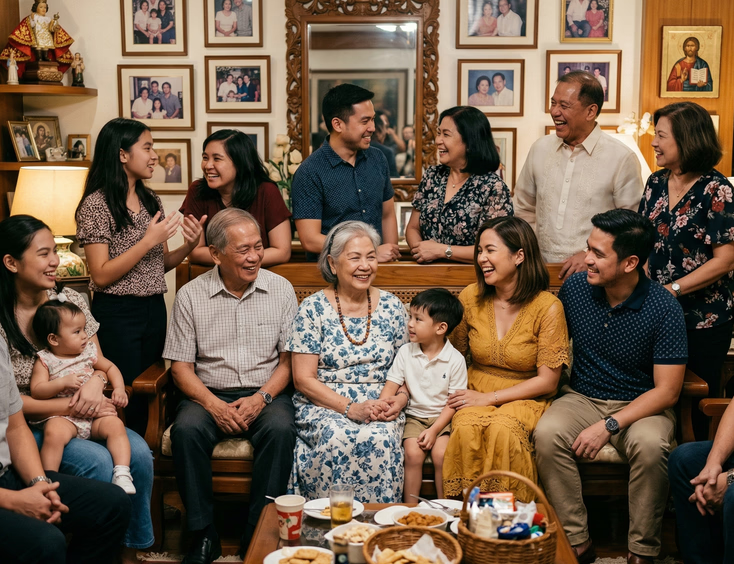
Filipino weddings are not private events between two people. They are family affairs. The extended family, called the pamilya, participates in planning, finances, and decision-making in ways that couples from other cultures may find intrusive but Filipinos understand as a form of love.
In an interfaith wedding, this dynamic intensifies. Both families bring their own religious expectations to the table. A Catholic lola who has attended 40 years of Sunday Mass may see a civil wedding as a failure. A Muslim father in Cotabato may see his daughter marrying outside the faith as a violation of his family's honor.
Neither reaction is irrational. Both come from a sincere place. Your job as a couple is to understand where the fear is coming from and address it with patience and consistency.
Pagpapahalaga, Respeto, and Hiya
Three Filipino values shape every interfaith wedding negotiation.
Pagpapahalaga means giving weight to relationships, especially with elders and parents. When a Filipino parent objects to an interfaith marriage, dismissing the objection as backward or irrelevant damages the relationship in ways that take years to repair.
Respeto means respect, particularly toward authority figures. A Filipino child who marries without parental blessing does not just lose approval. They create a wound in the family structure that affects every family gathering for years.
Hiya means shame. Families feel hiya when they believe their child's choices reflect badly on them within their community. A Catholic family in a conservative town may feel hiya if the wedding is civil-only. A Muslim family may feel it if their daughter marries a non-Muslim man without a Nikah.
Understanding these values does not mean surrendering your autonomy. It means you can address your family's concerns in terms they recognize rather than framing it as a debate you intend to win.
How to Approach Difficult Family Conversations
Talk to each set of parents separately before talking to them together. Let them ask their questions. Do not arrive with a plan already finalized. Families who feel they had input, even if the final decision differs from what they wanted, accept outcomes more gracefully.
Be consistent. If you tell your Catholic family the wedding will include a priest's blessing and then change the plan six weeks later, you erode trust. Decide what you are willing to offer and hold that position.
Ask each family what matters most to them and what they can live without. A Catholic mother may care deeply about the priest being present and care less about the venue. A Muslim father may care most about the Nikah being performed and care less about the reception format. Often, both families' core needs are compatible.
Ceremony Planning for Interfaith Couples
Civil Ceremony as the Foundation
A civil ceremony before a judge or mayor gives you a legally recognized marriage with no religious requirements attached. Many interfaith couples use the civil ceremony as their legal foundation and layer religious elements on top.
The civil ceremony itself is brief. The ceremony at the judge's office or the city hall function room takes 15 to 30 minutes. Most couples use a civil ceremony to secure the legal marriage and hold a separate celebration that reflects both faiths.
Joint Religious Ceremonies
Some interfaith couples hold a single ceremony that incorporates elements from both traditions. A Catholic priest and a Protestant pastor may co-officiate. A civil officiant may open the ceremony while a Catholic priest offers a blessing and a Born Again pastor reads scripture.
This works when both religious leaders agree to participate and when the ceremony is designed so neither faith tradition is treated as decoration for the other.
The design of the ceremony program matters. Each element should carry genuine meaning. An imam reciting the Fatiha at a Catholic-Muslim wedding is not a cultural flourish. It is a sincere religious act. Treat it accordingly.
The Traditional Filipino Catholic Wedding Elements
The Catholic wedding in the Philippines includes specific rituals with roots in Spanish colonial tradition and Filipino custom. These rituals are cultural as much as they are religious.
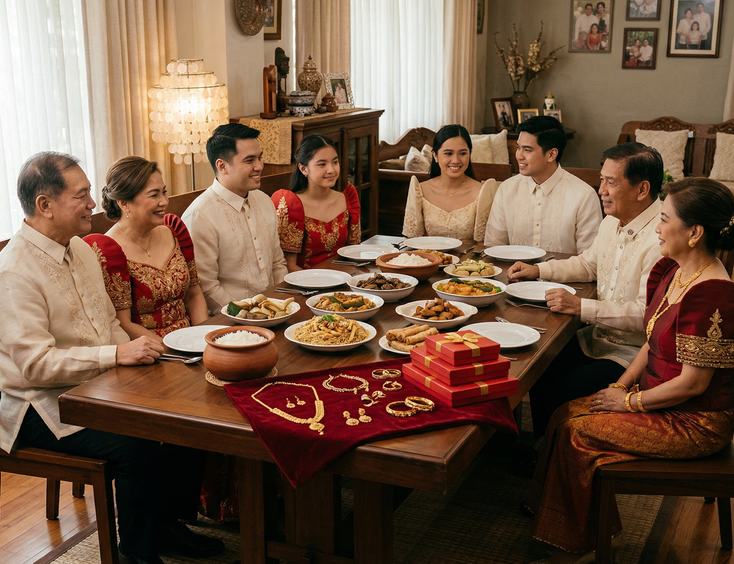
The arras, 13 gold coins exchanged between the couple, symbolizes the groom's commitment to share his resources. The veil placed over the couple's shoulders represents unity. The cord or yugal draped in a figure eight over the couple symbolizes their bond.
These elements are part of the Catholic Rite of Marriage in the Philippines but carry cultural meaning that many non-Catholic families also appreciate. In an interfaith ceremony, you can include these elements regardless of the non-Catholic partner's faith background. They do not require the non-Catholic partner to make any religious declaration.
Finding an Officiant Who Understands Interfaith Ceremonies
Your officiant shapes the entire ceremony. A priest who is uncomfortable with an interfaith union will let that discomfort show. An imam who has never spoken to a non-Muslim family will struggle with the setting.
Find an officiant with direct experience in interfaith ceremonies. Ask them how many interfaith weddings they have performed and what their approach is to couples from different faith backgrounds.
If you want a civil solemnizing officer who can craft a ceremony that honors both partners' backgrounds without defaulting to generic language, browse the wedding officiants on our directory and filter by experience with interfaith couples.
Designing the Ceremony Program
Write out every element of the ceremony before you finalize anything. Every prayer, reading, blessing, and ritual should have a reason for being there and a person responsible for delivering it.
Seat both families in a way that reflects your intention to unite two traditions. Brief your guests in the ceremony program about any rituals or prayers that may be unfamiliar to them. A short line explaining what the mahr is, or why the arras is part of the ceremony, gives guests context without turning the ceremony into a lecture.
Venue and Logistics
Choosing a Venue That Works for Both Faiths
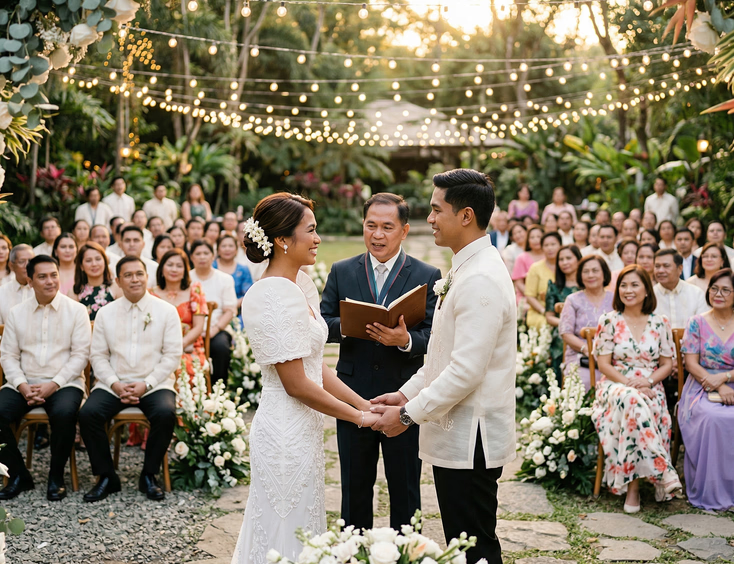
A Catholic church venue is not available to couples who need the dispensation from canonical form. The dispensation moves the ceremony outside the church, which means you need a venue that the officiants agree to use.
Garden venues, hotel ballrooms, heritage houses, and beach resorts all work for interfaith ceremonies. The venue needs to accommodate whatever ritual objects, altar arrangements, or prayer orientations either tradition requires.
If your ceremony includes a Nikah, confirm the venue's capacity to set up a space for the wali, the imam, and the witnesses in the appropriate arrangement. If your ceremony includes a Catholic blessing, confirm the priest's willingness to officiate outside a church building.
Halal Catering
If one partner is Muslim, the reception food must be halal. This applies to the meat, the preparation methods, and the serving staff's handling of the food.
Not all hotel caterers in the Philippines are halal-certified. Ask directly. A caterer who says "we can do halal" without a certification is not the same as a caterer with a legitimate halal certification from the Islamic Da'wah Council of the Philippines or an equivalent body.
Separate serving stations for halal and non-halal items are a practical solution for receptions where guests from both communities attend.
Guest Dress Code
Communicate dress code expectations in the invitation and the ceremony program. Muslim wedding guests generally dress modestly. Catholic wedding guests at a church ceremony follow the church's decorum. At a joint ceremony, dress modestly to respect both traditions and communicate this expectation to guests who may not know.
Raising Children in an Interfaith Household
This question will come up before the wedding, during the dispensation process, and repeatedly after. The Catholic Church requires the Catholic partner to promise to raise children in the Catholic faith. Filipino Muslim families expect children to be raised Muslim.
These expectations are in direct conflict when both parents hold their faith sincerely. No guide can resolve this tension for you. Couples who navigate it well tend to do two things: agree on a framework before the wedding and revisit it openly as the children grow.
Some interfaith couples expose their children to both traditions and let the children develop their own relationship with faith as they mature. Some agree that the children will follow one faith in formal observance while learning about the other. Some disagree, and the disagreement becomes a source of ongoing friction.
Be honest with each other about this before you sign any documents or make any promises to any church. The disparity between what you promise during the dispensation process and what you actually do at home creates a different kind of problem.
The Practical Timeline for an Interfaith Wedding in the Philippines
The legal and religious requirements for an interfaith wedding take longer than most couples expect. Plan for this timeline:
Twelve to eighteen months before the wedding, begin conversations with both families, identify your officiants, and start the parish interview process if a Catholic ceremony is involved.
Ten to twelve months before, submit your dispensation application to the diocese. Begin the required Pre-Cana or Marriage Preparation Seminar.
Eight to ten months before, apply for your marriage license at the Local Civil Registrar. Confirm your venue and your officiants.
Six months before, finalize the ceremony program with your officiants. Confirm halal catering, guest dress code communication, and any cross-cultural elements in the reception program.
One to two months before, confirm all documentary requirements are complete. Review the marriage certificate filing process with your solemnizing officer.
A Note on Annulment and Divorce in the Philippines
The Philippines, along with Vatican City, does not allow civil divorce. An interfaith couple who separates faces the same legal constraints as any other Filipino couple.
For Catholics, the Church offers annulment, which is a declaration that the marriage was never valid in the canonical sense. This is a Church process, not a civil one, and it does not dissolve the civil marriage on its own.
A civil annulment, governed by the Family Code, is a separate legal proceeding. The grounds for civil annulment are narrow and include lack of parental consent for underage marriages, fraud, psychological incapacity, and a few others.
Muslims who marry under the Code of Muslim Personal Laws have access to divorce under Shari'a, but this applies only to marriages that fall under that code.
If you are a foreign national marrying a Filipino, your home country's laws may allow divorce, and a divorce granted abroad by a foreign court can be recognized in the Philippines under specific conditions, allowing the Filipino spouse to remarry.
Understand these constraints before you marry, not after. They are part of the context of marriage in the Philippines for everyone.
Starting Your Interfaith Wedding Planning
Interfaith weddings in the Philippines are not rare events managed by a handful of specialists. Priests, imams, pastors, civil judges, wedding coordinators, and caterers across the country work with interfaith couples regularly.
The couples who plan these weddings well start with honest conversations, build a realistic timeline around the legal and religious requirements, and find suppliers with genuine experience in interfaith ceremonies.
Browse the wedding officiants in our directory to find solemnizing officers, civil officiants, and religious ministers who have worked with interfaith couples across different faith combinations and ceremony formats.
Still Searching for a Right Match?
Find Your Perfect Wedding Supplier Today!
Discover trusted wedding suppliers across the Philippines in our complete directory. Compare services and connect with the ones that fit your dream celebration.
Browse Wedding SuppliersFeatured Posts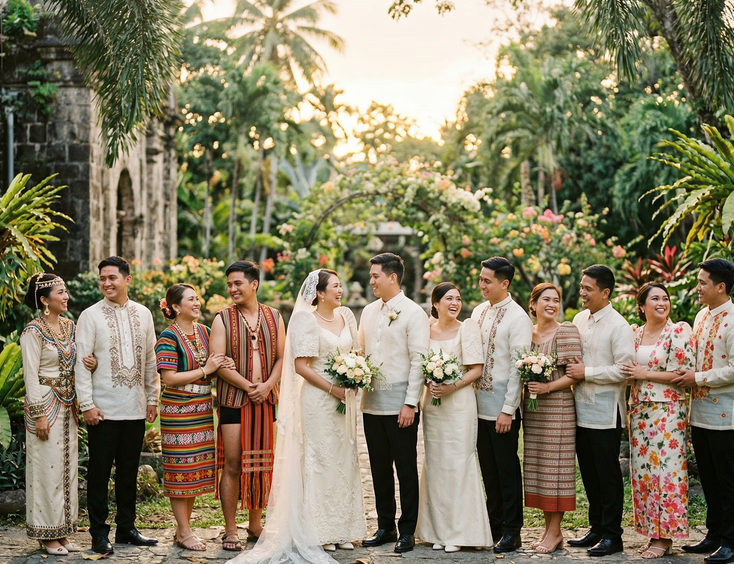
Regional Wedding Customs Every Filipino Couple Should Know
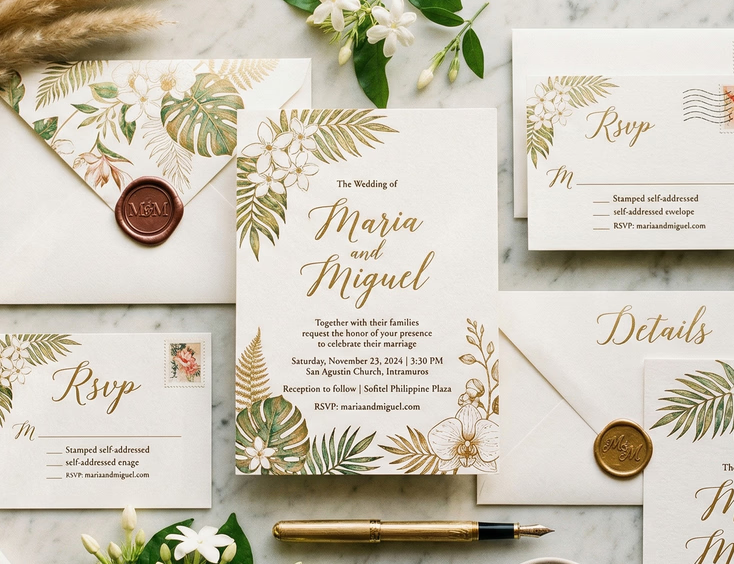
23 mins readThe Complete Guide to Filipino Wedding Invitations: From Traditional Customs to Modern Trends
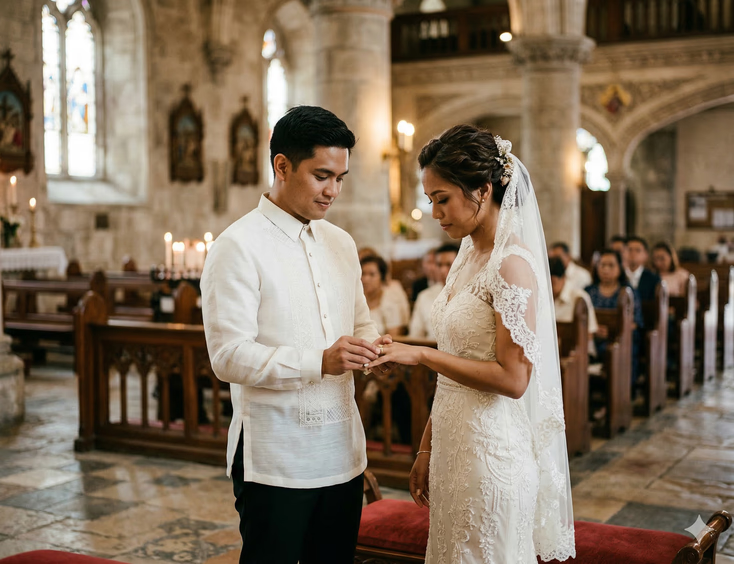
12 mins readThe Complete Filipino Couple's Guide to Wedding Rings & Bands in the Philippines: Traditions, Styles, Budgets & Where to Buy
22 mins read