


AVP and SDE Ideas for Your Debut Celebration
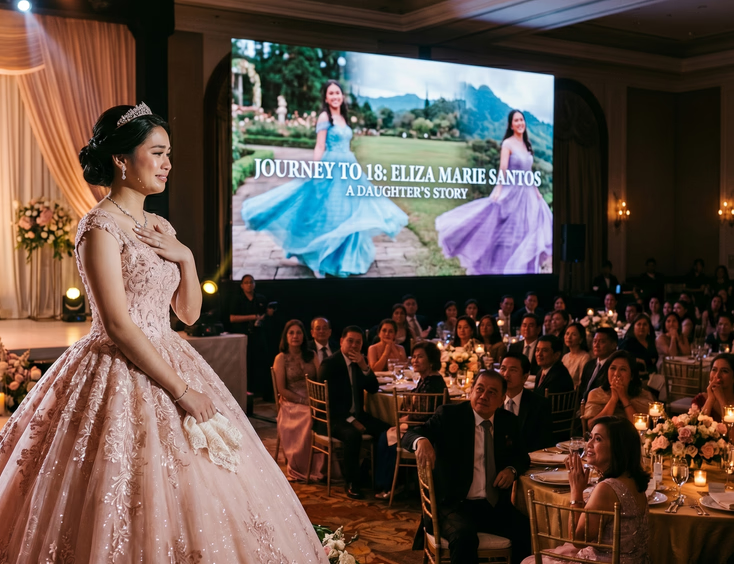
Two videos define the visual storytelling at your debut. The AVP plays during the opening of the program and sets the emotional tone for the entire night. The SDE plays during the reception and turns the celebration into something guests remember as a single, edited moment. Get either one wrong and the program loses its anchor. Get both right and the videos become the most rewatched assets from your debut.
Most first-time debutantes confuse the two. Some skip one entirely without realizing the other one alone leaves a gap in the program. This guide walks you through what each video does, the concept directions to pull from, the production timeline, and how to brief your team for videos worth saving.
Understand What Each Video Does
The AVP and the SDE serve different jobs at different points in the program. Treat them as separate productions even if the same team handles both.
AVP (Audio Visual Presentation) A pre-produced video played during the program. Usually 3 to 6 minutes long. Shown at one of three points: as the program opener, as a mid-program tribute, or as a thank-you closing segment. Built from pre-debut shoot photos, childhood archive photos, video clips, and curated music. Edited weeks in advance, finalized before the event.
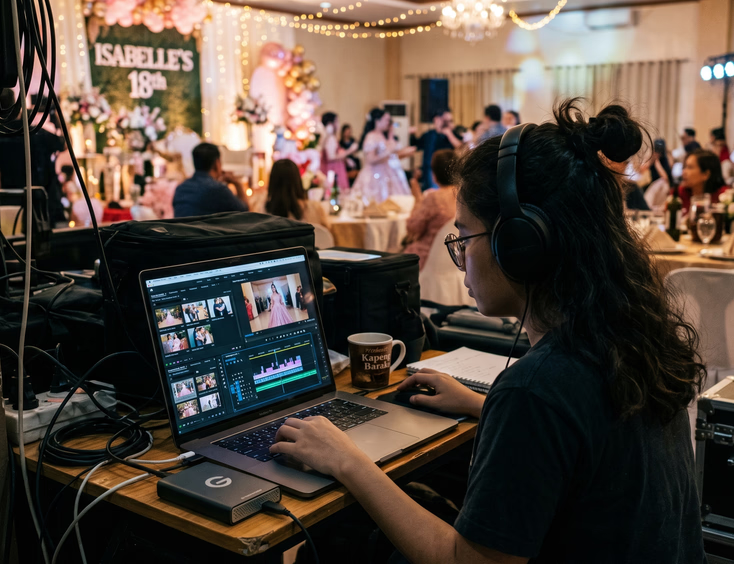
SDE (Same-Day Edit) A highlight video edited during the event itself. Usually 2 to 4 minutes long. The video team shoots in the morning during preparation, captures the early program, edits on-site during dinner, and reveals the finished video during the reception. The SDE shows guests a polished version of the day they're still living through.
Both serve different storytelling jobs. The AVP looks back. The SDE captures the now. Together, they bookend the program with two distinct emotional beats.
For broader video team guidance, see our guide on how to choose the right debut photographer and videographer.
Decide Where the AVP Plays in the Program
The placement of the AVP shapes its concept. Three common slots:
Program opener (most common) The AVP plays right after the host introduces the program. Sets the tone before the debutante's grand entrance. Functions as a hype reel: pre-debut photos, childhood moments, build-up to the present. Ends with a transition that cues the entrance.
Mid-program tribute The AVP plays between segments, often after the 18 Roses and before the 18 Candles. Functions as an emotional pause. Builds the storytelling between the upbeat opening and the heavier candle ceremony.
Closing tribute The AVP plays near the end of the program, often before the last dance. Functions as a thank-you to family, friends, and guests. Reflects on the journey to 18, the people who shaped it, and the night itself.
Some debuts use two AVPs: one as a program opener and a shorter tribute later in the program. Two AVPs need different concepts and pacing.
Pick the AVP Concept
The concept defines the storytelling, the pacing, and the emotional arc.
The journey to 18 Childhood photos transition to teenage years to the present-day pre-debut shoot. A chronological visual story. Often paired with a voice-over from the debutante or a written tribute on screen.
A letter from parents The parents narrate or write a letter, read on screen with childhood and recent photos cycling through. Heavy emotional pull. Best as a mid-program or closing AVP.
A tribute to specific people A short feature on each parent, grandparent, sibling, or significant person. Their relationship with the debutante captured in photos and short clips.
The thank-you AVP A reverse tribute. The debutante speaks to the camera (or appears with on-screen text) thanking each significant person by name. Names appear on screen alongside relevant photos.
The hype reel opener A high-energy montage of pre-debut shoot photos, behind-the-scenes prep clips, and reaction shots. Synced to an energetic song. Builds the audience's anticipation for the entrance.
The theme reveal AVP The AVP doubles as a styling preview. Shows the debutante in styled looks tied to the theme. Lands on a final shot that mirrors the actual entrance look.
The mockumentary or sitcom concept A scripted short film featuring the debutante and friends or family. Comedic, light, and personality-driven. Best for debutantes with a strong sense of humor.
The cinematic short film A scripted narrative with strong cinematography. Treats the debutante as the protagonist of a coming-of-age story. Requires a larger video budget and a director with film background.
The K-drama or aesthetic story Heavily styled, soft-focused, slow-paced. Pulls from K-drama visual language. Fits Korean-inspired debuts.
The travel diary The debutante visits meaningful places (childhood school, family home, a favorite cafe) and reflects on what each place means. Shot weeks before the event in cinematic style.
For broader concept inspiration tied to themes, see our roundup of trending debut theme ideas.
Pick the SDE Concept
The SDE pulls from the day's actual footage, so the concept needs to match what's filmable in real time.
The cinematic highlight A movie-style edit treating the day as a feature film. Slow-motion shots, color-graded footage, scored to one strong song. Captures preparation, entrance, family moments, and program highlights.
The pop music video High-energy edit synced to a trending or chosen song. Fast cuts, dance shots, candid laughter. Treats the day like a music video.
The behind-the-scenes documentary Captures the chaos of prep, the small moments, the team setup. Less polished, more intimate. Works for debutantes who want the day's reality on screen, not just the polished moments.
The thank-you SDE Combines program footage with on-screen text thanking guests. Less about the debutante's journey, more about the celebration itself.
The parent-focused SDE The footage focuses on the parents' reactions throughout the day. Their tears during prep, their pride during the entrance, their dance moments. A gift back to them in video form.
The friends-focused SDE Heavy on the barkada and cotillion crew. Their energy, their reactions, their dancing. Fits debuts where friends played a major role in the celebration.
The hybrid concept A two-part SDE: a cinematic opening followed by a pop-music-video reception edit. Plays during the dance set after dinner.
Pair the Music Carefully
Both videos live or die by the music choice. The right song amplifies every cut. The wrong song undermines even the best footage.
For the AVP:
- Emotional ballads for journey, tribute, and closing AVPs
- Upbeat acoustic for hype reels and theme-reveal AVPs
- Cinematic instrumentals for short-film concepts
- Soft K-pop or K-drama scores for aesthetic AVPs
- A combination of two tracks if the AVP runs longer than 4 minutes
For the SDE:
- A current trending song for high-energy edits
- A cinematic instrumental for movie-style SDEs
- A Filipino OPM ballad for emotional, family-focused SDEs
- A song that means something to you personally (your favorite song, a family anthem, a track tied to a specific memory)
Confirm music licensing with your video team. Some platforms (YouTube, Instagram Reels, TikTok) flag copyrighted music. If you want to repost the AVP or SDE online, your team needs to either license the music or use royalty-free alternatives. Personal use within the event itself is rarely an issue.
Plan the AVP Production Timeline
The AVP needs lead time. Don't book the editor a week before the event.
Standard timeline:
- 3 months before the debut — Concept locked, song selected, pre-debut shoot scheduled
- 2 months before — Pre-debut shoot completed, editing brief shared with the video team
- 1 month before — First draft of the AVP delivered for review
- 2 weeks before — Final revisions completed
- 1 week before — AVP finalized and shared with the venue's AV team and SDE crew for playback testing
If the AVP includes parent narration or voice-over, schedule recording sessions early. Voice work often takes multiple takes and revisions.
For the broader debut planning timeline, see our guide on the debut planning timeline month-by-month.
Plan the SDE Production Workflow
The SDE is high-pressure on the day. The team usually shoots in the morning during prep, captures the early program, then breaks to edit during dinner.
A typical SDE workflow:
- 8:00 to 11:00 AM — Capture preparation footage at home or the venue
- 11:00 AM to 4:00 PM — Continue capturing styling, venue setup, and pre-program moments
- 4:00 to 6:00 PM — Capture the cocktail hour, guest arrivals, and entrance
- 6:00 to 8:00 PM — Capture the early program (entrance, family portraits, opening segments)
- 8:00 to 9:30 PM — SDE editor works in a corner of the venue or in a back room, editing the footage with a pre-built template
- 9:30 to 10:00 PM — SDE rendered and exported
- 10:00 PM (or scheduled reveal time) — SDE plays during the reception
This timeline shifts based on the program flow. Confirm the SDE reveal time with your host so the program builds toward the reveal naturally.
Confirm Equipment and Setup
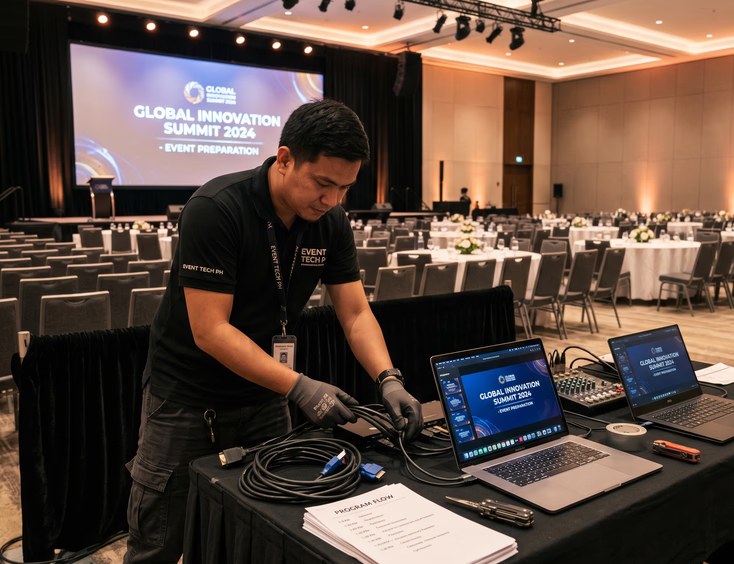
The AVP and SDE both need the venue's AV system to play smoothly. Confirm:
- Screen or LED wall size and aspect ratio (most venues use 16:9, some use square or vertical LED walls)
- Audio routing so the video's audio plays through the venue's sound system, not just the screen's built-in speakers
- Playback format the venue accepts (MP4 at 1080p or 4K, file delivered via USB or shared drive)
- Backup playback in case the primary device fails (a second laptop or external drive with the same file)
- Cue coordination with the host so the AVP plays at the right moment without dead air
For the SDE specifically, the editor needs:
- A workspace on-site, ideally a quiet corner with a power outlet and a stable table
- A reliable laptop with editing software pre-loaded
- Fast file transfer from the camera team to the editor (SD card hand-offs, wireless transfer, or a shared drive)
- A backup laptop in case the primary fails mid-edit
Coordinate With Your Other Suppliers
The AVP and SDE intersect with multiple suppliers:
- The host or emcee — for cue-in lines before each video plays
- The band or DJ — for audio ducking during video playback (the band stops or lowers volume so the video's audio carries the room)
- The lights and sounds technician — for stage lighting that dims during playback and rises after
- The photographer — to capture audience reactions during the videos
- The venue's AV team — for screen and projector control
Loop the video team into the supplier chat group two months before the event. The handoffs go smoother when everyone's introduced early.
For how all your suppliers fit together, see our guide on essential debut suppliers to book early.
Brief the Editor Properly
The editor delivers what you communicate. Vague briefs lead to generic edits.
For the AVP, share:
- The chosen concept with a written one-paragraph description
- The selected song with timestamps for key emotional beats
- A folder of all photos and clips to use (pre-debut shoot, childhood archive, family photos, video clips)
- A specific order or arc you want (chronological? thematic? alternating between you and your parents?)
- On-screen text or voice-over scripts
- Tone references (3 to 5 sample AVPs you love and a note explaining what specifically you love about each)
For the SDE, share:
- The chosen concept
- The selected song
- Specific shots you want included (the entrance reaction, the father-daughter dance, your mom's tears, a specific group of friends)
- Style references (3 to 5 SDE samples you love)
- The reveal time and program slot
The more specific the brief, the closer the final edit lands to your vision.
Set the Budget
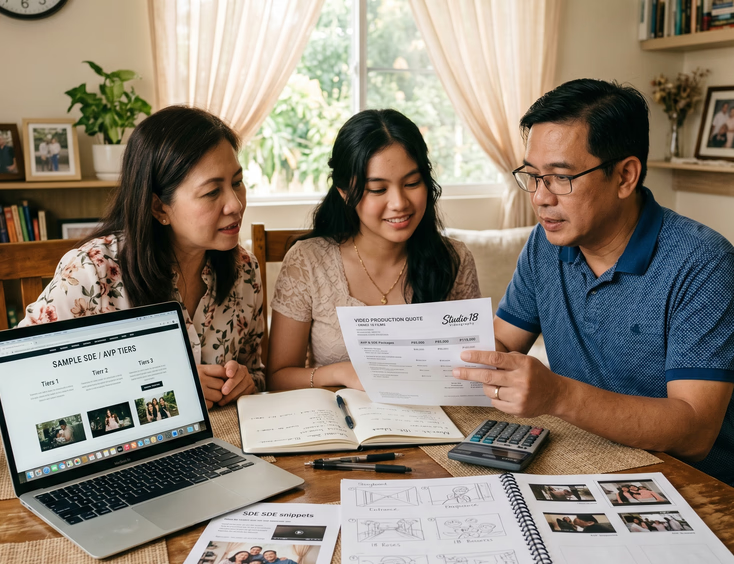
AVP and SDE production sits inside the photo and video budget but often gets billed separately.
Expect:
P8,000 to P20,000 — Basic AVP from a single editor working with provided photos and a simple template
P20,000 to P50,000 — Mid-tier AVP with custom motion graphics, color grading, and editing direction
P50,000 to P100,000+ — High-end AVP with scripted concepts, voice-over recording, animated graphics, or short-film production
P15,000 to P40,000 — Basic SDE with one on-site editor and standard editing
P40,000 to P80,000 — Mid-tier SDE with custom motion graphics, color grading, and a polished narrative
P80,000+ — Premium SDE with a full team (lead editor, assistant editor, color grader) and cinematic post-production
If both videos come from the same team, bundled pricing usually saves 15 to 25% compared to booking separately.
For where the videos fit in the bigger budget picture, see our debut cost breakdown.
Walk Through the Contract
Before booking, confirm:
- Number of videos (AVP only, SDE only, or both)
- Length of each video
- Number of revision rounds
- Music licensing handling
- Voice-over recording inclusion (if relevant)
- Delivery format (1080p, 4K, file format, aspect ratios for social media)
- Turnaround for the AVP (typically 4 to 6 weeks for first draft)
- SDE reveal time and on-site workflow
- Total cost and payment schedule
- Cancellation and rescheduling policy
Get the concept and revision count in writing. "We'll figure it out as we go" is not a production brief.
Red Flags to Skip
Walk away from a video team who:
- Won't share full AVP or SDE samples, only highlight reels
- Can't articulate a clear concept brief during the inquiry
- Has no on-site SDE workflow described
- Refuses to share the editor's specific portfolio
- Quotes prices wildly below market without explaining the difference
- Has consistent recent reviews mentioning late delivery, generic templates, or off-tone music choices
- Pushes you to book without a discovery call or concept discussion
How a video team communicates during booking predicts how they'll handle the production.
Your Pre-Booking Checklist
Before you sign anything, confirm:
- Concept locked for both AVP and SDE
- Song selections finalized
- Pre-debut shoot scheduled for AVP assets
- Production timeline locked with milestones
- SDE on-site workflow confirmed with the venue
- Coordination with host, band or DJ, photographer, and lights technician planned
- Equipment, backup, and playback testing scheduled
- Total cost fits your video budget
- Contract terms, deliverables, and revision count documented
The AVP opens the night's emotional arc. The SDE closes it. Together, they turn your debut from a single evening into a story you can rewatch on demand.
For how the AVP and SDE fit into the bigger debut planning picture, return to our pillar guide on planning an unforgettable Filipino debut celebration.
Still Searching for a Right Match?
Find Your Perfect Wedding Supplier Today!
Discover trusted wedding suppliers across the Philippines in our complete directory. Compare services and connect with the ones that fit your dream celebration.
Browse Wedding SuppliersFeatured Blog Posts

Filipino Wedding Entourage - Roles, Order of March, and Modern Etiquette
6 mins readCivil Weddings in the Philippines - Requirements, Costs, and Step-by-Step Process
9 mins readCivil Wedding Requirements in the Philippines - Complete Checklist
6 mins readCost of Wedding in the Philippines - 5 Essential Things You Need to Know
7 mins readPrincipal Sponsors (Ninong/Ninang) - How Many, How to Ask, What They Really Do
4 mins readVeil, Cord, Candle & Coins - Roles, Options, and When They Happen
4 mins readEntourage for a Traditional Pinoy Wedding - Complete Roles and Guide
6 mins readComplete List of Civil Wedding Requirements in the Philippines
8 mins readHow to Choose Wedding Ninongs and Ninangs - Ask Yourself These 3 Important Questions
5 mins read